How our Isando workshop shapes each press
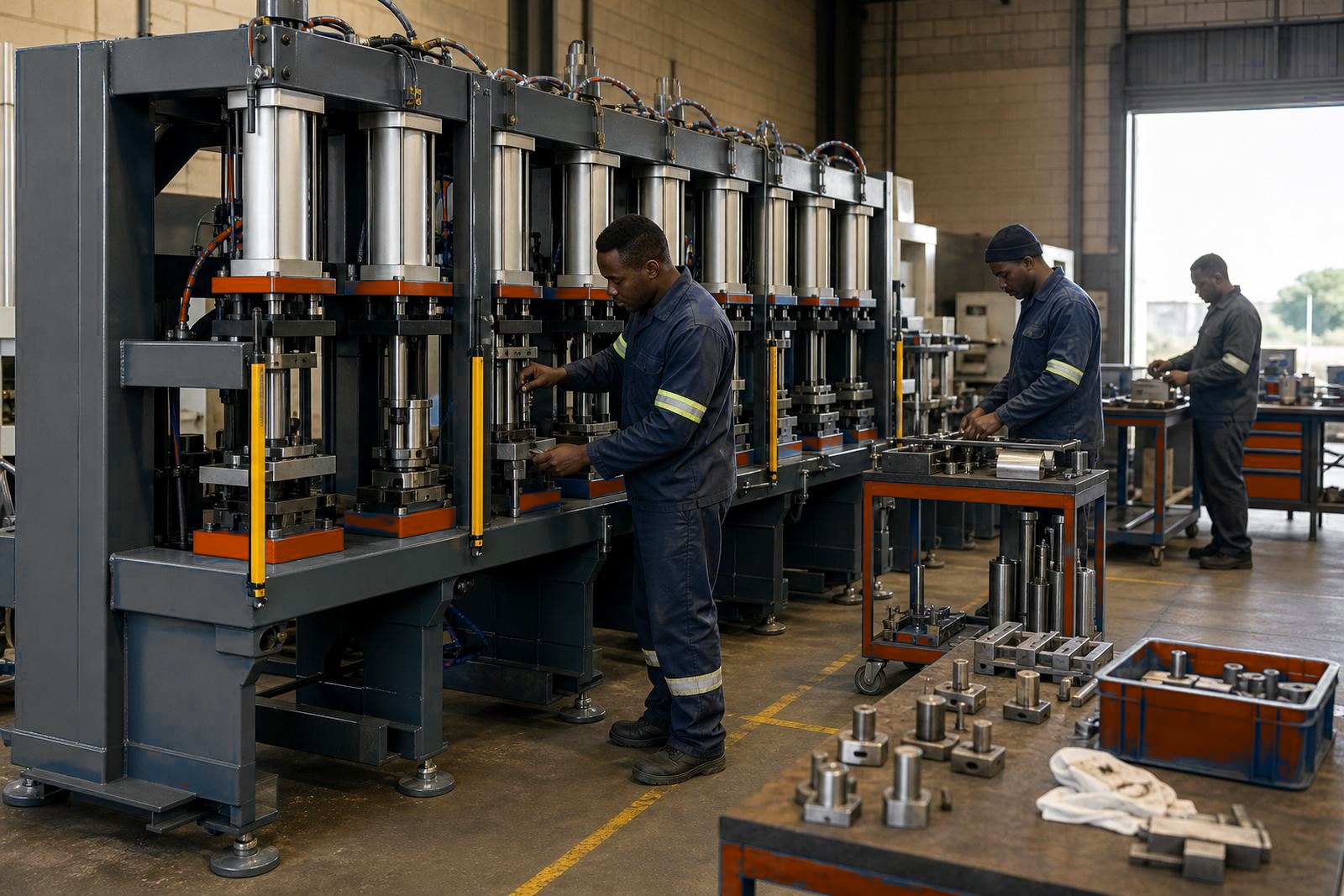
Our work starts with the job on the floor, not with a catalogue page. A press for one plant may need four stations, another may need six, and the stroke, air pressure, bed height and tooling layout all need to suit the part being handled. Some jobs call for a clean assembly action, others need controlled crimping, riveting, staking or pack sealing, so the machine has to be built around the process rather than the other way round.
The workshop in Isando handles the build, the fitment of cylinders and guides, and the detail that keeps a press steady under daily use. Tooling has to meet the part squarely, the guarding must suit the operator position, and the controls must make sense for the team using it. That is where small choices matter, like stroke setting, two-hand controls and the spacing between stations.
What we build for assembly, crimping and sealing lines
Multi-station pneumatic presses are useful when a line needs several actions in one controlled machine. One station may locate a component, the next may crimp a terminal, the next may stake a pin, and the last may seal a pack or finish an assembly. This keeps the work moving in a measured sequence, with each station doing its own part of the cycle.
We design the tooling to suit the product and the operator flow. Where the part needs positive location, we build fixtures that hold it true. Where the job needs repeatable force, the cylinder and stroke are set for that exact movement. If the application needs extra guarding or a light curtain, we build that into the layout so the press stays practical for daily use. It is careful work, and it shows in the finish of the machine.
- Custom tooling matched to the part and station layout
- Fixture design for repeatable location and alignment
- Two-hand controls where operator control is needed
- Light curtain integration for guarded access
- Air line setup and stroke setting for stable operation
Guarding, controls and safe use on the line
Safety is not treated as an add-on here. A press that is meant for factory use has to protect hands, fingers and product, while still being easy to run under pressure. That means proper guarding, clear access points, reliable two-hand controls and, where needed, light curtain integration that suits the station spacing and the operator stance.
We look at how people feed parts, clear jams and remove finished pieces, because the real risk is often in those moments. The layout has to reduce reach into the danger zone and still allow the operator to work without awkward movements. When the control method is right, the machine feels more natural to run and the line stays easier to manage. A press that makes people fight it will always cause trouble later.
Our team also checks how the compressed air supply comes into the machine, how the pressure is set, and whether the motion is even through the full stroke. A press can look complete on the floor but still need careful setting before it is ready for production. That setting work matters in Johannesburg, Pretoria, Durban, Gqeberha and East London, where different factories use different line speeds and product mixes.
Commissioning on site, not just on paper
Commissioning is where the build meets the real factory. The machine is placed, levelled and connected to the air line, then we test the stroke, timing and control sequence under working conditions. If the tooling needs a small change, we handle it there. If the guard door clearance is too tight, we adjust it on site. That practical approach saves time later and gives the plant a press that is ready to be used with confidence.
We work across Isando, Kempton Park, Boksburg, Johannesburg, Pretoria, Durban, Gqeberha and East London, because many of these lines are in plants that need direct support from the people who built the equipment. Some sites need a full production handover after installation, while others need a tooling change on an existing line so the machine can handle a different part. Either way, the goal is the same: a press that fits the process and holds its setting.
- Site installation and air line setup
- Press commissioning with stroke and pressure checks
- Tooling changes for new parts or revised cycles
- Production handover once the line is running correctly
The people behind the presses
MultiPress runs on a small team with defined roles, and that matters when a factory needs clear answers and proper follow-through. Pieter Sauls leads the business as Managing Director, while Thandiwe Matlala coordinates projects and keeps the moving parts in step. Musa Hartnick handles tooling design, Johan Ramokgopa oversees the workshop, Lerato Moagi manages commissioning on site and Anele Engelbrecht leads operator training.
That mix keeps the work grounded. The person planning the tooling understands the workshop realities, the person handling commissioning knows what a line needs once it is installed, and the person training operators can see where a process breaks down in practice. We do not separate the machine from the people who run it, because the machine only works well when both are considered together.
Operator training that sticks to real plant work
Training is most useful when it reflects the real machine, the real part and the real shift pattern. We show operators how to load the press, use the controls, watch the stroke, notice wear on the tooling and keep the guarded areas clear. If the line has several stations, the sequence is explained in the order it will be used. If the machine needs a particular air pressure range, that is part of the routine too.
Good training reduces confusion after handover. It also helps supervisors notice when a tooling change or alignment check is needed before a fault grows into a stoppage. On sealing lines, crimping jobs and riveting presses alike, the goal is the same: steady production with fewer surprises and less rough handling of the equipment. That kind of discipline is what keeps a press useful over time.
Clients get in touch through our enquiry form on the contact page when they need a fresh build, a tooling change or help with an existing line. We work with factories that want the press built properly, installed properly and taught properly, without noise around the basics.