People we hire into the shop and project flow
Our work calls for practical people who can handle detail, measure twice and keep a press line moving without guesswork. We look for fitters, mechanical assemblers, tooling hands, commissioning technicians, field support staff and project coordinators who can work with drawings, parts lists and real factory conditions.
The right person is usually calm around a workshop bench and on a noisy production floor. Some jobs focus on building frames, cylinders and tooling. Others sit closer to guarding, light curtain checks, stroke setting or handover with operators at the end of a project.
- Assembly and mechanical fitting for press build work
- Tooling design support and fixture layout
- Commissioning and site setup across local factories
- Operator training and production handover
What our press work asks from a new team member
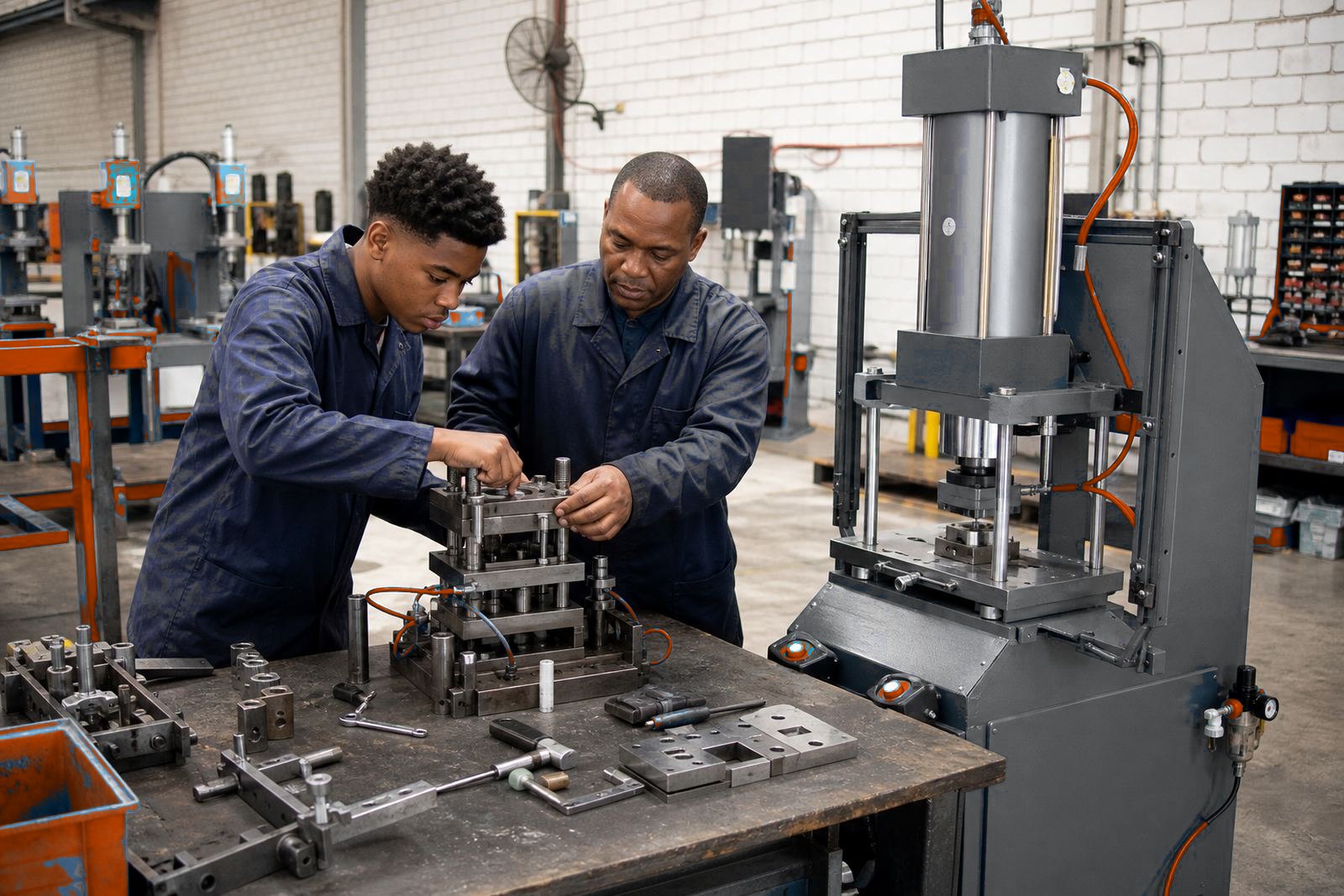
Multi-station pneumatic presses need people who understand pressure, stroke, clamping force and safe sequence control. A good hire knows how to work around air lines, cylinder movement, guarding, tooling changes and two-hand control stations without treating any step as routine.
We deal with assembly, crimping, riveting, staking and pack sealing lines, so the work is varied. One day may be a fixture build in Isando. The next may involve setting a stroke, checking a guarding gap or walking a plant team through the press cycle before production starts.
- Measuring and setting with care on each station
- Reading mechanical detail and spotting fit issues early
- Working neatly around hoses, actuators and guarding panels
- Keeping workshop records clear for the next stage
Workshop conditions in Isando
Our base is in Isando, Ekurhuleni, where workshop work and project planning sit side by side. The environment suits people who can move between tools, materials and client requirements without losing track of tolerances or safety steps.
Some roles are mostly hands-on. Others mix workshop time with travel to Johannesburg, Pretoria, Durban, Gqeberha, East London, Kempton Park or Boksburg for commissioning and production handover. If you are used to factory floors, steel parts and a job that changes with each machine, that matters here.
- Clean, accurate work on press components and tooling
- Safe habits around moving parts and air-powered systems
- Travel-ready thinking for site installation and handover
- Comfort with production talk and operator questions
The kind of experience that helps here
We do not need everyone to come from the same background. Some people arrive from machine building, toolmaking or maintenance. Others have worked in assembly lines, jig and fixture work, or industrial installation. What matters is that you can learn a build sequence and keep your work consistent.
It also helps if you can work with basic documentation, interpret dimensions and talk clearly when a press needs adjustment. A steady hand and practical judgement count more than fancy language. On a site visit, the smallest detail can affect stroke setting, tool wear or operator safety.
The following experience is useful, though not all of it is required:
- Mechanical assembly or maintenance experience
- Knowledge of pneumatic systems and air line setup
- Tooling, fixtures or guarding work
- Factory commissioning or production support
How to send your CV for a role
To apply, send your CV through the enquiry form on our contact page and tell us what type of role you want considered for. You can also note whether your strength is workshop build work, commissioning, operator training or tooling design, so the right person reviews it with the right context.
If you have worked on presses, jigs, guards, two-hand controls or light curtain integration, say so plainly. If your experience is broader, that is fine too. We are interested in practical exposure, steady workmanship and an honest picture of what you can do on site or in the workshop.
Use the enquiry form on our contact page and attach your CV there.
A workday here is built around real machines
Most days involve machines that have to run safely and repeatably. That means checking tooling, confirming guard positions, reviewing strokes and making sure the operator can work with confidence at the end of commissioning. It is not office work hidden from the floor, and it is not idle bench work either.
People who settle in here usually like tangible results. A press is either set correctly or it is not. A tool either lands cleanly or it needs adjustment. That clarity suits people who prefer practical proof over talk, and who enjoy solving problems with their hands as well as their head.