

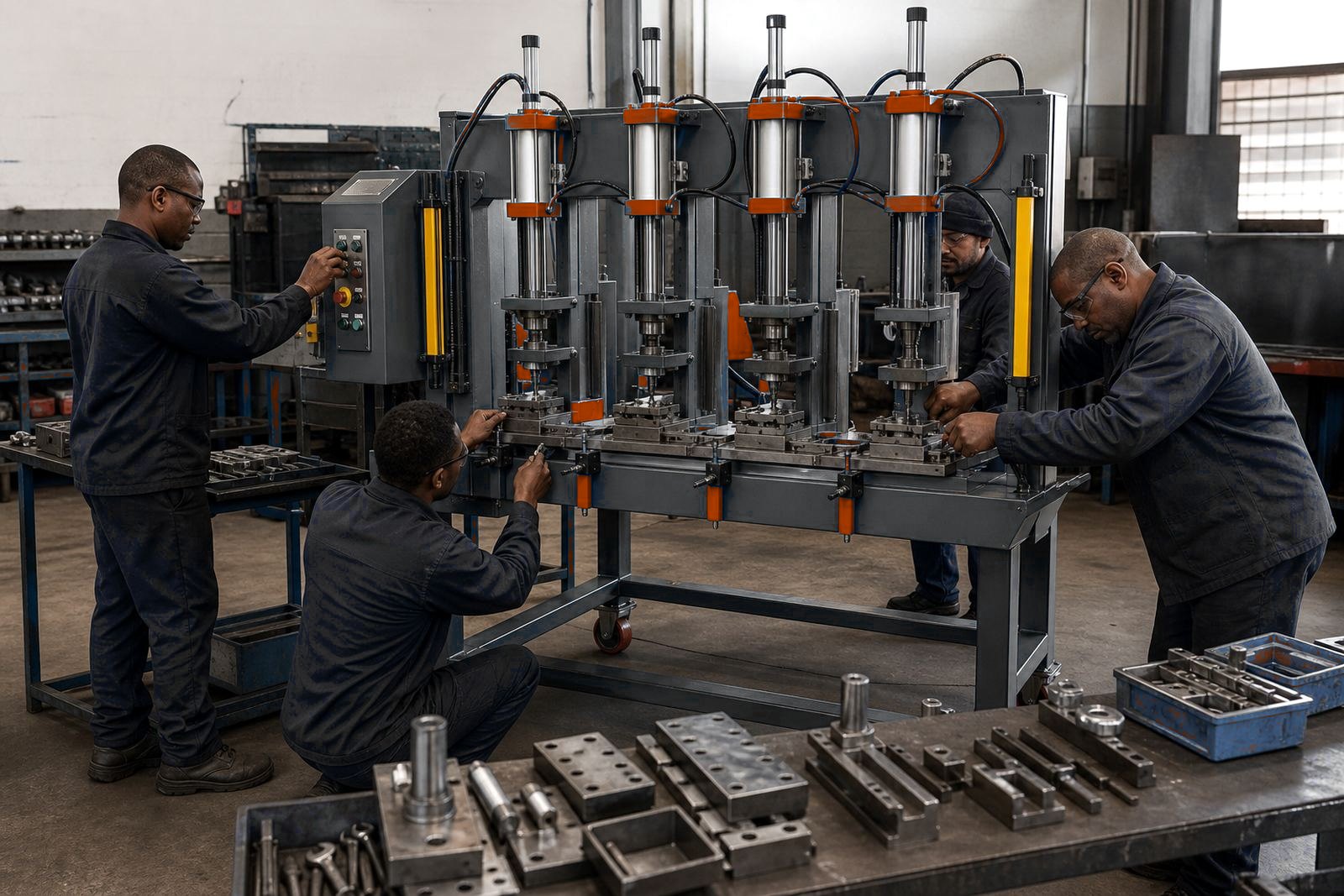
A workshop built around pressure, stroke and repeatability
The early work was hands-on from the start. Factories needed presses that could hold a part square, bring a cylinder down with the right force, and repeat the same action through a shift without drama. That meant thinking about air pressure, stroke length, guide movement and tooling from the first drawing, not as afterthoughts.
Those jobs were often for assembly lines where a small error in alignment would show up at the end of the shift. A press had to suit the part, the operator and the sequence around it. Some jobs asked for crimping, others for riveting, staking or pack sealing, and a single frame could not be treated as a one-size answer.
- Multi-station layouts for different production steps
- Tooling matched to the component and the cycle
- Two-hand controls for safer operation at the press face
- Guarding and light curtains where access needed control
How the craft grew beyond a single machine
As the work broadened, the team moved from building one press at a time to planning full stations around the press. That meant thinking through fixture design, part loading, clamp points, line flow and how the operator would move between steps. A good machine is only part of the job; the surrounding setup shapes the result just as much.
Customers came from factories that needed practical equipment for assembly, crimping and light forming work, with enough consistency to keep production moving. Some lines needed compact stations for smaller parts. Others needed taller access, longer stroke, or a wider opening for packaging and sealing tasks. Coastal humidity in places like Durban, and the dust and heat found in inland plants, also shaped the way tooling and guarding were finished.
Over time, the workshop approach became more disciplined. Materials were chosen for wear, pins and guides had to hold their position, and the air line setup needed to suit the installation site. That is where experience matters, because a press that looks fine on paper can still feel wrong on a factory floor if the stroke, pressure or operator reach is off.
What local factories kept requesting
Most of the work has been for South African plants that need machines to do a specific task cleanly and with less variation. The customers are not all the same. Some want a station for crimping terminals. Others need riveting for hardware assemblies, staking for formed joints, or a pack sealing station that closes product consistently before it leaves the line.
There is also a practical side to the relationship with customers. They want presses that can be commissioned properly, operators that know the sequence, and tooling that can be changed without causing a mess on the floor. In many cases the request starts with a sample part and a rough production target, then grows into a station that needs guarding, light curtains and a clear handover process.
- Assembly and sub-assembly work on production floors
- Crimping and riveting for repeatable joining tasks
- Staking for pressed-in features and formed connections
- Pack sealing where neat closure matters to the line
The Isando team behind the machine frames
Today the work is carried by a small team with distinct jobs, and that keeps the process steady. Pieter Sauls leads the business as Managing Director, while Thandiwe Matlala keeps projects moving and Musa Hartnick handles tooling design. Johan Ramokgopa leads the workshop floor, Lerato Moagi looks after commissioning work, and Anele Engelbrecht handles operator training.
That mix matters because a pneumatic press is never only a welded frame with a cylinder bolted on. It needs a tool path that makes sense, a guard that fits the process, controls that suit the task, and a handover that leaves the production team ready to run it. The team works across those stages rather than treating them as separate jobs.
In practice that means checking the build, setting the stroke, setting pressure for the task, and watching how the part sits through the cycle. A minor typo in a drawing note or a loose bracket on site can slow things down, so the team tends to stay close to the details.
Commissioning across the country, not only in one plant
Although the base is in Isando, the work has travelled far beyond the workshop. Commissioning and installation support have been part of the story for factories in Johannesburg, Pretoria, Durban, Gqeberha and East London, with jobs also moving through Kempton Park and Boksburg. That spread has shaped the way the business plans, because each site brings its own floor space, air supply and production habits.
Commissioning is where design decisions are tested in real conditions. The stroke needs to land where it should, the two-hand controls need to feel natural, and the guarding has to suit the operator's reach without getting in the way of the task. If a press is intended for repeated work, the setup must support production rather than fight it.
- Site installation for new press stations
- Air line setup matched to the machine requirements
- Stroke setting for the part and cycle length
- Production handover after testing and adjustment
What the business looks like now
The present shape of MultiPress is a mix of workshop build work, on-site setup and operator support. Custom tooling, fixture design, guarding builds and light curtain integration sit alongside the press itself. Tooling changes are handled with the line in mind, so the station can suit more than one component where the job requires it.
Our history is not marked by one dramatic change. It is more practical than that. It is a pattern of learning from plant floors, adapting the machine design, and keeping the build grounded in what South African factories actually need. The result is a business that still speaks the language of cylinders, air pressure, stroke and guarding, while also understanding the people who stand at the press all day.
From the first year of trading to today, the work has stayed close to the same basic question: how do you build a press station that fits the part, suits the line and can be run with confidence? That is the thread that runs through the whole story, and it still shapes the way the team works now.