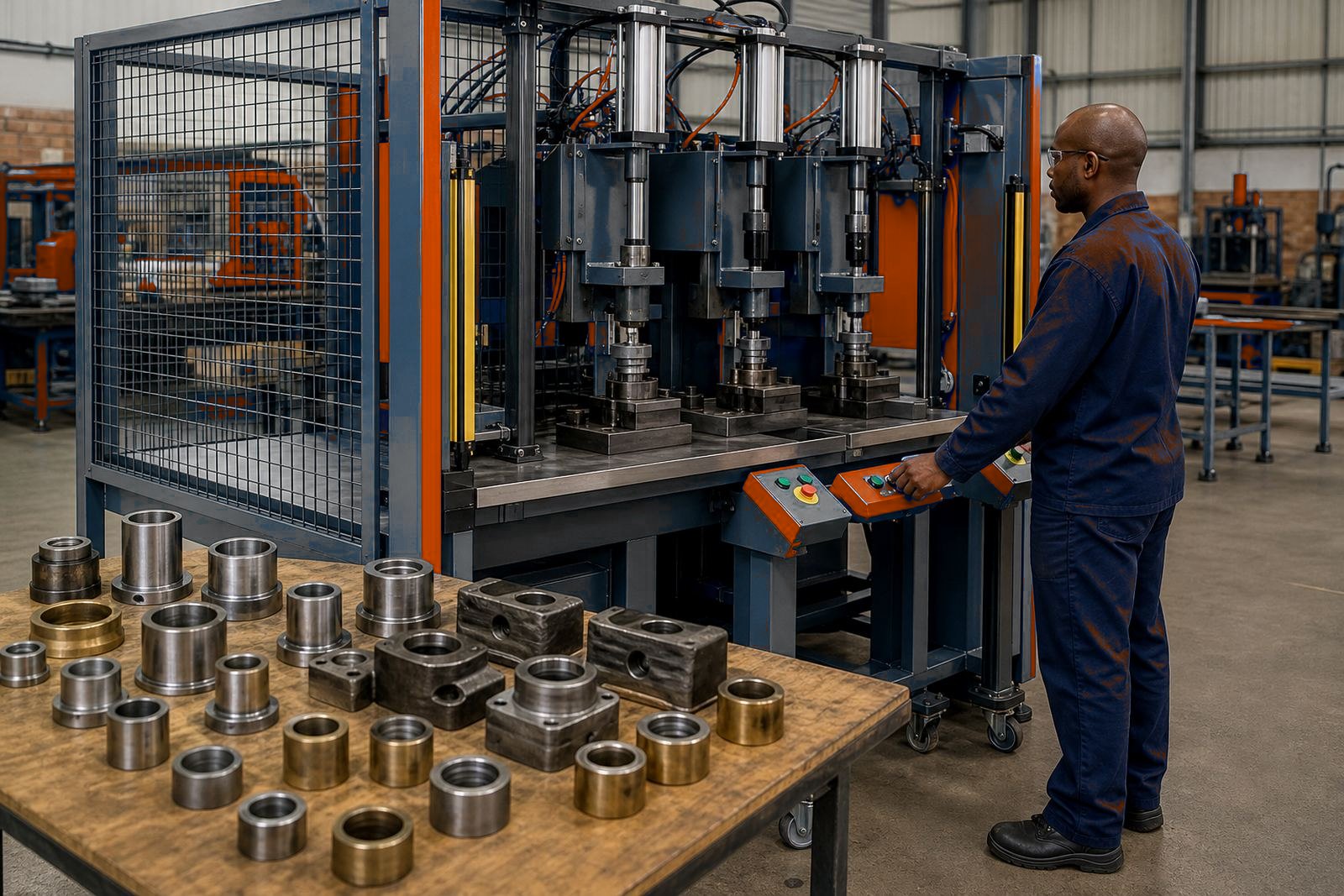
When blister packs start lifting at the seal line
Blister pack sealing work gets tricky when the pack flexes, the lid shifts or the seal area sees uneven pressure. In a factory setting, that usually shows up as poor closure, crushed corners, loose flanges or pack splits near the seal edge.
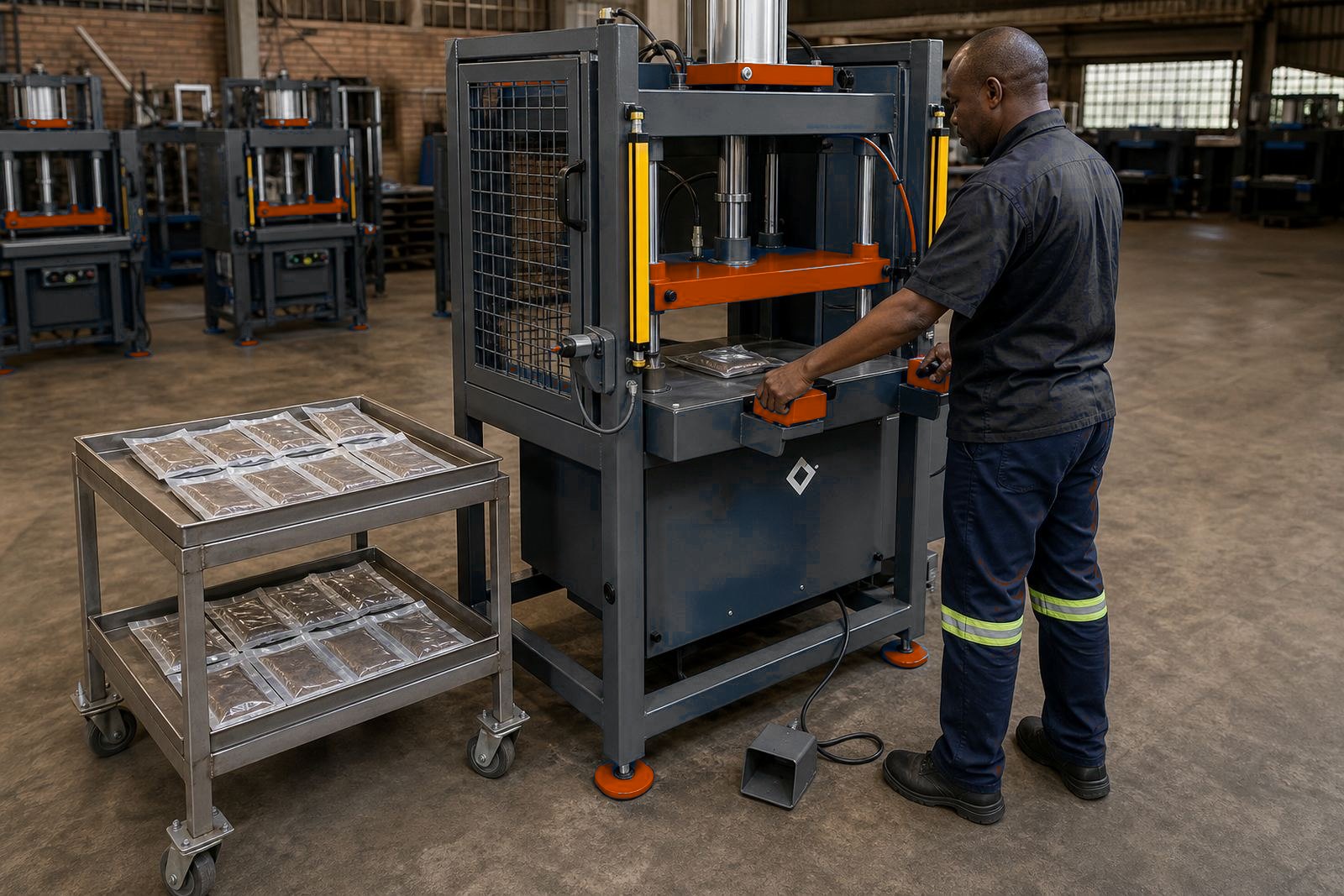
A pneumatic press suits this kind of work because the downward force is controlled by air pressure and the stroke can be set to match the pack height. For blister or tray style packs, the head must land square, hold contact for the right dwell period and release without dragging the pack sideways.
Typical press set-up for pack sealing lines
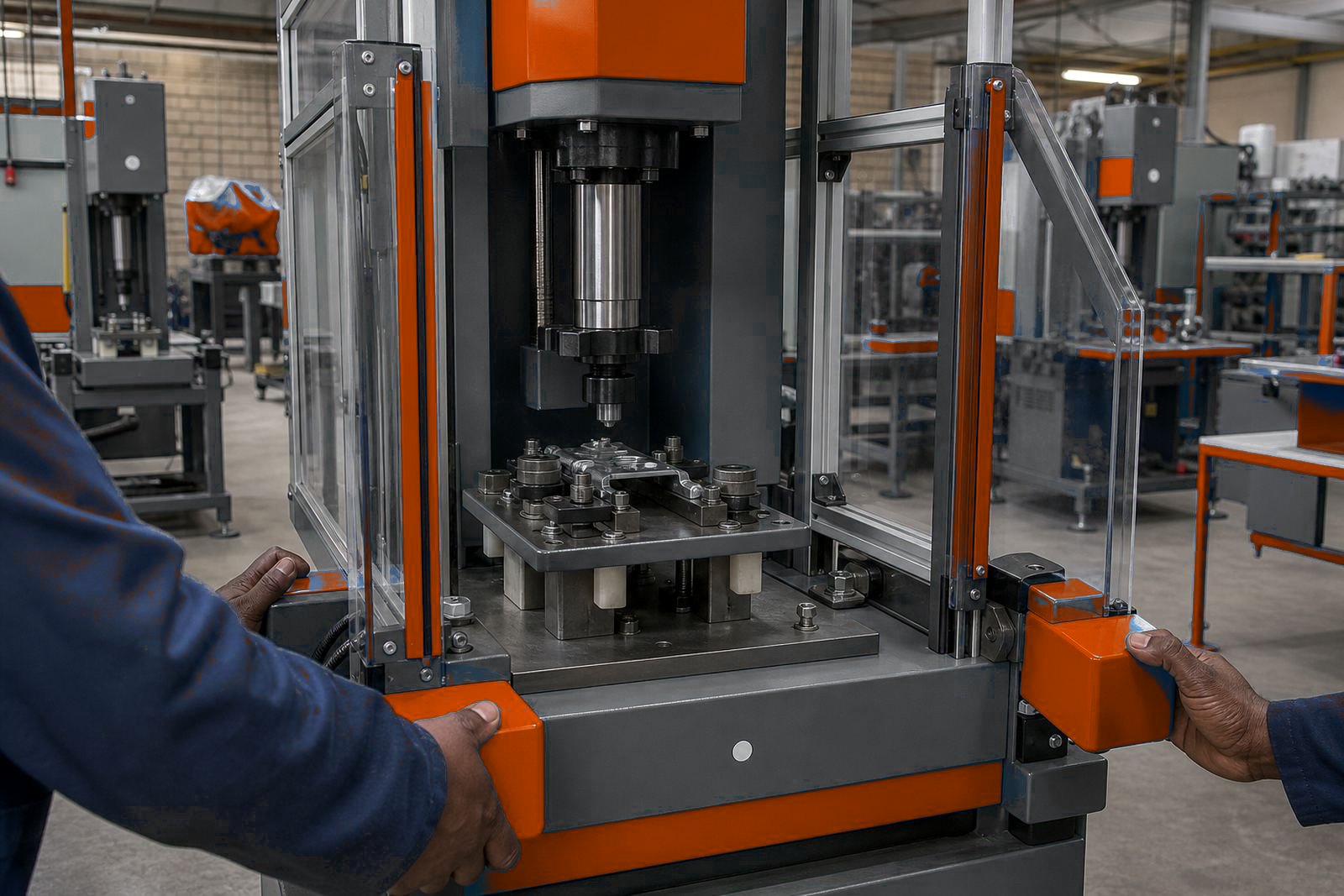
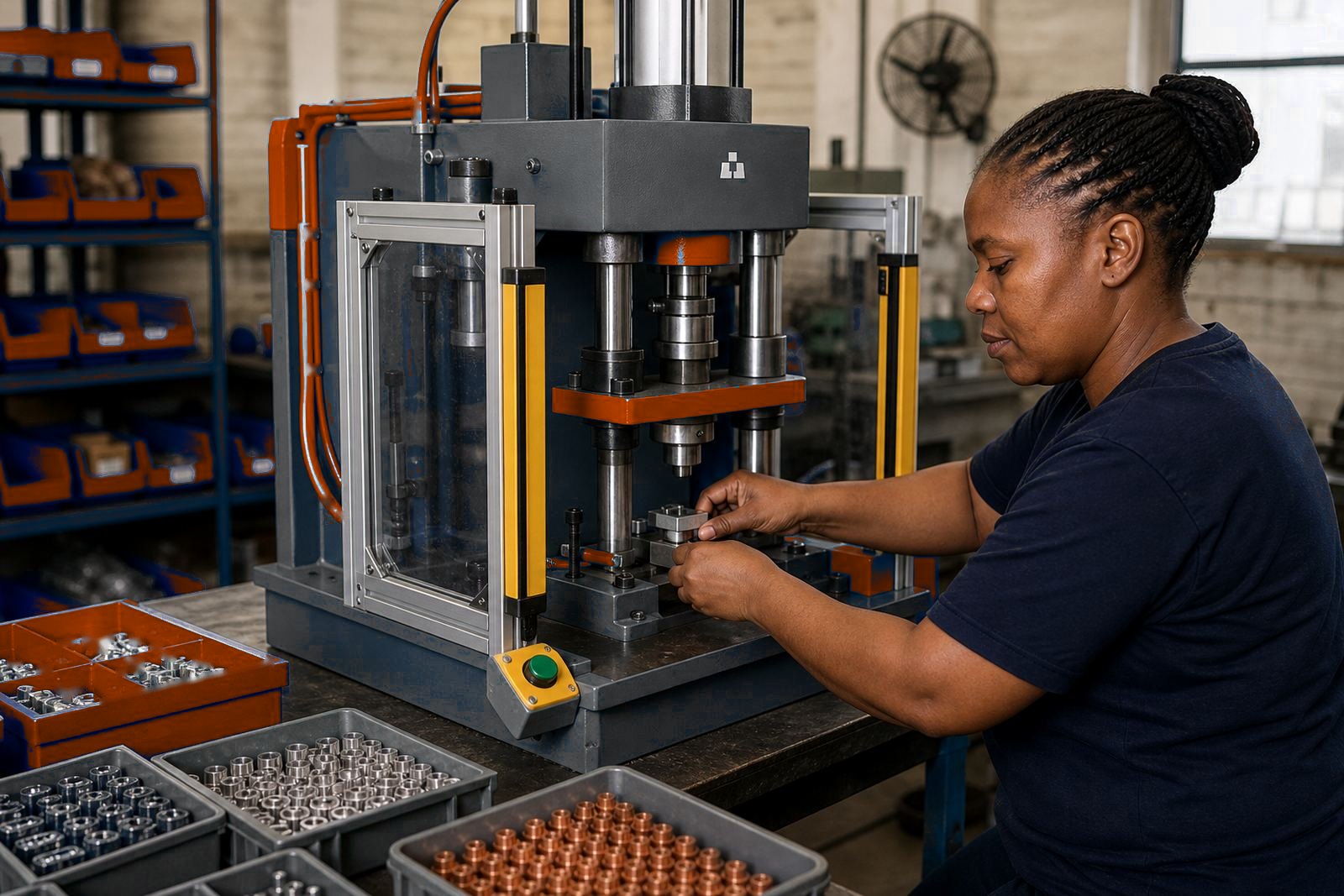
A sealing station is usually built around a rigid frame, one or more pneumatic cylinders, a guided platen and a dedicated sealing tool. The tooling may carry a flat face, a formed nest or a clamp surface depending on the pack shape and the film or lid material.
- Single or multi-station press layouts for one operator or a small line
- Adjustable stroke setting for different pack heights
- Two-hand controls to keep the operator away from the closing zone
- Light curtains where access around the station must stay open
- Changeable tooling for different pack sizes or cavity layouts
- Air line setup with clean, dry air and steady pressure at the press
On a busy line, the station often sits close to filling, inspection or cartoning. That means the frame height, reach and discharge side need to suit the full packing route, not just the sealing step.
Planning the station around the pack, not only the press
Layout matters because blister sealing depends on how the pack enters the nest and where the operator stands during loading. If the pack is awkward to seat, the closure will wander and the seal line will take the strain.
The best results usually come from clear guide rails, positive location points and a tooling face that supports the full pack footprint. Where packs are shallow or thin-walled, the tooling needs a softer contact surface or a shaped insert so the product inside is not damaged.
- Match the stroke to the tallest pack in the range, then fine tune it
- Keep the tooling face easy to clean for foil dust, trim and adhesive residue
- Allow enough space for pack loading, removal and inspection
- Place controls where the operator can work without twisting or reaching across the station
- Allow for future tooling changes if the pack format may change later
Pack sealing in humid coastal areas can need extra care on storage and airflow around the station, especially where film and lid materials react to the room conditions.
Common faults we see on sealing jobs
Most sealing faults trace back to setup, not the air cylinder itself. A press can be strong enough but still give poor packs if the stroke is too long, the tool is off-centre or the closure pressure is not matched to the pack material.
Another common issue is inconsistent operator loading. If one pack sits fractionally high and the next one sits low, the contact point changes and so does the seal. That is why guided movement, repeatable nests and a clear hand position are so important.
- Inconsistent seal width from pack to pack
- Crushed or marked corners from poor tool alignment
- Film or lid slip during closure
- Incomplete contact because the stroke is set too short
- Over-compression where the pack material is too thin for the tooling face
Guarding and light curtain placement also need to suit the line. A guard that blocks access to loading points creates workarounds, and workarounds lead to unsafe habits.
Budgets in Rand for small and larger sealing stations
Pack sealing projects in South Africa vary with frame size, cylinder count, tooling complexity and safety equipment. A compact single-station press with basic tooling usually sits at a lower level than a multi-station unit with guarding, light curtains, air setup and changeable nests.
For planning purposes, a simple sealing station can begin in the low hundreds of thousands of Rand, while a larger custom build with several stations, custom tooling and commissioning can move into a higher bracket. The final figure depends on the pack size, the closure force needed and the amount of integration around the station.
Where tooling changes are frequent, it is worth budgeting for spare nests, change parts and clear marking on settings so the line team can move between pack formats without guesswork.
Commissioning, training and handover on South African factory floors
Once a sealing press is built, the next step is getting it to run the way the production team needs it to run. That includes setting the stroke, checking air pressure, testing the two-hand controls, confirming guarding and loading the right tooling for the actual pack.
Our commissioning work covers plant setup, site installation, operator training and production handover across Johannesburg, Pretoria, Durban, Gqeberha, East London, Kempton Park and Boksburg. The point is to leave the station ready for real packs and real shifts, not a bench test that looked neat in the workshop.
- Stroke setting for the pack height and closure depth
- Air line setup with clean connections and steady supply pressure
- Tooling changes and practical operator guidance
- Production handover with the line team at the station
On a sealing line, small details matter. A pack that sits a few millimetres off centre can show the problem all the way through the carton packout.
What a blister pack sealing brief should cover
A useful brief gives us the pack size, material layers, target output, station count and any guarding or access limits on the floor. It also helps to know whether the same press will seal one pack style or handle several formats with tooling changes.
We work from Isando, Ekurhuleni and support factories through our contact form. Pieter Sauls leads the business, with Thandiwe Matlala on projects, Musa Hartnick on tooling, Johan Ramokgopa in the workshop, Lerato Moagi on commissioning and Anele Engelbrecht on operator training.
For blister pack sealing, the best place to begin is with a clear image of the pack, the line and the handling around it. The press can then be built around the job, not forced into a shape that only works for one shift.