Hinge joints that need a steady press cycle
Hinge riveting is rarely only about squeezing a fastener into place. The parts need to sit square, the hinge leaf must be supported, and the rivet has to form without distorting the knuckle or marking the finished face. On a busy line in Isando or a plant in Kempton Park, that means the station must repeat the same movement across shift changes and tool changes. If the hinge sits even a little off centre, the rivet can lean, the joint may bind, and the panel starts to feel heavy or loose.
For that reason, we build hinge riveting stations around a stable frame, guided cylinders and dedicated tooling that holds the hinge, backing piece and workpiece in one position. The press stroke is set to suit the rivet form and part height, while air pressure is adjusted to suit the material and the force needed at the station. The result is a controlled press action at the pedal or trigger.
What a hinge riveting station usually carries
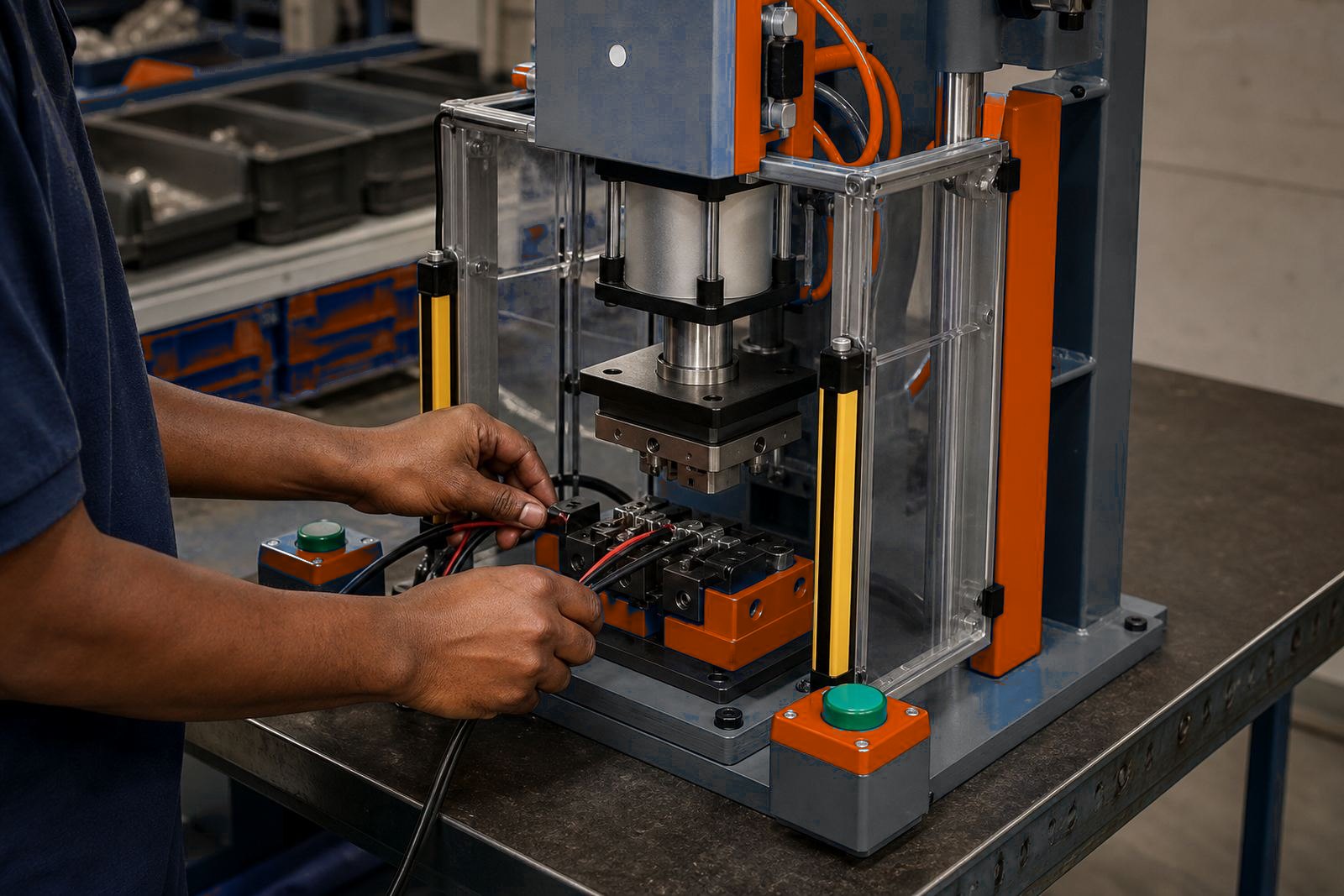
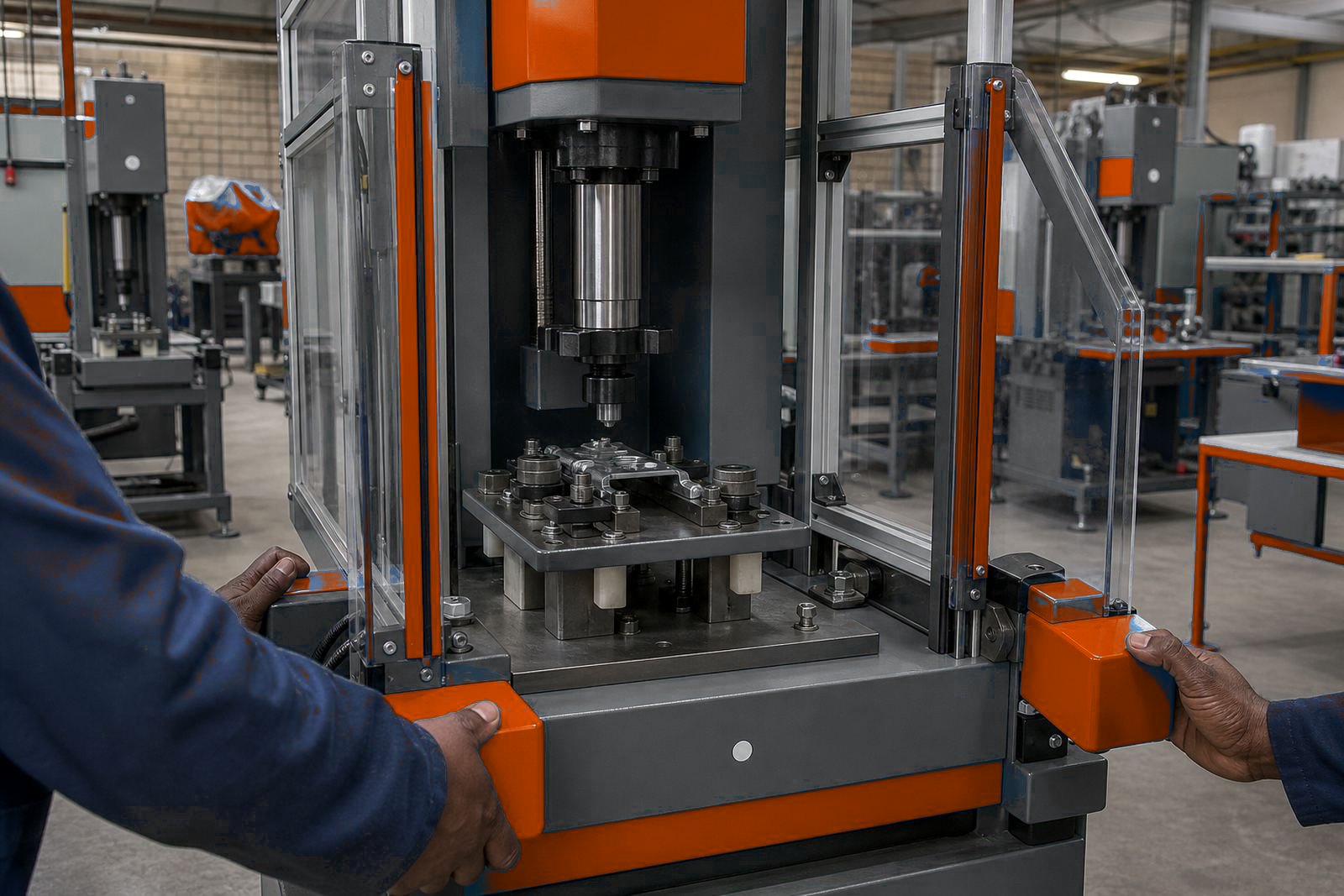
A practical hinge riveting set-up normally includes a pneumatic press head, a fixed lower nest, a shaped anvil or backing support, and tooling that locates the hinge leaf before the cycle starts. Some lines use one station per hinge point, while others use a multi-station layout with separate positions for locating, riveting and checking. Where the hinge range changes often, quick-change tooling can help the workshop keep movement between jobs tidy.
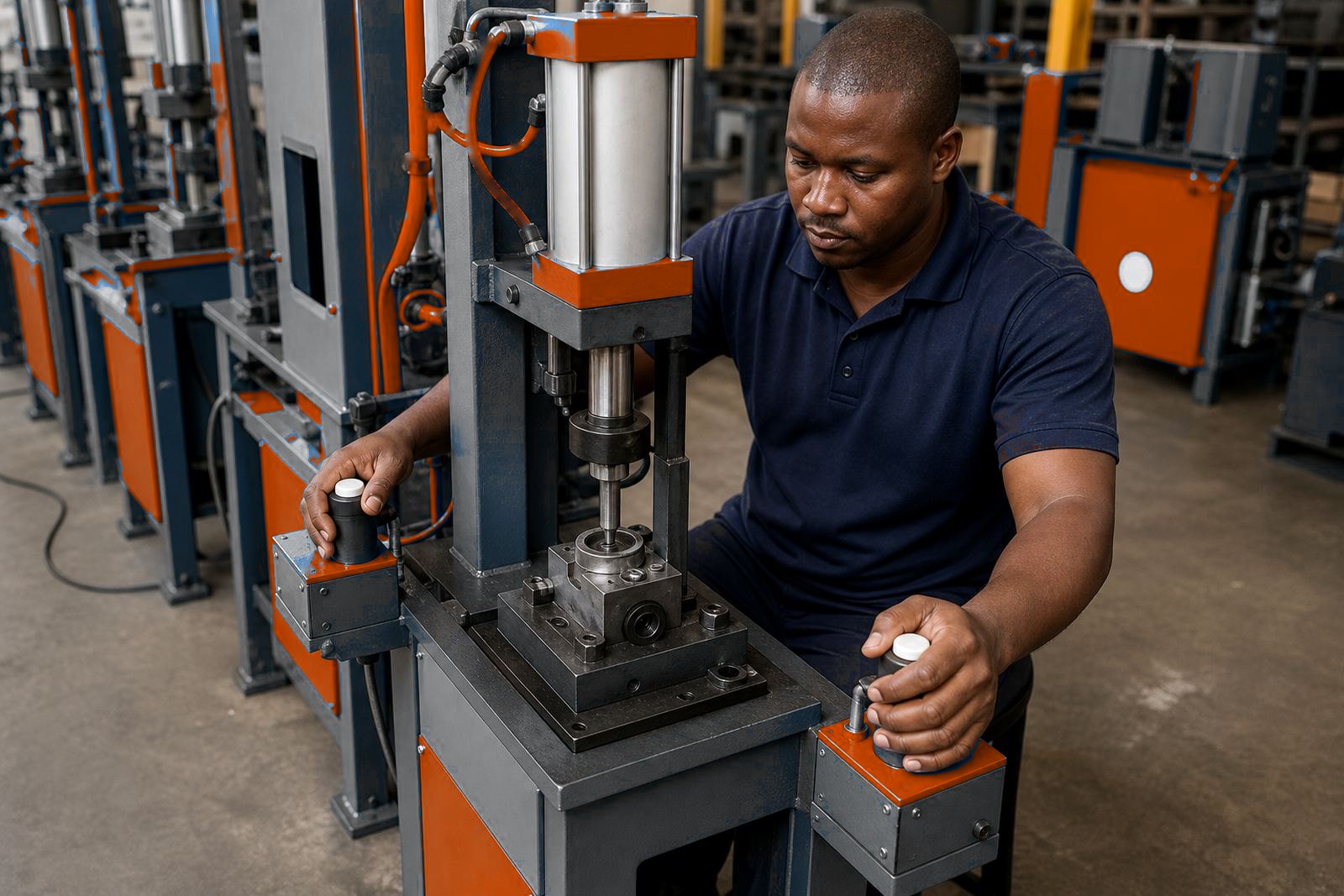
- Air cylinder sized to suit the required force and stroke
- Lower nest or fixture that supports the hinge and body panel
- Top tooling matched to rivet head form and material thickness
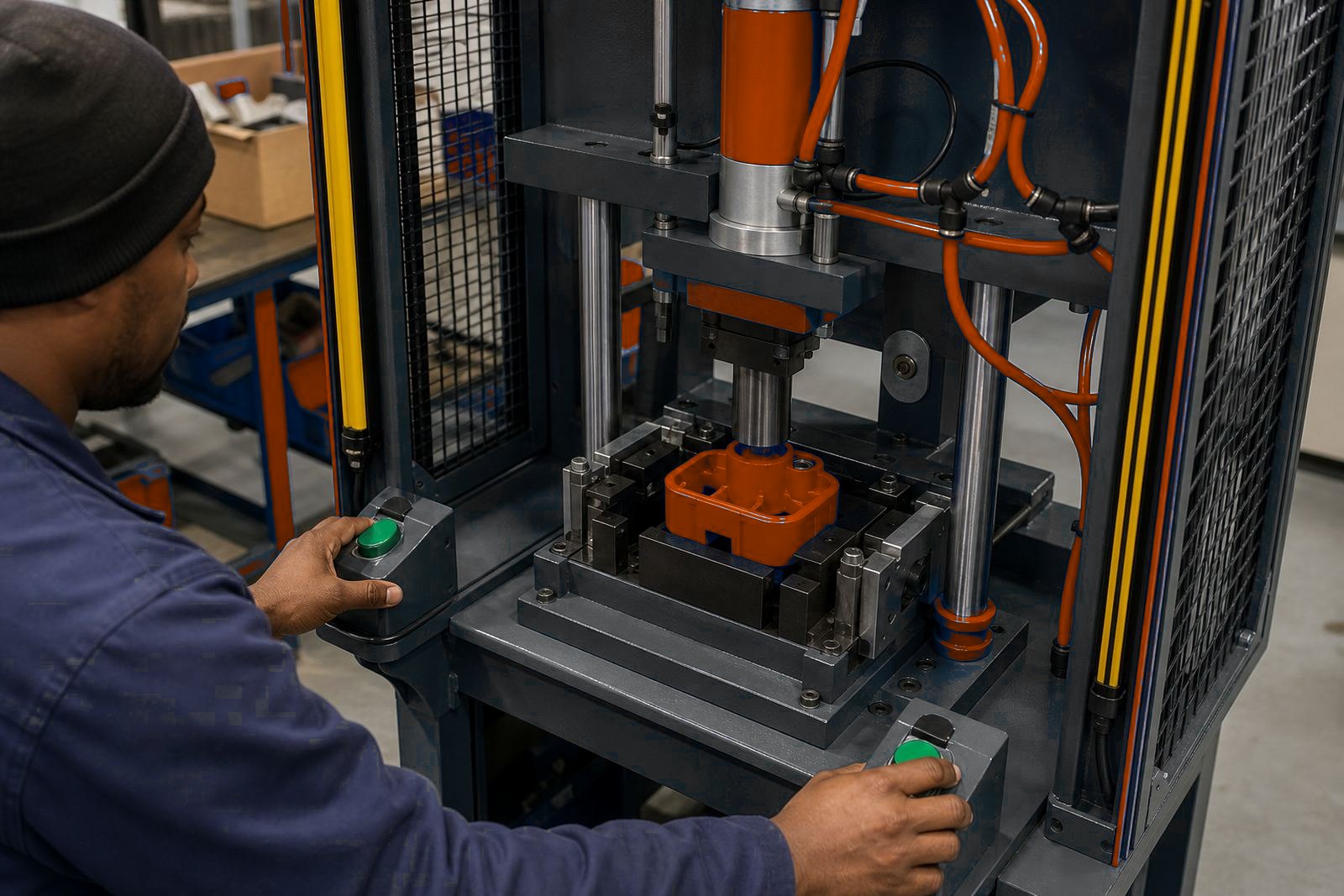
- Two-hand control or guarded start controls for safe operation
- Light curtain protection where the hand access area stays open
- Air line setup with clean, stable supply to the press
- Stroke setting for shallow, medium or deeper form movement
Where the hinge part is small or awkward to reach, the tooling should guide the operator’s loading position and make the clamp points obvious. That cuts down on skewed placement and helps keep the rivet form consistent across a long run.
Layout planning for a line that must stay square
Hinge riveting stations work best when the material flow is plain. The operator should not have to twist the body, shuffle the hinge, then reach too far to start the cycle. A short and direct layout reduces handling errors. In Durban or Port Elizabeth, where coastal humidity can bring extra surface care issues, the tooling faces and fixtures also need sensible corrosion protection and regular cleaning, especially if the line runs fine steel parts or plated hinges.
We normally look at entry height, hand access, part presentation and discharge path before the station is fixed in place. If the hinge assembly is part of a bigger build, the station must sit at the right point in the sequence so the next process receives a square, secure component. The press should not force the operator to work around the frame or lean into the guarded area.
- Keep loading face-on, not at a side angle
- Leave enough room for fixture opening and part removal
- Plan cable and air routing so they do not cross walk paths
- Place the station where inspection marks can be read without strain
- Allow room for maintenance access to cylinders, guides and controls
Common mistakes that upset hinge alignment
A hinge riveting problem often starts with the fixture, not the rivet. If the backing support is too soft, too narrow or not seated properly, the joint can move during the press stroke and the hinge leaf shifts out of line. Another common issue is using a stroke setting that is too long for the job. That can flatten the rivet head, mark the component or push the hinge beyond its natural position. Too little stroke can leave the rivet under-formed and the assembly feels loose.
Operators also struggle when the tooling is not clear enough about part orientation. If the hinge can fit two ways, the station needs a physical stop or locator that makes the correct position obvious. A good setup reduces the chance of hand corrections inside the guarded area. When light curtains or two-hand controls are fitted, they should suit the actual hand movement around the job, not just the general press frame.
- Loose fixtures that allow the hinge to creep during pressing
- Poorly matched top tooling for the rivet head profile
- Air pressure set too high for thin materials
- Stroke left unchecked after a tooling change
- Guarding that blocks loading or encourages bypassing
Commissioning, tooling changes and training on the shop floor
Once a hinge riveting station is built, the setting work matters as much as the steelwork. Commissioning covers press movement, pressure setting, stroke depth, fixture alignment and guard function. If the station forms part of an assembly line, the handover should include a proper check on cycle timing, part fit and loading rhythm. For plants in Johannesburg, Pretoria, Boksburg and beyond, that handover helps the team keep the station useful after the first week of running.
Tooling changes need a clean method too. Hinge sizes, rivet lengths and body shapes do change, so the operator should know what to adjust and what to leave alone. Our operator training covers safe loading, part orientation, start control use, inspection of the finished joint and basic checks before the next shift begins.
- Commissioning of cylinder travel and stop positions
- Setting and recording the press stroke for the job
- Training on two-hand controls or light curtain use
- Safe tooling changeover and fixture inspection
- Production handover with the line team on site
Budget ranges for hinge riveting in Rand
Costs vary with station size, level of guarding, tooling complexity and whether the job needs one press point or several. A single-purpose hinge riveting station with standard pneumatic control and basic fixture work may sit in the lower band, while a multi-station set-up with custom tooling, light curtain integration and more involved site installation moves into a higher band. For South African factories, it helps to budget for the complete working station, not only the press frame.
As a working guide, smaller hinge riveting stations often start from about R85,000 to R160,000. Mid-range custom stations with stronger tooling, better guarding and on-site commissioning can fall around R160,000 to R320,000. More involved multi-station assemblies, especially where several hinge positions or production checks are built in, can move from R320,000 to R650,000 or more. Final cost depends on stroke length, cylinder sizing, fixture count and the amount of integration needed on the line.
If the job needs site installation, air line setup and training across more than one plant, the budget should also allow for travel and time on the floor. That is where the line becomes a real production tool, not just a press sitting in the corner.