When small components need steady pressure, not force
Small parts work usually involves clips, terminals, inserts, spacers, sleeves or light metal components that must sit in the same position every cycle. A short stroke pneumatic press suits this kind of assembly because the ram moves predictably and the pressure can be set to match the part, not crush it.
In a South African factory the real challenge is often not the press itself, it is the repeatability around it. If the part shifts, if the operator reaches too far, or if the tooling leaves too much clearance, the press cycle starts to vary. That is where a proper station layout matters. The press frame, the work height, the air supply and the guard position all need to work together.
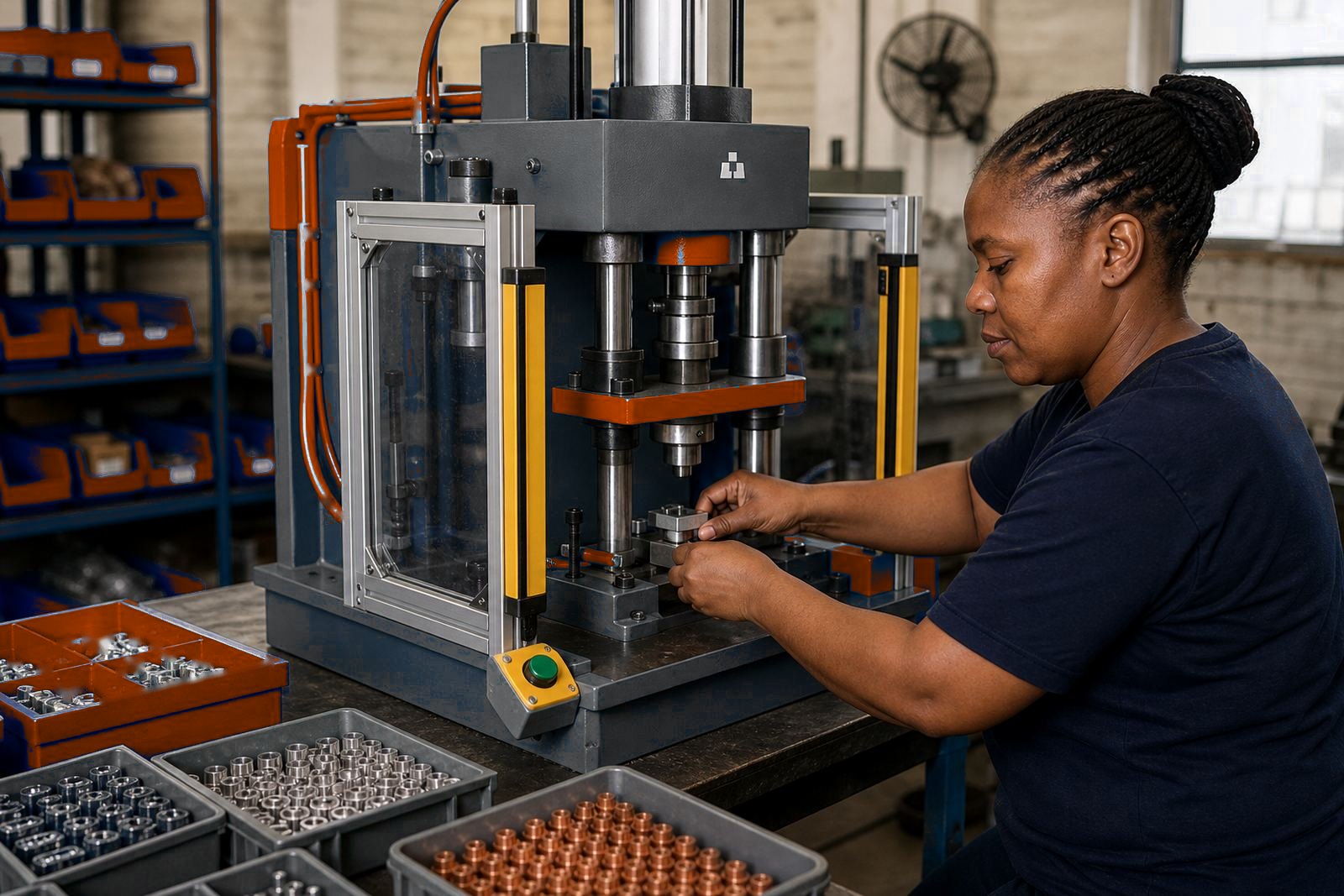
For small parts assembly we usually look at a set-up with a short stroke cylinder, a stable base, a fixed nest and a clean seating face. Where the part has a spring or an insert that must stop at a measured depth, stroke setting becomes as important as force. Too much travel wastes time and can mark the component, too little leaves the job incomplete.
Typical press set-up for small parts lines
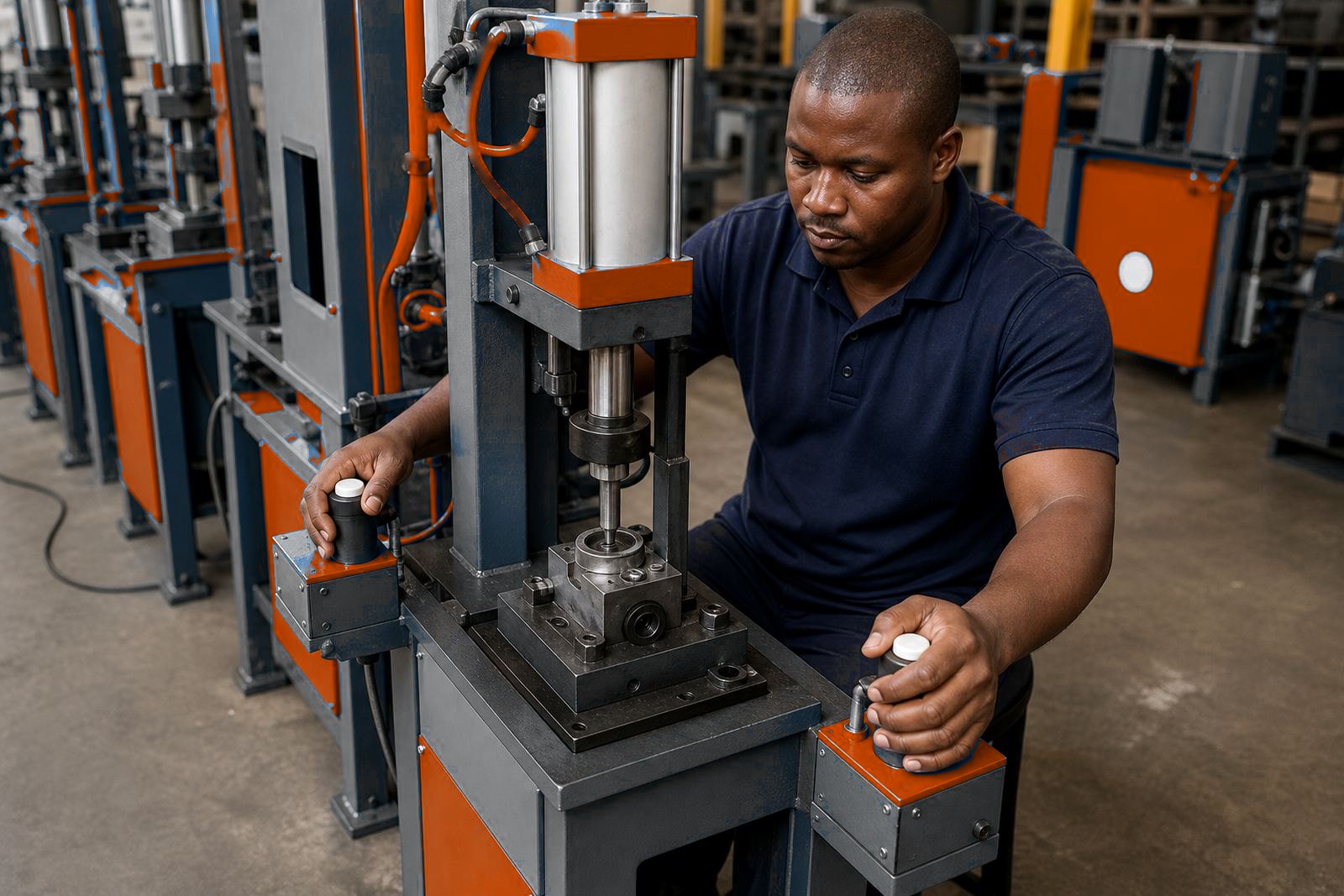
A practical line often uses one or more stations built around a pneumatic cylinder, a guided slide or ram, and a dedicated jig or fixture. The tooling controls the component position, while the press supplies the seating force. For some jobs the same frame can carry different nests, which helps when the product range is wide but the parts stay light.
- Short stroke pneumatic press with controlled downward travel
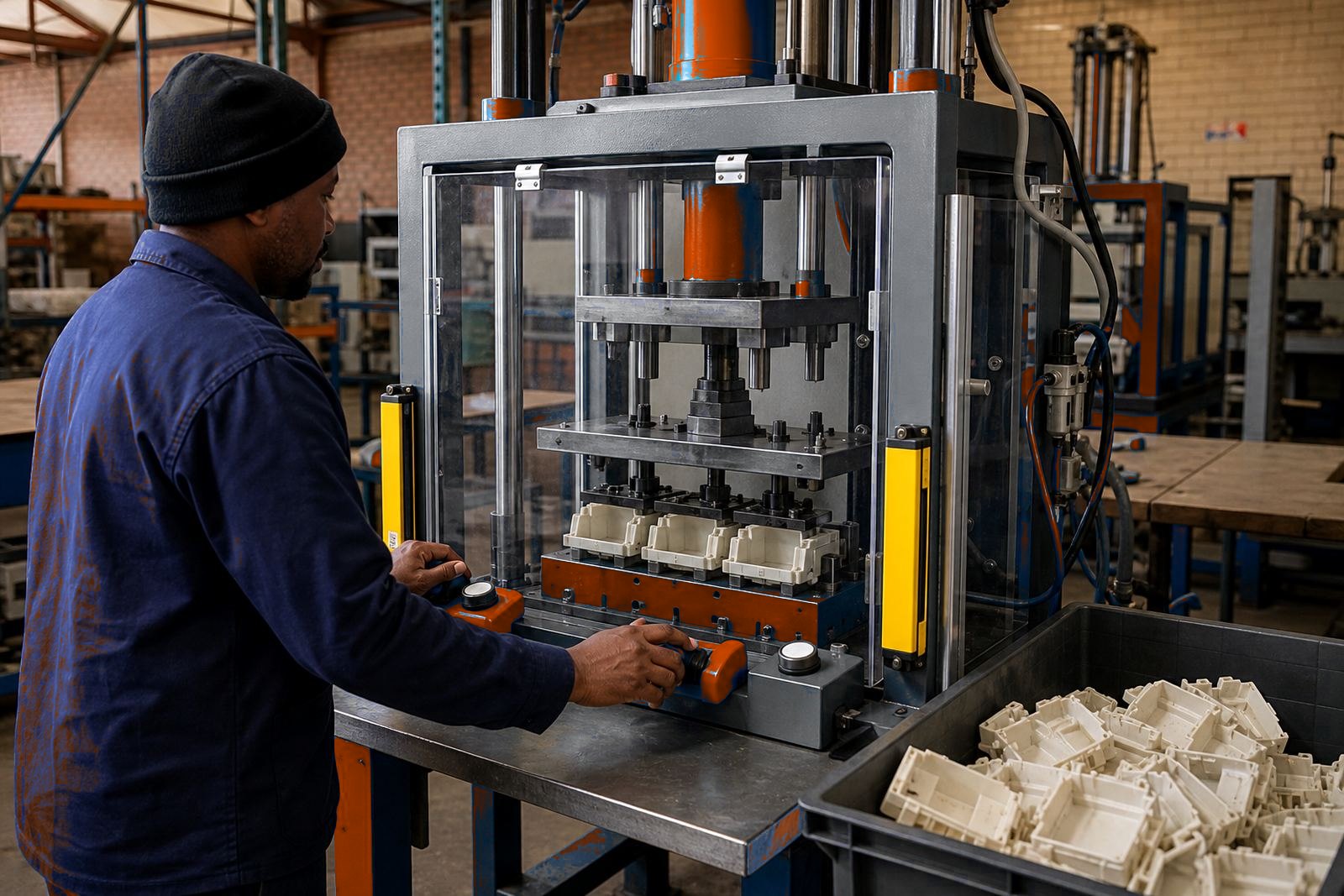
- Two-hand control for safer cycle start on open stations
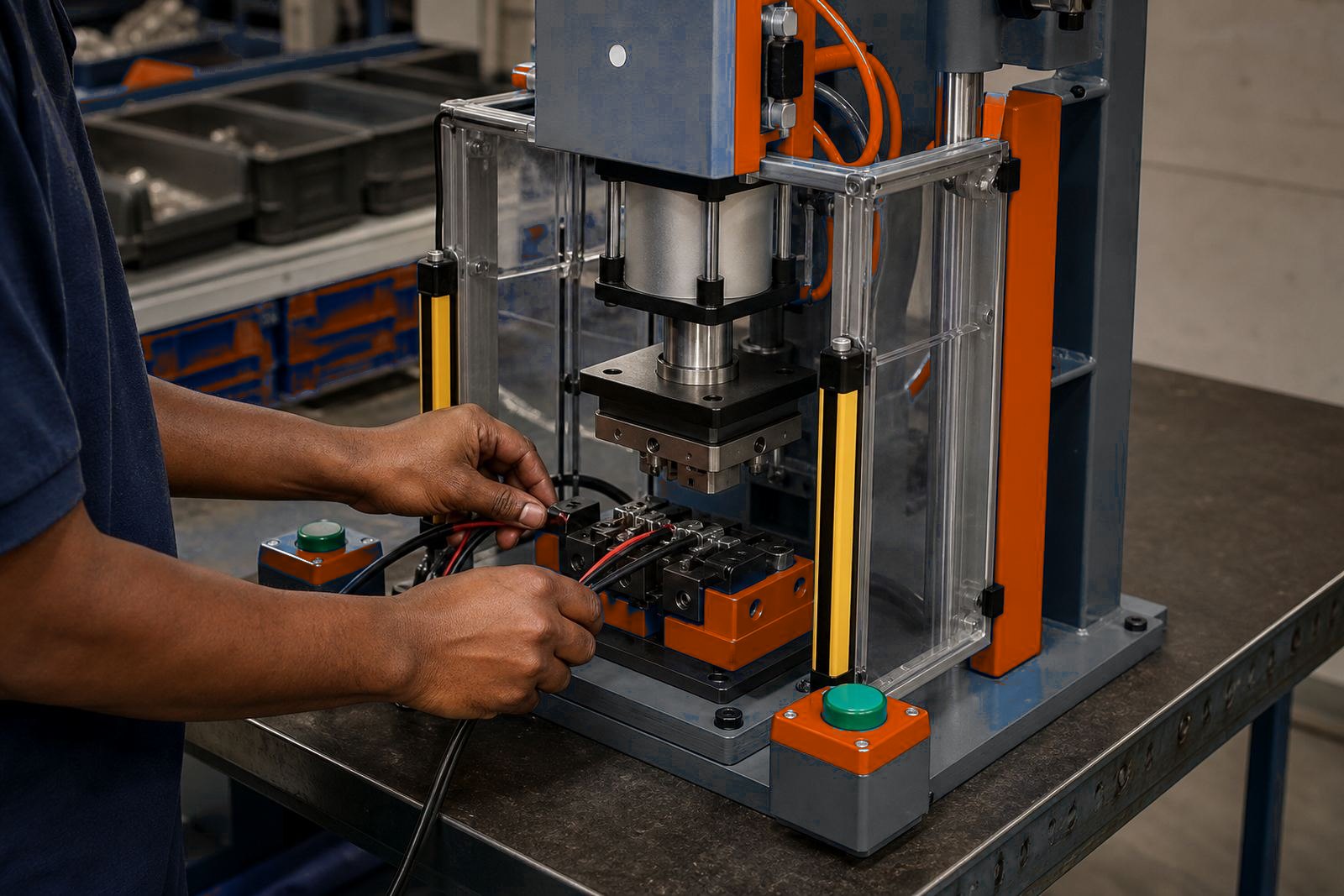
- Light curtain protection where hand access is needed
- Custom nest, locating pins and part support tooling
- Air line setup with correct filtration and pressure regulation
- Stroke setting for shallow or deep seating moves
- Guarding that suits the operator reach and line flow
Some small parts are best assembled in a single cycle, others need a two-stage action. One station may locate the part, the next may crimp, stake or set a rivet. On heavier lines we may use separate stations so that the operator is not juggling too many movements in one cycle. That keeps the job neat and lowers the chance of mixed parts at the bench.
Planning the layout around hands, fixtures and flow
The layout should follow the part, not fight it. If the operator must twist, stretch or lean across the frame, small part handling becomes tiring and errors start creeping in. The best position is usually waist height, with the nest close to the front edge and the control where it can be reached without crossing into the work zone.
We also look at the airflow and the supporting services. Pneumatic presses need clean, steady compressed air, and the regulator must be set for the duty at hand. In humid coastal conditions, moisture in the line can affect valves and seals, so air preparation matters more than many plants expect. Where the line runs all day, the tooling and guide surfaces should be easy to clean between shifts.
- Keep the part feed short and direct
- Set the work height to suit the operator range
- Leave space for inspection after each cycle
- Separate the finished part path from the incoming parts
- Use clear marking for station positions and tool changes
Mistakes that show up fast on small parts jobs
The most common mistake is overspecifying the press force. Small parts do not need a big cylinder just because the frame can take it. When the force is too high, the finish gets marked, tabs flatten unevenly and tooling wears faster. Another common issue is a long stroke where only a short seating move is needed. That slows the line and makes timing harder to control.
Guarding is often treated as an afterthought, then the line has to be reworked once production starts. Two-hand controls are useful on some open stations, but they need the right spacing and the right cycle logic. Light curtains help where access is needed for loading or inspection, although the sensing zone must be chosen carefully so the operator is not tempted to bypass it.
A third mistake is poor tooling changeover. If the nests are awkward to remove or the tooling sits loose, the line loses time and the operator starts forcing parts into place. That is how a small assembly job turns into a maintenance problem. Good fixture design keeps the part stable and makes the changeover path obvious.
Budget bands for small parts assembly in Rand
Budget depends on station count, tooling complexity, guarding and whether the line needs installation and commissioning on site. A straightforward single-station press with basic tooling sits at a lower level than a multi-station arrangement with custom nests, light curtains and production handover. When the job includes part-specific fixtures and multiple set-ups, the budget moves up because the engineering work is doing more of the control.
As a practical guide, a compact single-station assembly press can begin in the tens of thousands of Rand, while a more advanced multi-station system with custom tooling and guarding can rise into the mid to high hundreds of thousands. Larger lines with several stations, controlled transfer points and full commissioning can exceed that range. Transport, site works and any line integration can also affect the total.
It helps to cost the line around the part, not around a machine size. A short stroke press with well-made tooling may do the job better than a larger frame that needs extra adjustment. For South African factories, the useful question is usually what keeps the parts seated properly, protects the operator and holds the cycle steady across the shift.
What the workshop team builds into the job
Our Isando team handles the press build, the fixtures and the on-site handover as one job rather than separate pieces. That includes custom tooling, guard frames, two-hand controls, light curtain integration, air line setup, stroke setting, press commissioning and operator training. Where the line needs it, we also cover site installation and tooling changes for different product runs.
- Custom tooling matched to the part geometry
- Guarding builds sized to the station opening
- Commissioning for cycle setting and safe operation
- Operator training focused on the actual station layout
- Production handover after the press is running to spec
Small parts assembly rewards clean mechanics and plain controls. When the stroke is short, the part support is true and the guarding is planned early, the line is easier to run and less likely to drift during normal production.