Where angled access makes the difference
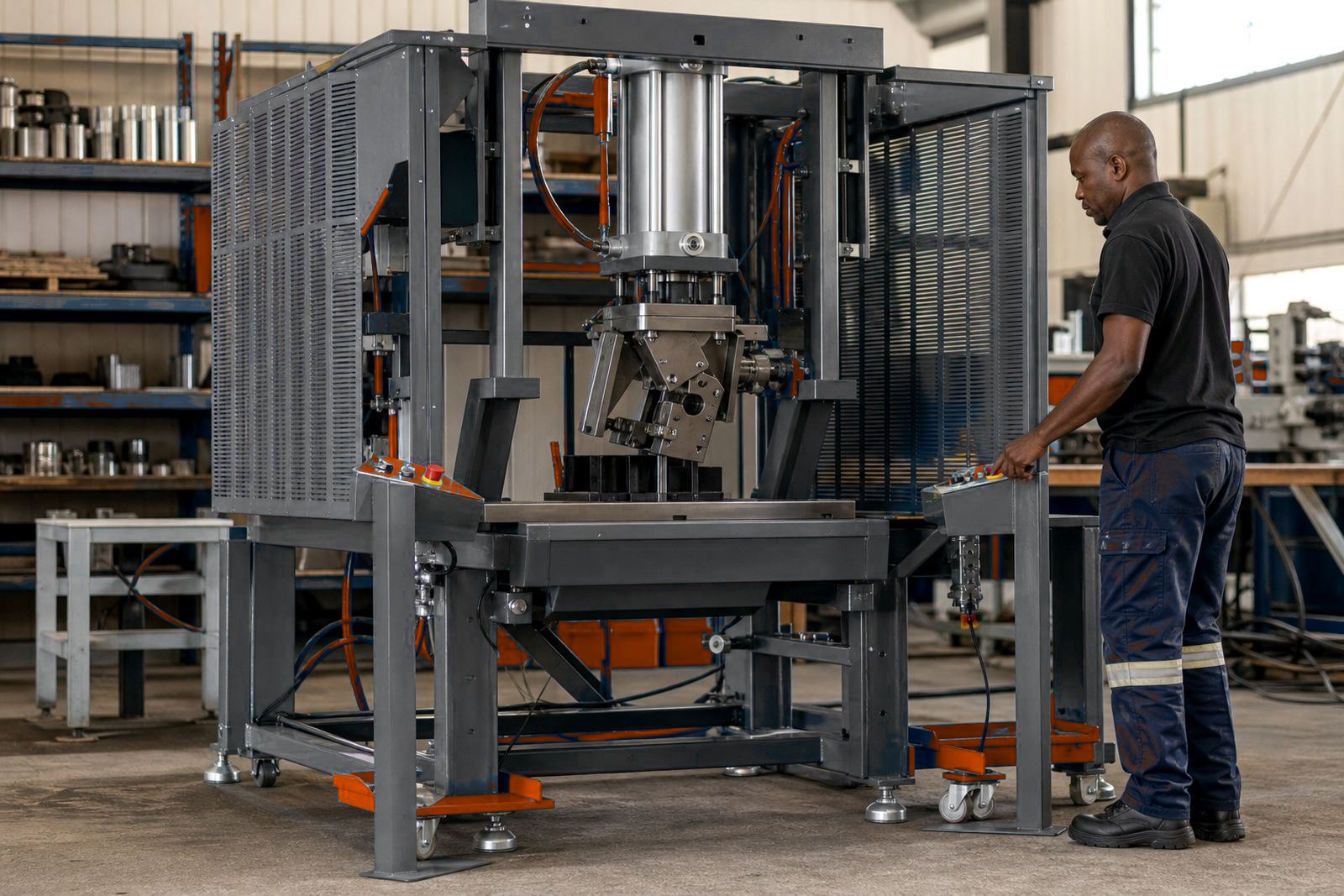
An angled tooling press is used where the working face of the part sits at a lean, on a side wall, or inside a formed section that blocks a straight vertical press stroke. The press frame carries the cylinder and tooling at a set angle, so the tooling can meet the workpiece cleanly while the part stays clamped and located in the fixture.
These presses are common on lines that handle crimped terminals, rivets, staking points, clips, retainers and sealed pack components. On a busy floor in Isando or Boksburg, the real need is repeatable access and a tool path that does not fight the shape of the part. The angled head helps the operator load the component in the same position every cycle, which keeps variation under control.
- Angled tool approach for awkward part geometry
- Suitable for clamping, crimping and forming work
- Built around the fixture, not forced onto the part
Press sizes, stations and stroke control
Angled tooling presses can be supplied as single-station units or as part of a multi-station line, depending on the cycle and the number of operations on the component. Cylinder bore, air pressure, stroke length and shut height are set to suit the force required and the space available under the tooling angle.
Typical options include short-stroke presses for light crimping, medium-stroke stations for staking and riveting, and deeper stroke settings where the tooling needs travel to reach a formed edge or recessed feature. Air pressure is matched to the cylinder size and the clamping requirement, with stroke stops and flow control used to keep the motion steady and predictable.
- Single station or multi-station layouts
- Adjustable stroke setting for production work
- Tooling angle matched to the part and fixture
- Air pressure set to suit the force requirement
What the press line can include
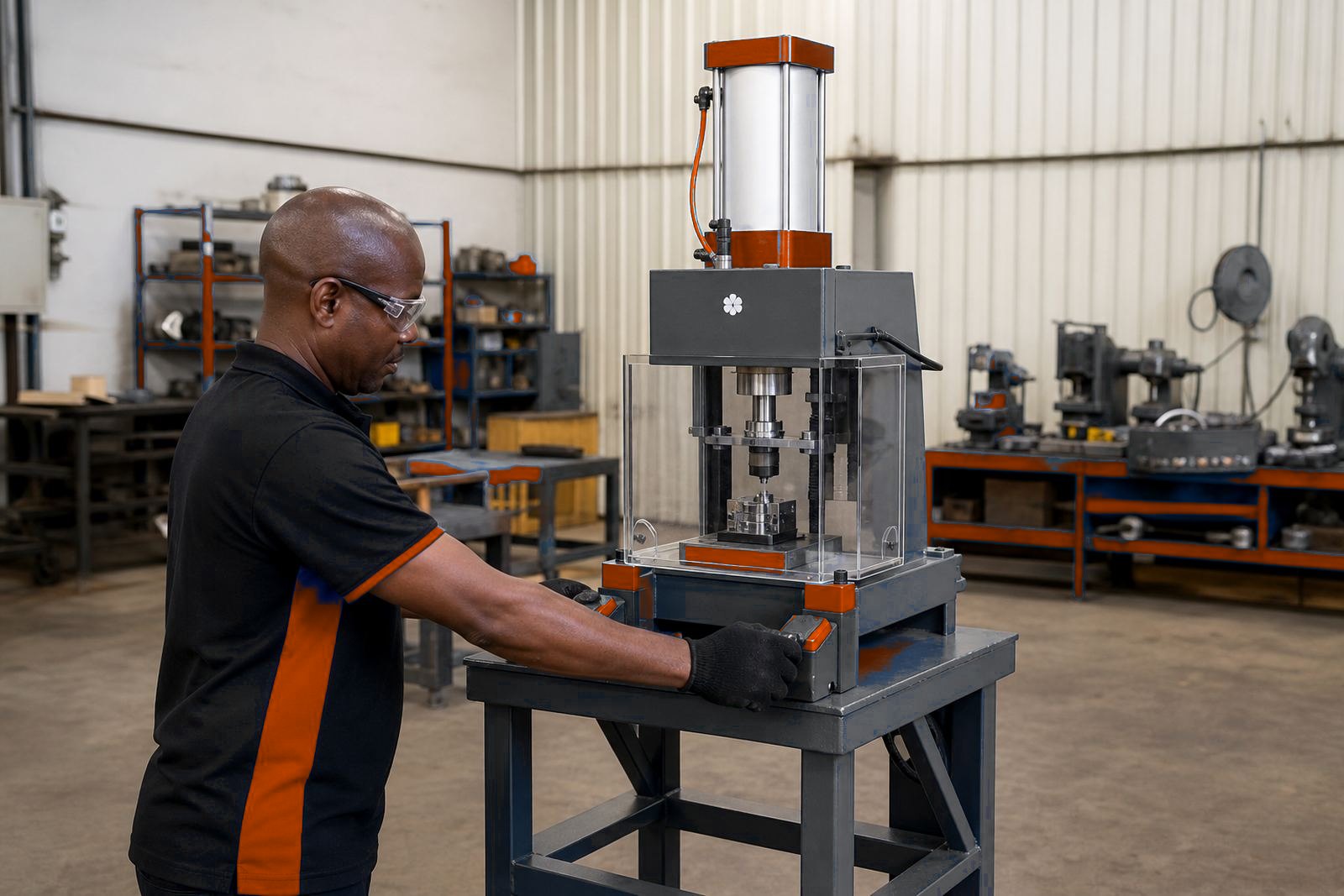
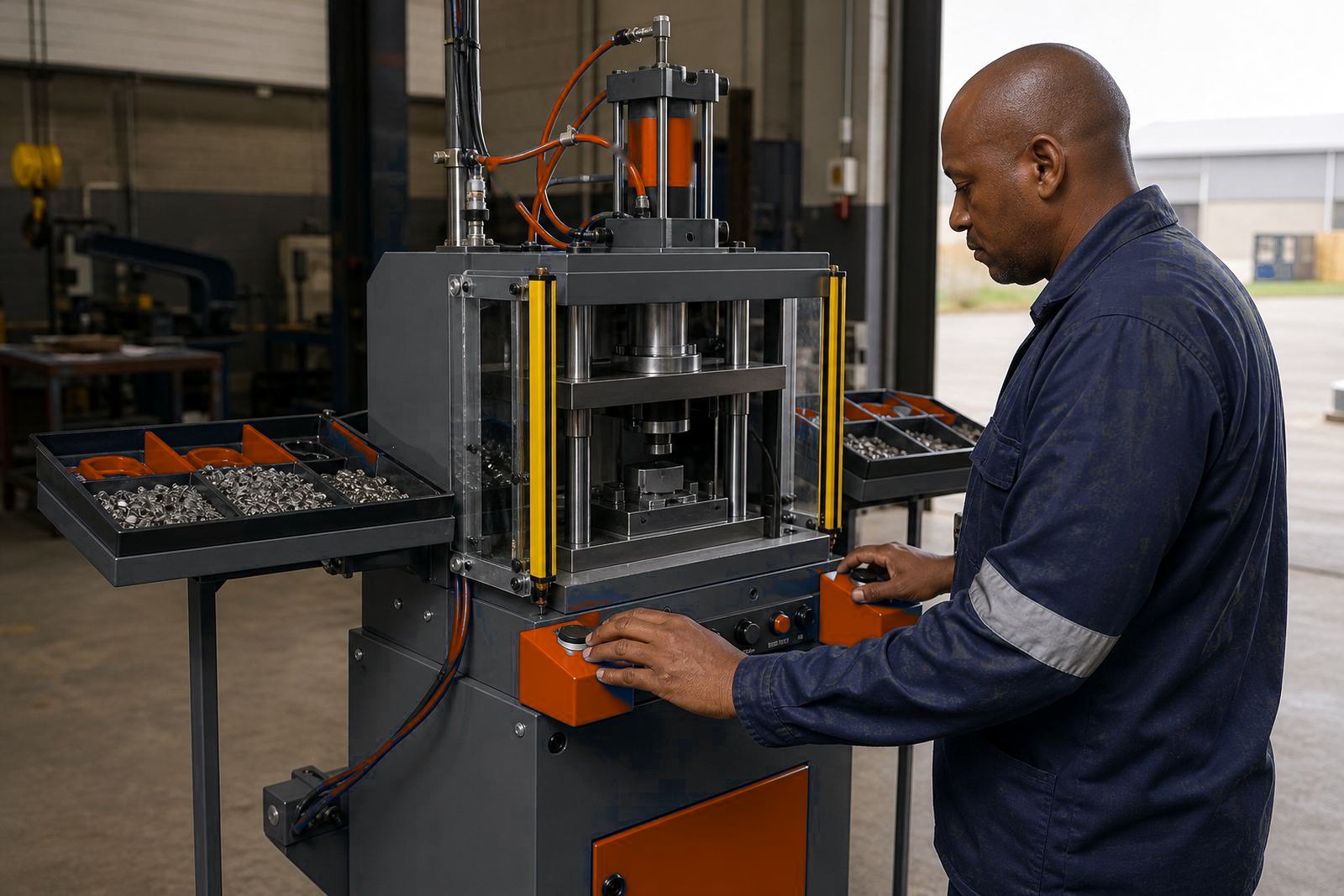
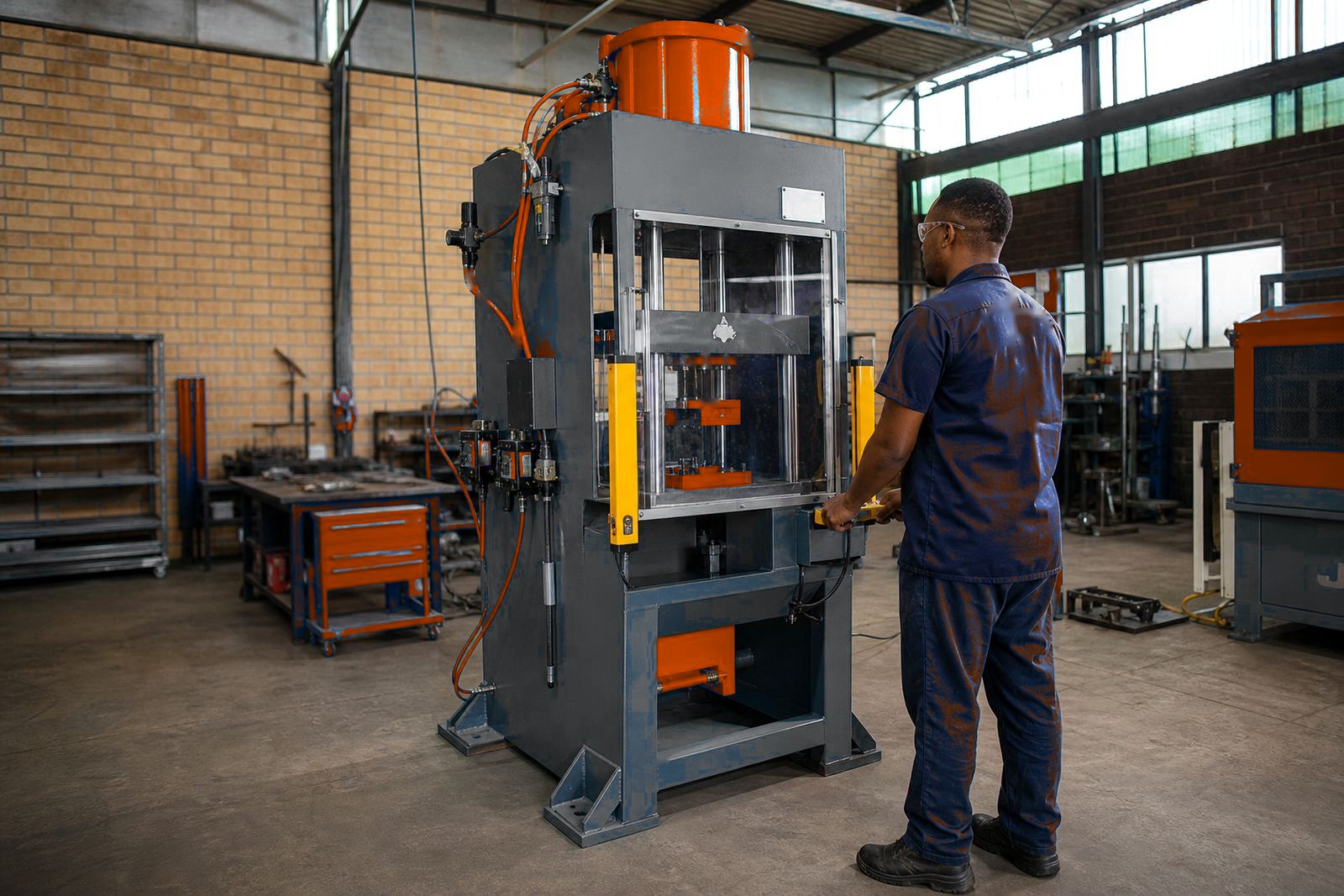
An angled tooling press can be built with two-hand controls, light curtains, guarding, local clamping and quick-change tooling depending on the job. For operators moving between pack sealing, staking and riveting, the tooling face and nest are designed to locate the part with very little hunting, which helps on lines running in Johannesburg, Pretoria and Durban where mixed batches are common.
We build in the hardware that supports the job rather than bolting on extras later. If the line needs a guarded front opening, an interlocked enclosure or a clear access window for loading, that is included in the layout from the start. Tool changes can be set up with locating dowels, repeatable stops and accessible fasteners so maintenance staff are not fighting the setup every time a tool is swapped.
- Two-hand controls for operator guarding and cycle control
- Light curtain integration where the access pattern needs it
- Guarding builds for open or enclosed stations
- Fixture design for repeatable part location
- Tooling changes with simple alignment and locking
Fitting the press into a real production line
Installation is usually driven by the job layout, the air supply and the floor space around the station. The press needs a stable base, a clean compressed-air line, and enough clearance for the angled head, the tooling sweep and the operator’s loading position. Where the press is being fitted into an existing assembly line, we work around the current conveyor, bench height and part feed method.
Site installation may include line setup, stroke setting, guard placement and commissioning of the full station. If the line uses a light curtain or two-hand control, these are checked against the physical layout so the operator has workable reach and a comfortable stance. On some jobs a slightly higher frame gives the better result, while on others a lower loading face works better. The press angle must match the part, not the other way round.
- Needs a stable mounting surface and compressed air supply
- Installed to suit bench height, operator reach and line flow
- Commissioning covers stroke, tooling contact and safety devices
- Can be fitted into a new line or an existing station
Materials, tooling and wear points
The press frame, head and guides are built to carry repeated cycles without the tooling wandering under load. Tool faces are made around the part feature, whether the job calls for a formed crimp, a rivet seat, a staking point or a sealed pack closure. For coastal sites near Durban or Gqeberha, corrosion control matters as much as force, so exposed parts and tooling surfaces need sensible material selection and routine care.
Wear usually shows up first in the tooling, the locating nest and the moving seals inside the pneumatic cylinder. If the part starts to sit differently, the stroke can land off centre and the result will follow the error. That is why the fixture, the tooling and the cylinder setting are treated as one system. A good station gives the operator very little room to place the part badly.
- Tooling made to the part feature and contact point
- Wear checks on seals, guides and locating faces
- Corrosion care matters in humid coastal plant areas
- Fixture and cylinder setting need to work together
Details to confirm before the press is built
Before a press is made, the team needs the part drawing, the material thickness, the operation type and the direction of approach. It also helps to know the required stroke, the expected air pressure range, the space available for the station and whether the loading is manual or assisted. If the job uses an existing line, a sample part and photos of the current setup make the tooling discussion more practical.
For angled stations, the angle itself is a key point. Too shallow and the tool may scrape or miss the feature. Too steep and the part can become awkward to load or clamp. The final layout should also note whether the press needs guarding, light curtains, two-hand controls or a changeover method for more than one product size. That way the build follows the part and the stroke it needs.
- Part drawing, sample piece and material thickness
- Operation type such as crimping, riveting or staking
- Stroke, air pressure and available installation space
- Safety devices and loading method for the station
- Changeover details if more than one size runs on the press
Key facts
| Product type | Angled tooling pneumatic press |
|---|---|
| Station layout | Single station or multi-station |
| Drive method | Compressed air cylinder |
| Typical operations | Assembly, crimping, riveting, staking, pack sealing |
| Control options | Two-hand controls, light curtains, guarding |
| Build scope | Custom tooling, fixture design, commissioning, operator training |