A taller press frame for heavier station work
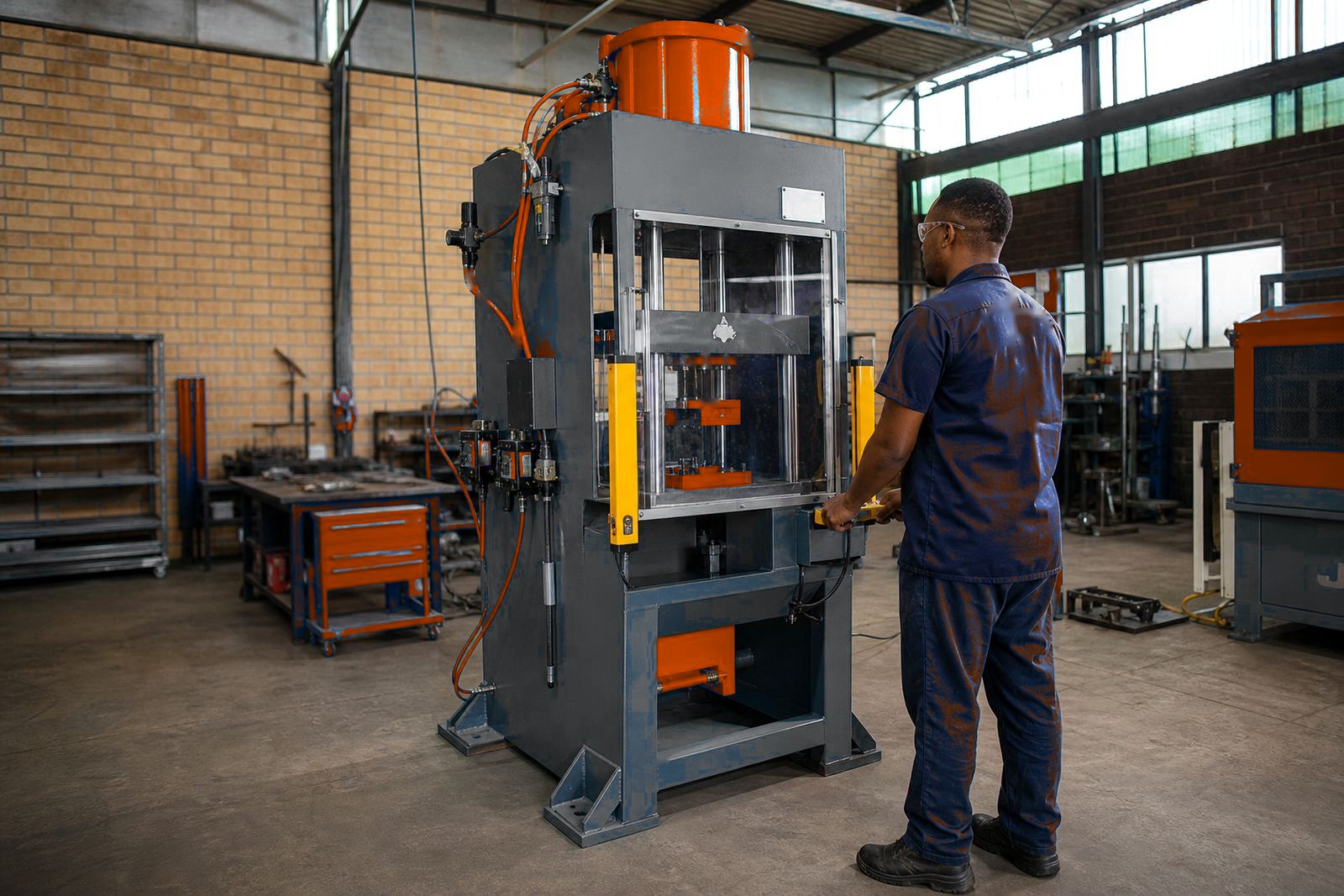
A floor standing press is built as a freestanding machine with the working head set above the floor on a rigid base frame. That layout gives more room around the tooling area and makes it easier to set up presses that need larger fixtures, deeper throat access or a higher, more natural working position for the operator. In a production line, that matters when parts are awkward to present by hand or when the tool set needs clearance for guides, nests and safety guarding.
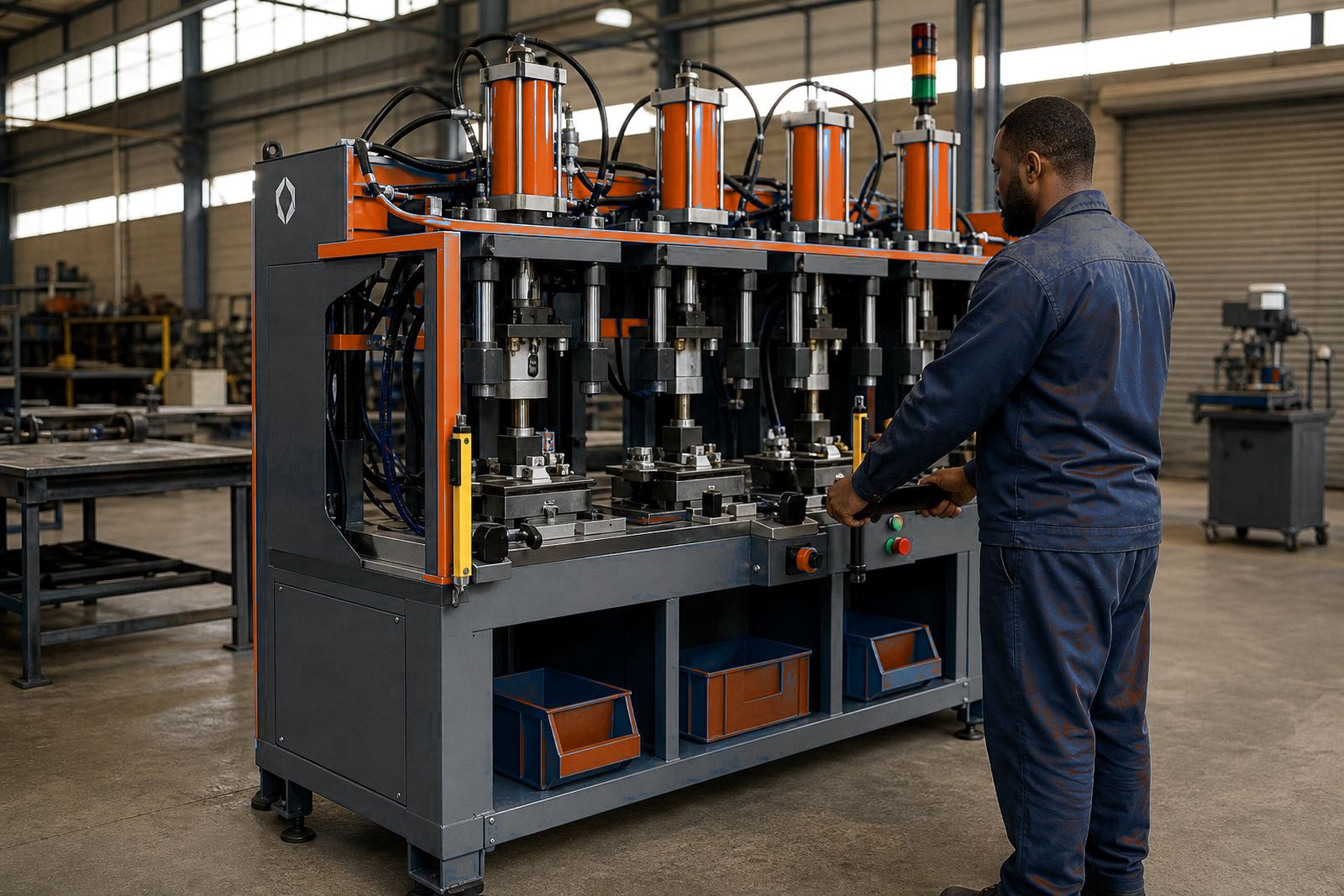
For assembly work the press can carry a single station or a multi-station arrangement, depending on how many operations need to happen in one cycle. Common jobs include crimping terminals, riveting components, staking plastic or metal features and pressing pack seals into position. The machine can be matched to the job with the cylinder size, stroke length, platen area and air pressure range chosen to suit the part and the tooling.
Station counts, cylinder sizes and working strokes
The floor standing format is often selected when a bench frame would be too small or too low for the job. Station count can range from a single working point to multiple stations set into one frame, with each station carrying its own tooling detail or shared fixture pattern. On a multi-station press the layout may use one main cylinder driving all stations, or separate cylinders where the process calls for independent control and more even force across the tooling face.
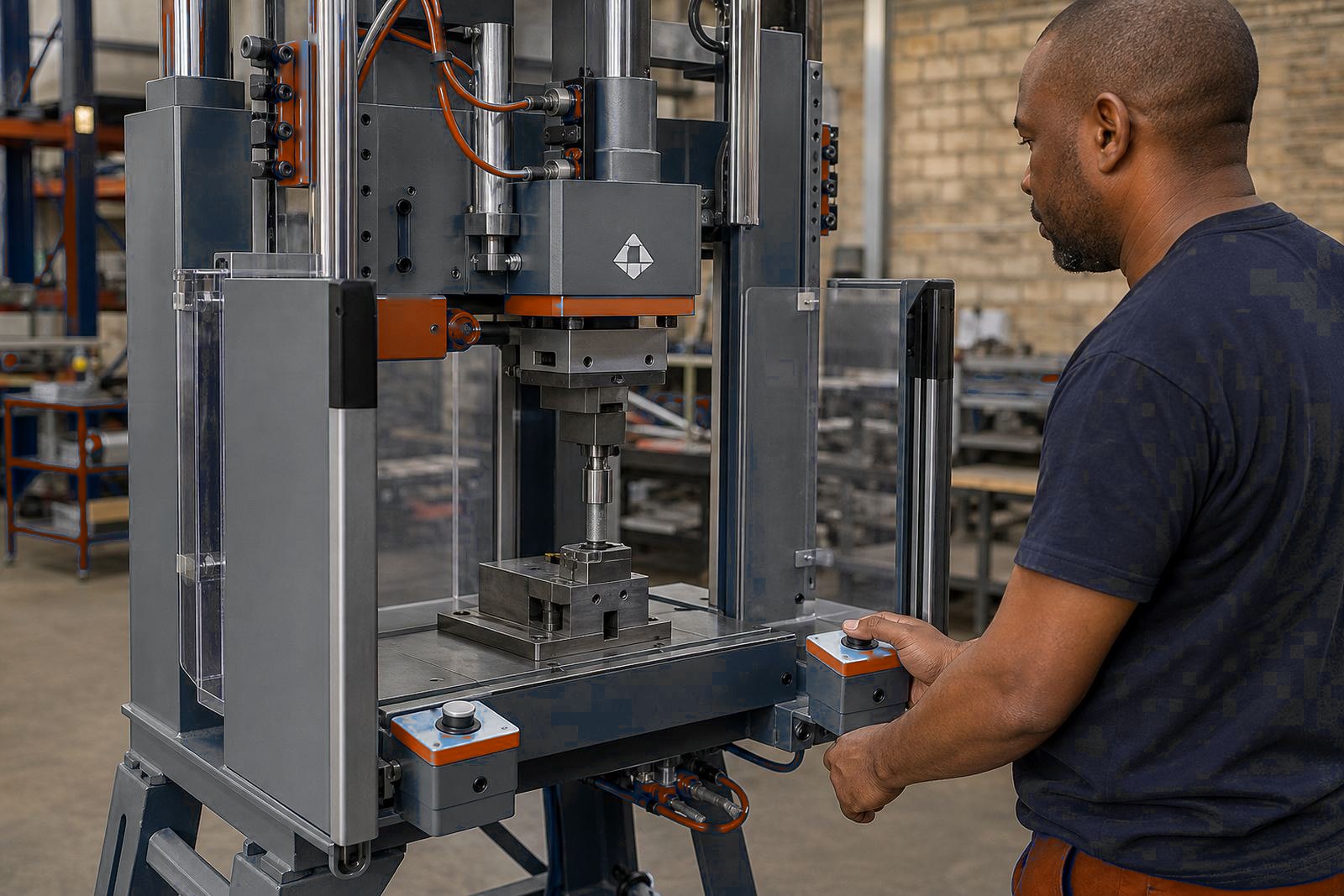
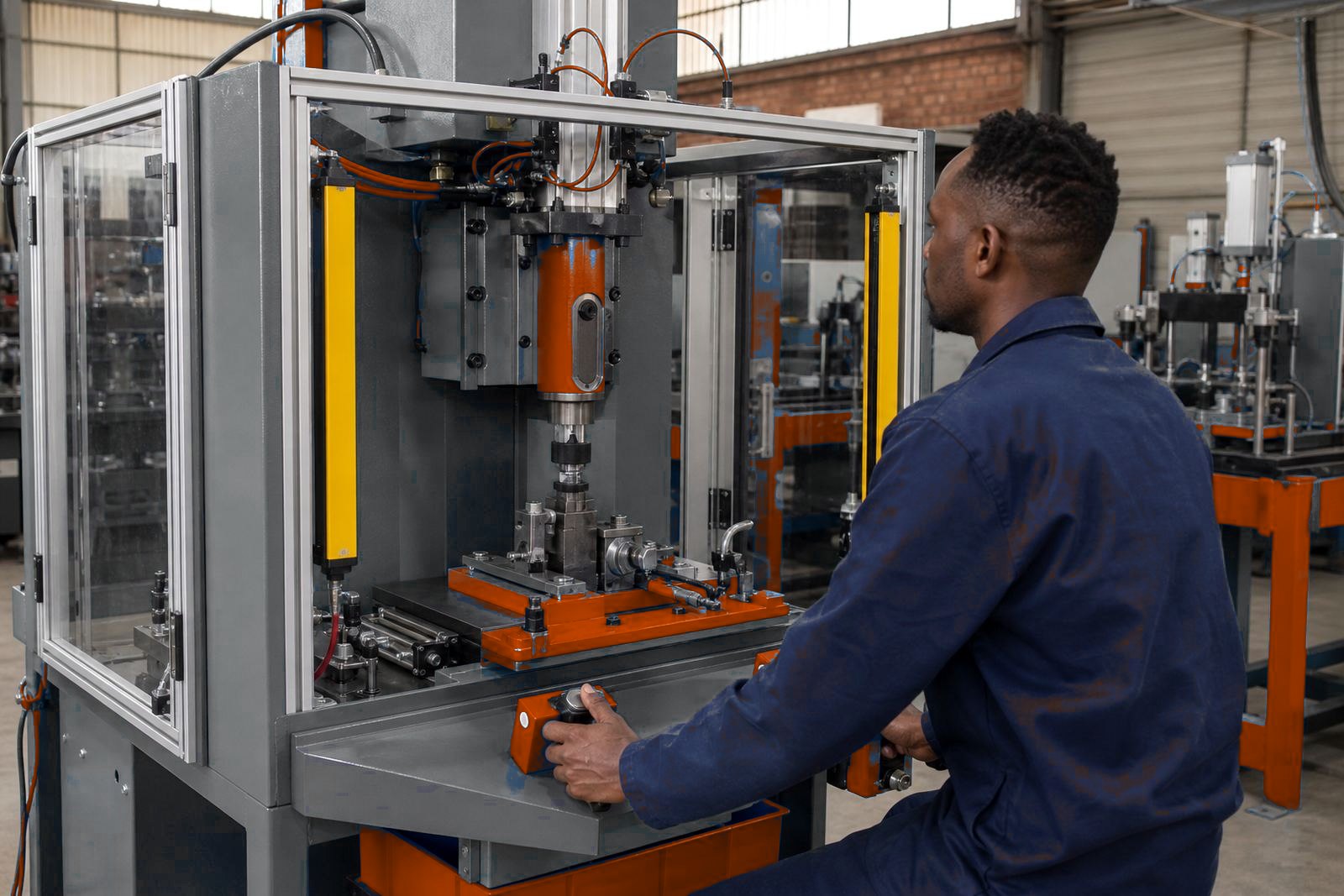
Typical build choices include a stroke set for short, accurate pressing or a longer stroke for deeper reach into a fixture. Air pressure is selected to suit the force required, and the final set-up must leave enough reserve for consistent cycle work without overloading the tooling. Two-hand controls are commonly fitted where the process needs both hands clear at the start of the cycle, and a light curtain may be added where access and guarding rules call for monitored entry at the front opening.
- Single or multi-station layout for one or several pressing actions
- Air cylinder sizing to match force, stroke and part resistance
- Short or extended stroke settings for shallow or deep tooling
- Two-hand control for safer cycle initiation
- Light curtain integration where the opening needs active protection
Where a floor standing press makes sense
This type of press suits factories that handle larger fixtures, deeper frames or parts that are easier to present at waist height rather than on a low bench. It is commonly used where the operator needs room to load a component, square it against a nest, then complete the press action without bending into an awkward position. In packaging lines it can also support seal fitting and pack closure work where the product size calls for a full standing station.
On South African factory floors the layout often needs to fit into an existing process line with a conveyor, loading table or hand transfer point feeding the press. A floor standing machine is useful where floor space is available and the process calls for a fixed unit that can stay aligned to nearby equipment. In Isando, Kempton Park, Boksburg and other industrial areas around Ekurhuleni, these presses are often placed where material flow is tight and the operator needs a clear front opening and proper guarding around the working face.
- Assembly lines with larger jigs or deeper frames
- Crimping and riveting jobs with repeated part positioning
- Staking operations on plastic or light metal components
- Pack sealing work where the product needs a standing press station
- Line sections that need a fixed machine height and stable footprint
Guarding, tooling and operator control on the press face
A floor standing press is only useful when the front end is built around the job properly. The tooling has to locate the part cleanly, hold it in the correct position and release it without scraping or trapping the component. Custom tooling can include nests, locators, clamps, dies and change parts built to the actual component shape so the part loads correctly, stays in position and releases cleanly.
Guarding may be built into the frame, with fixed panels, access doors or interlocked sections depending on the process. Where the operator needs to load by hand, two-hand controls can keep both hands away from the work zone during actuation. Light curtains are often added where the process needs open access but must still watch the entry line. For packing and sealing work, stroke setting is important because too much travel can mark the pack while too little travel leaves the seal incomplete.
- Custom tooling for crimping, riveting, staking and sealing jobs
- Fixed guarding or interlocked access where the process needs it
- Two-hand controls for controlled cycle initiation
- Light curtain options for monitored front access
- Stroke setting to protect the part and finish the cycle cleanly
Installation, air line setup and commissioning on site
Fitting a floor standing press usually starts with the floor position, anchor points and access around the machine. The base needs to sit level and the working face must align with the operator position and any infeed or outfeed point. Once the frame is in place, the air line setup must be sized for the cylinder demand and routed so it does not restrict access or create a trip issue across the work area. Clean, dry air is important on presses with cylinders and control valves, especially where coastal humidity or poor line drainage can affect repeat movement.
Commissioning includes checking the stroke, setting the force range, confirming the control logic and testing the guarding arrangement under normal operating conditions. Where the press forms part of a line, production handover should include tool change steps, basic fault checks and the correct loading sequence. MultiPress carries out site installation, press commissioning and operator training for factories in Johannesburg, Pretoria, Durban, Gqeberha and East London, with the machine set to the actual tooling and work cycle in use.
Care, checks and the details to confirm before ordering
Routine care is practical and straightforward. Keep the tooling face clean, check fasteners on the fixture, watch for air leaks at the line fittings and inspect the guarding for damage or loosened mounts. Cylinder seals, guide pins and moving parts should be checked during planned maintenance so the press does not drift out of setting or start to feel uneven under load. A floor standing press used on a busy line will stay more accurate if the tooling is cleaned at shift change and the stroke stop points are verified after changeovers.
Before ordering, the key details should cover the part size, required force, stroke length, station count, tool layout and the safety arrangement around the opening. It also helps to know whether the press will work as a standalone station or as part of a wider line with fixed loading points. Our contact form is the simplest way to send the job details for a proper review, including the factory location, the part drawing and any guarding needs that affect the final frame build.
- Part dimensions, weight and material
- Required force, cycle count and stroke length
- Single station or multi-station layout
- Tooling style, fixture height and changeover method
- Safety controls, guarding and light curtain needs
- Factory location and installation access
Key facts
| Frame type | Floor standing press on a rigid base frame |
|---|---|
| Working mode | Pneumatic cylinder driven |
| Station options | Single station or multi-station layouts |
| Control options | Two-hand controls and light curtain integration |
| Typical uses | Assembly, crimping, riveting, staking and pack sealing |
| Service scope | Custom tooling, installation, commissioning and operator training |