A four-point press line for a Boksburg assembly floor
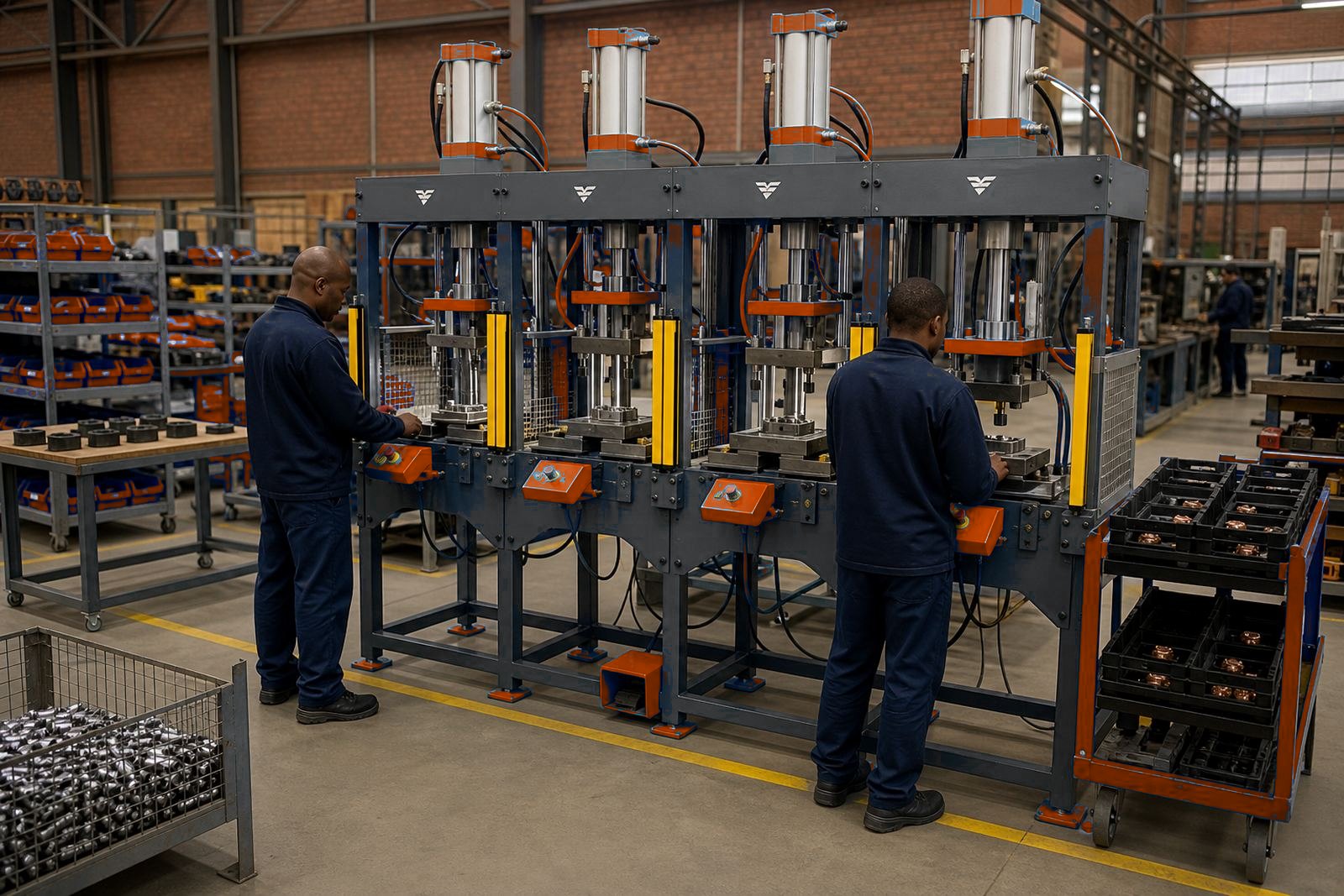
The job came from a Boksburg assembly plant running mixed component builds for local production and pack-out. The brief asked for a four-station pneumatic press that could hold parts cleanly, support controlled fitting, and give operators a clear way to check each step before the next station moved on.
Space around the line was tight, so the frame had to fit into an existing production run without pushing walkways out of place. The plant also wanted guarded access, simple station handover and tooling that would not need constant adjustment when shift changes swapped over.
- Four working stations arranged for sequential assembly
- Pneumatic cylinder drive with controlled stroke travel
- Two-hand controls for the main press cycle
- Guarding and light curtain protection at the operator face
- Tooling set up for fitting, locating and checking
How the brief was turned into a working press
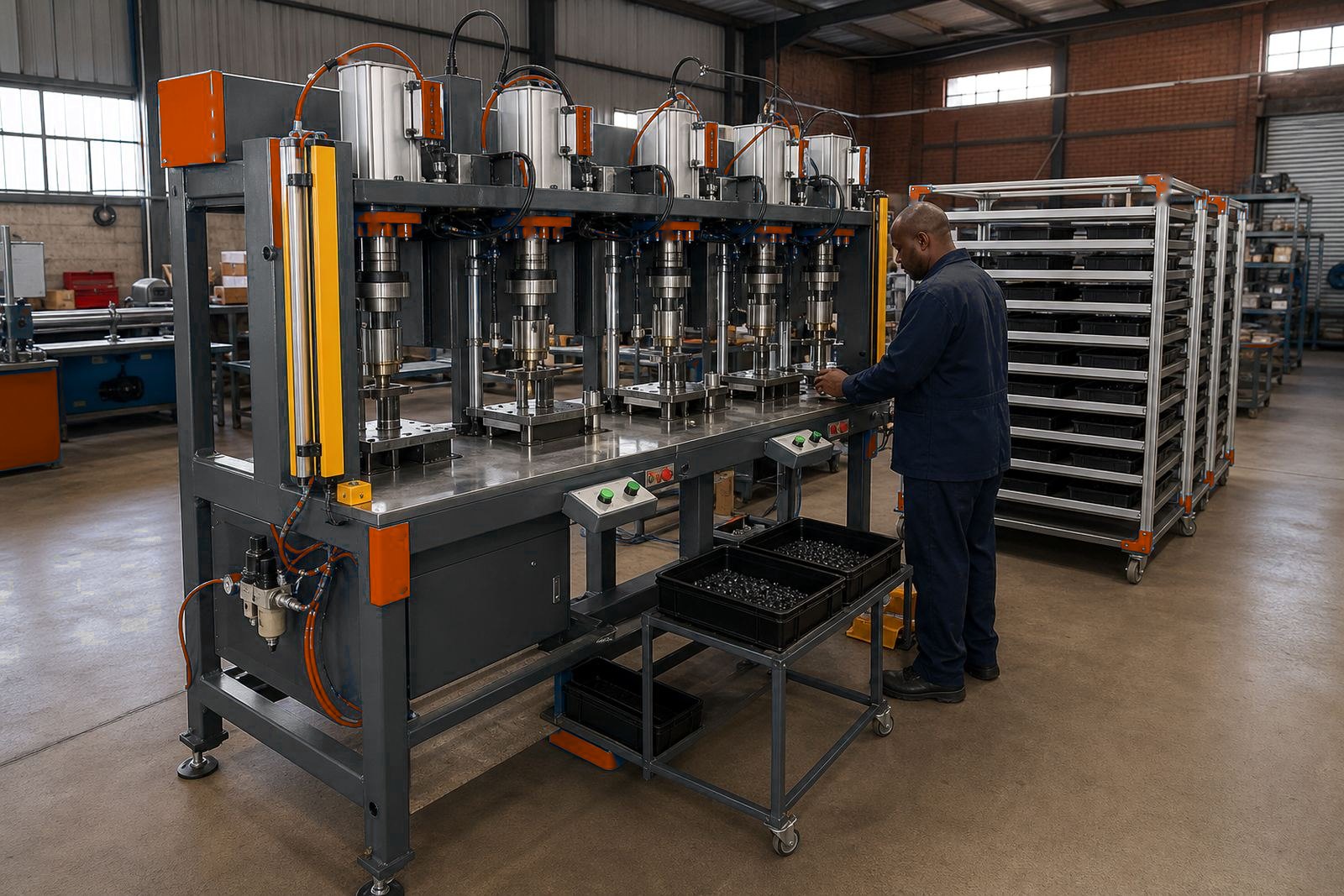
The press was built around a rigid frame with four stations set for stepped assembly work. Each station used pneumatic force for repeatable movement, with stroke setting matched to the parts so the tooling could land cleanly without over-travel. The layout let the operator place, align and press in one flow, then move the component to the next position for the next operation.
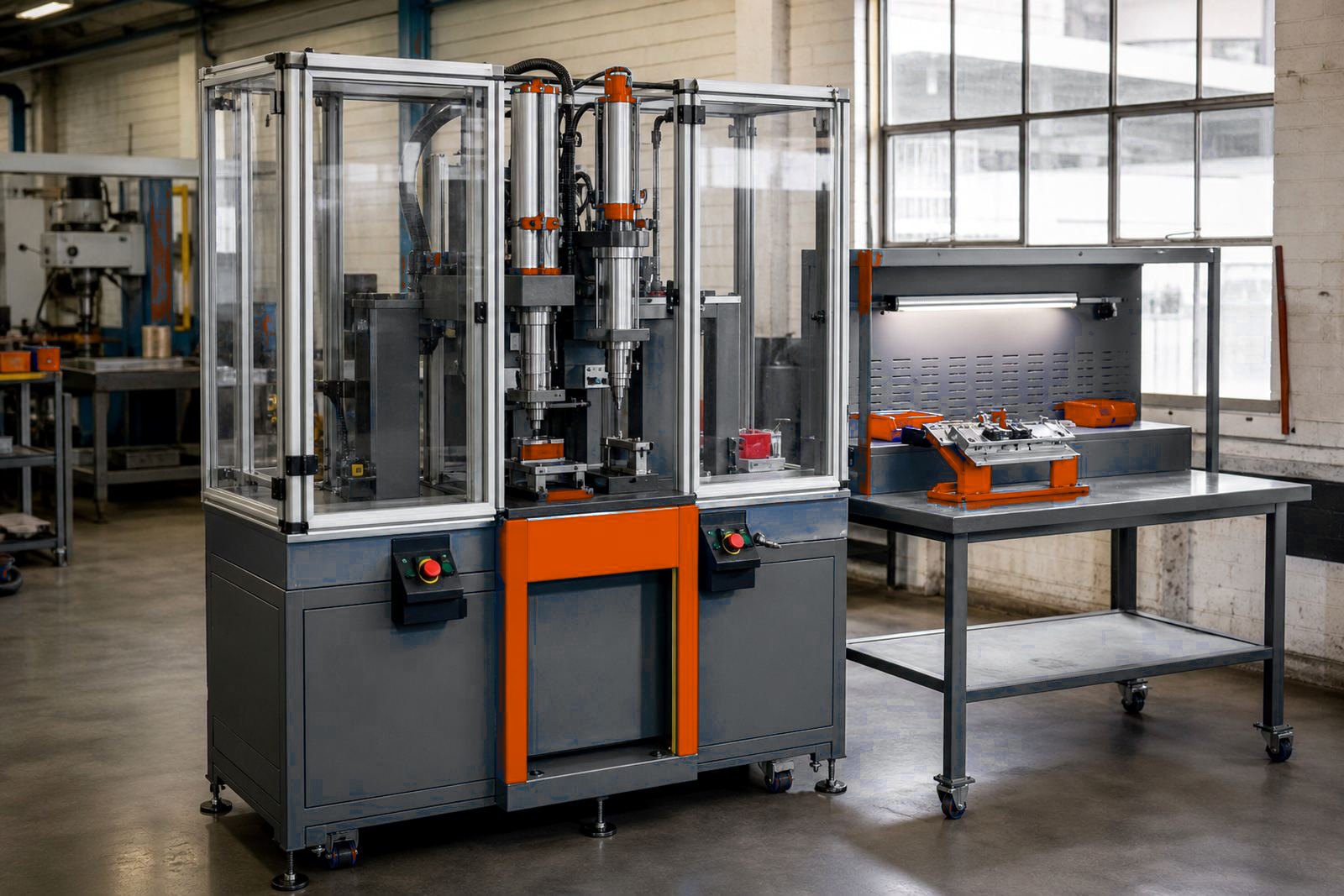
We designed the tooling to suit the parts rather than forcing the parts to suit the machine. That meant proper nest support, positive location and enough clearance for a smooth load and release cycle. For a plant handling repeated assembly work, the value sits in the way the press behaves from one shift to the next, not just in the steel around it.
- Custom tooling to match the component stack-up
- Station sequence planned for assembly and checking
- Stroke set to suit the job and avoid extra travel
- Air line setup arranged for stable cylinder operation
- Tool change access kept practical for the workshop team
Guarding, controls and the operator side of the line
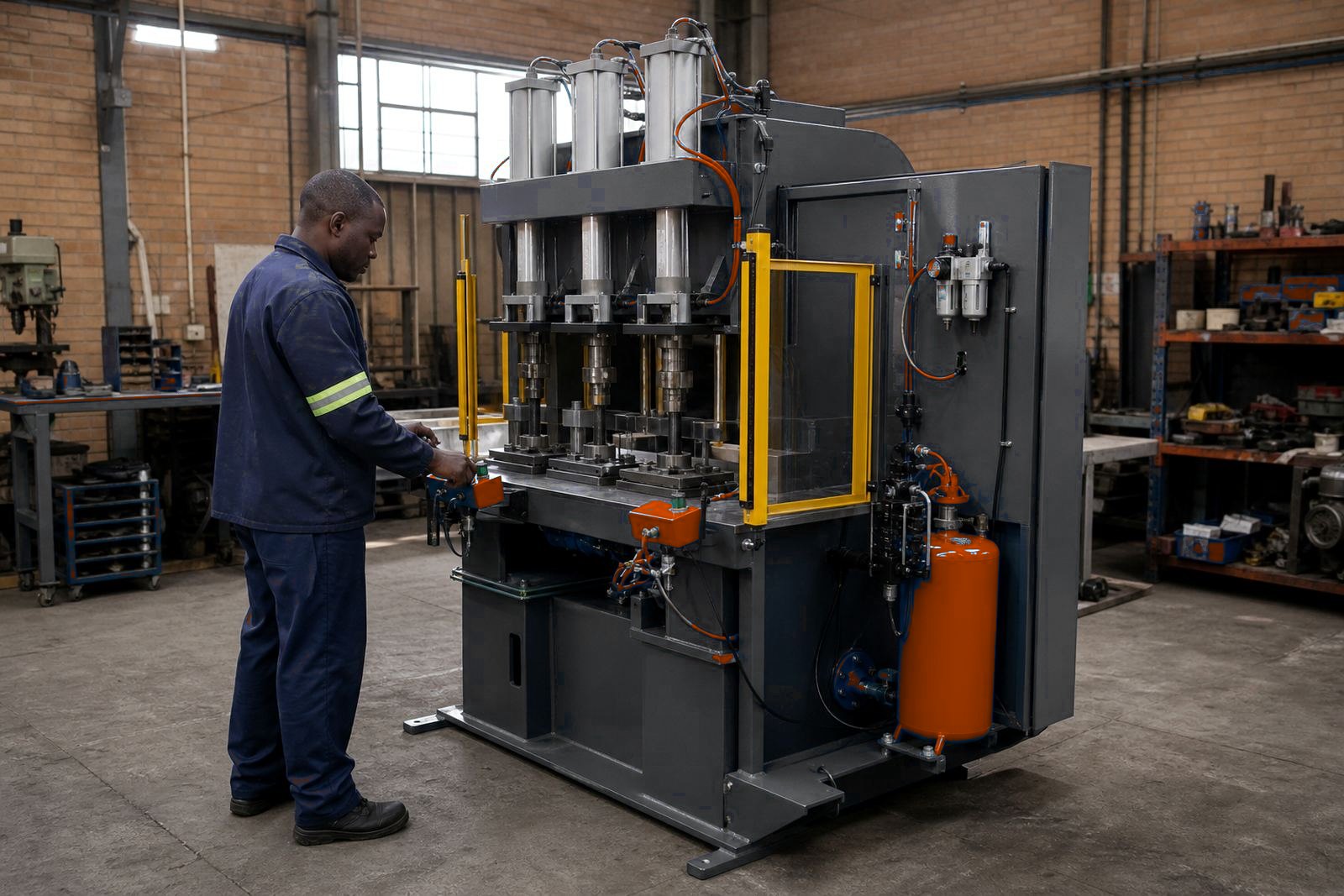
Safety control was part of the build from the start. The main cycle used two-hand controls so the press could not run with one free hand in the working area, and the guarded zone was arranged to suit the reach of the operator and the size of the parts. Light curtains were added where access and visibility had to work together, especially at the point where the component entered and left the press area.
The plant wanted a line that could be trained on the line without making the setup feel oversimplified. We covered the press sequence, safe loading, station checks and the fault conditions that matter on a real floor. The result was a line that stayed practical for day shift and night shift, with consistent tooling position and cycle control.
- Two-hand controls fitted at the operator position
- Light curtain integration for access protection
- Guarding built around the actual working envelope
- Operator training focused on safe cycle use
Installation work carried through in stages
The job took five weeks, starting with final drawings and ending at handover. The first stage covered measurements, station layout and tooling checks. After that, the frame, cylinders and control set were prepared in the workshop, then the team moved into site installation, air line connection and stroke setting once the machine reached Boksburg.
Commissioning took place on site with the plant team present, so adjustments could be made against the real components and the normal production sequence. That included checking press travel, confirming the station order, tuning the tooling and testing the safety devices under working conditions. The line was then handed over with the operators trained on the sequence, the safety controls and the routine checks that keep the job steady.
- Week 1: we measure the site and review the job
- Week 2 and 3: frame, tooling and control build
- Week 4: delivery, installation and air connection
- Week 5: commissioning, testing and operator handover
What changed once the press was running
The Boksburg plant wanted better control over stepped fitting and checking, and the new press gave the team that control in a single line. With the stations set properly, the component could be located, pressed and checked without unnecessary handling. That reduced the amount of movement between separate benches and gave the floor a more direct production path.
Because the tooling was built for the parts in question, the operators had clearer registration points and fewer awkward adjustments during the shift. The line also suited pack sealing and adjacent assembly tasks where a clean, repeatable stroke matters more than brute force. In a factory like this, consistency matters a lot more than drama.
- Cleaner part location between stations
- Less handling between separate benches
- More repeatable press movement across shifts
- Clearer checks at each assembly step
What we would put into a similar job
On a similar project, we would keep the same order: measure the station flow first, lock the tooling around the actual part stack-up, and bring guarding into the drawing before fabrication starts. That keeps the machine, the safety devices and the operator path aligned from the start, which matters when the line has to fit inside an existing plant with fixed space and fixed traffic around it.
We would also keep the training tied to the machine that goes into the factory and to the station sequence the team will run every day. The plant sees the exact stroke, the exact station order and the exact control positions it will use in daily work. That saves confusion later and leaves the workshop team with a press that feels built for the task, not adapted after the fact.
Key facts
| Project | Boksburg Assembly Plant |
|---|---|
| Machine type | Four-station pneumatic assembly press |
| Primary operations | Stepped fitting and checking |
| Controls | Two-hand controls with light curtain protection |
| Functions | Assembly, crimping, riveting, staking and pack sealing |
| Timeline | 5 weeks from review to handover |