A closure line built for a Durban production floor
The project came from a Durban factory making closure assemblies for packaged goods. The line had to support repeat pressing work across several closure variants, with a stable setup for crimping, riveting, staking and final pack sealing. The team wanted one line that could be guarded, controlled and handed over for daily use without a lot of guesswork at the machine.
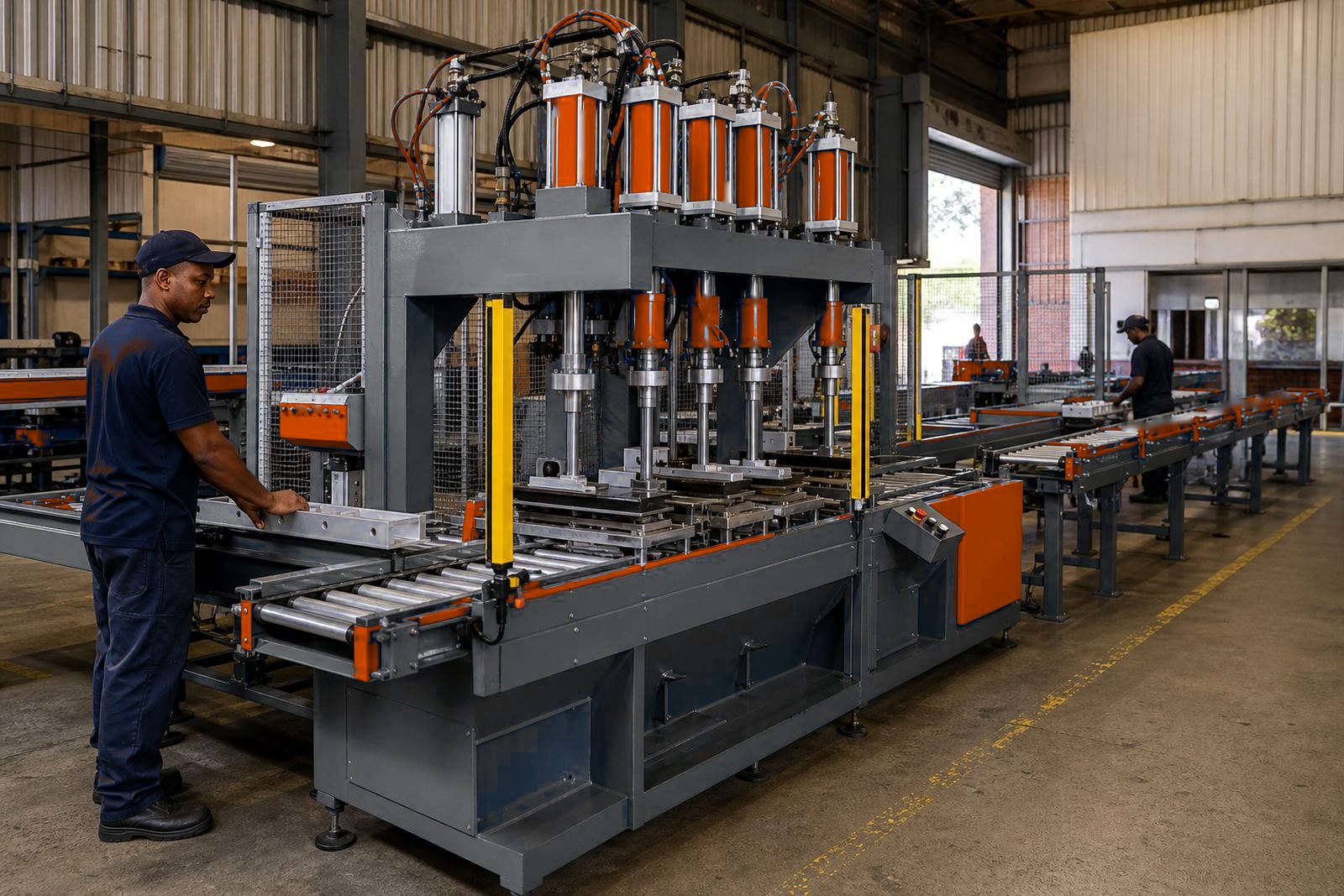
The factory floor had limited space, so the equipment had to fit into a straight working run and leave enough room for loading, inspection and pack removal. Durban’s coastal humidity had to be factored into the press setup. Tooling surfaces, fixings and guards had to be arranged so the line stayed easy to clean and did not trap waste around the press area.
We mapped the station order first, then matched each press station to the task it would do. Some stations needed a shorter stroke for quick closure work, while others needed a more deliberate press movement for controlled forming. The final arrangement kept the operator facing the same work flow through the line, which reduced handling steps and made the process easier to repeat.
The brief, set out in working terms
The factory needed a pressing line that could do the following without overcomplicating the setup:
- Press closures in repeatable station sequence
- Handle crimping, riveting, staking and pack sealing
- Use guarded operation with two-hand controls at the press points
- Allow for tooling changes without upsetting the full line layout
- Keep the working area clear for inspection and pack transfer
The brief also asked for tooling that could be adjusted as product sizes changed. That meant setting the station heights, stroke lengths and air pressure ranges with enough room for changeover, but not so much slack that the parts moved around in the tooling. We kept the station layout compact and practical, with each press doing one job cleanly before the part moved on.
Because the line was going into a coastal plant, guarding and cable routing had to stay out of the way of daily cleaning. The client did not want loose fixes or awkward corners where dust and moisture could collect. That shaped the frame details, guard position and the way the air lines were brought into the line.
How the press stations were arranged
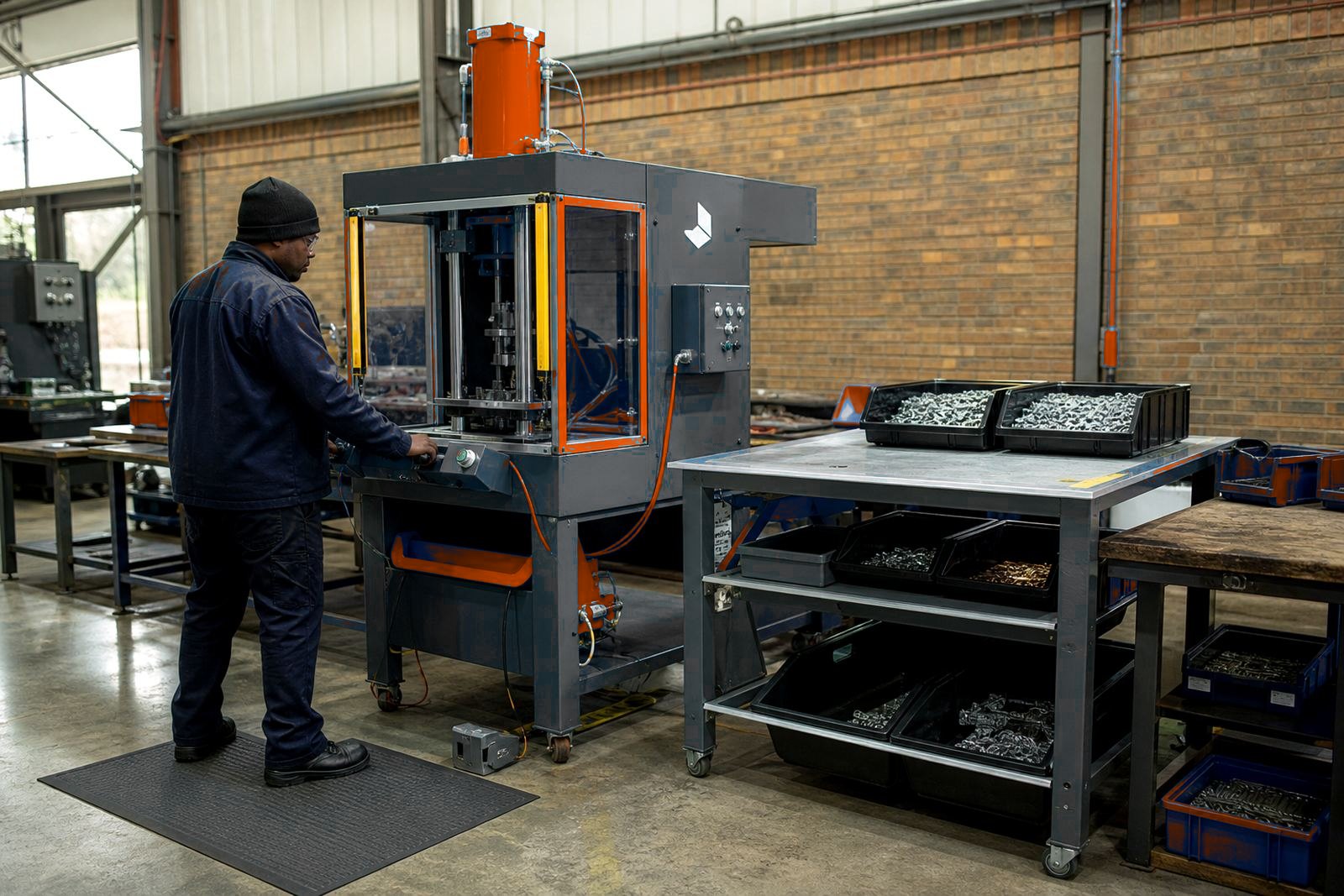
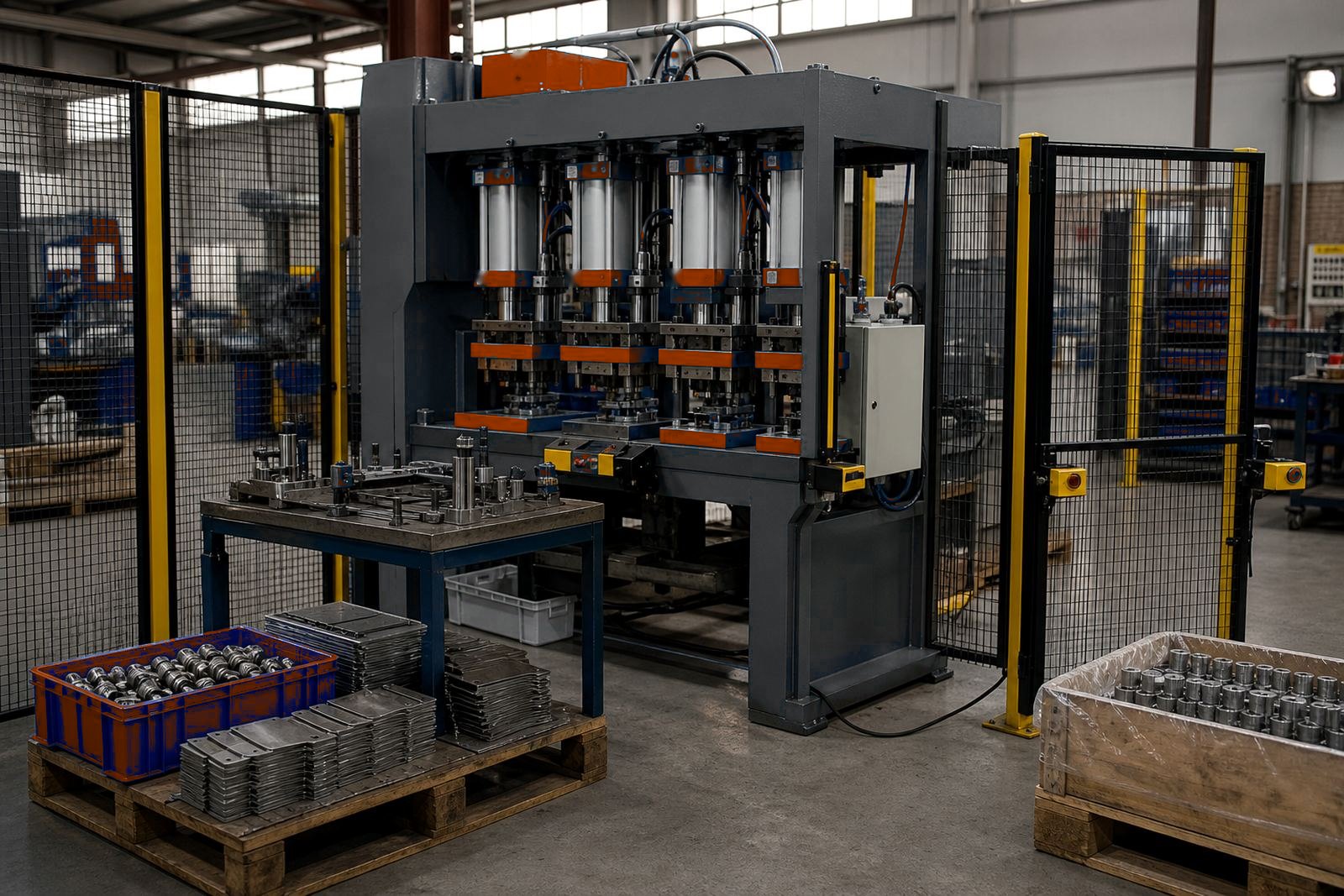
The line used multiple pneumatic stations arranged for steady flow rather than bulk movement. Each station was matched to a specific operation, with air cylinders sized to suit the job and stroke setting adjusted for the part being pressed. The setup allowed the operator to move the workpiece through the line in a clear order, from loading to final seal.
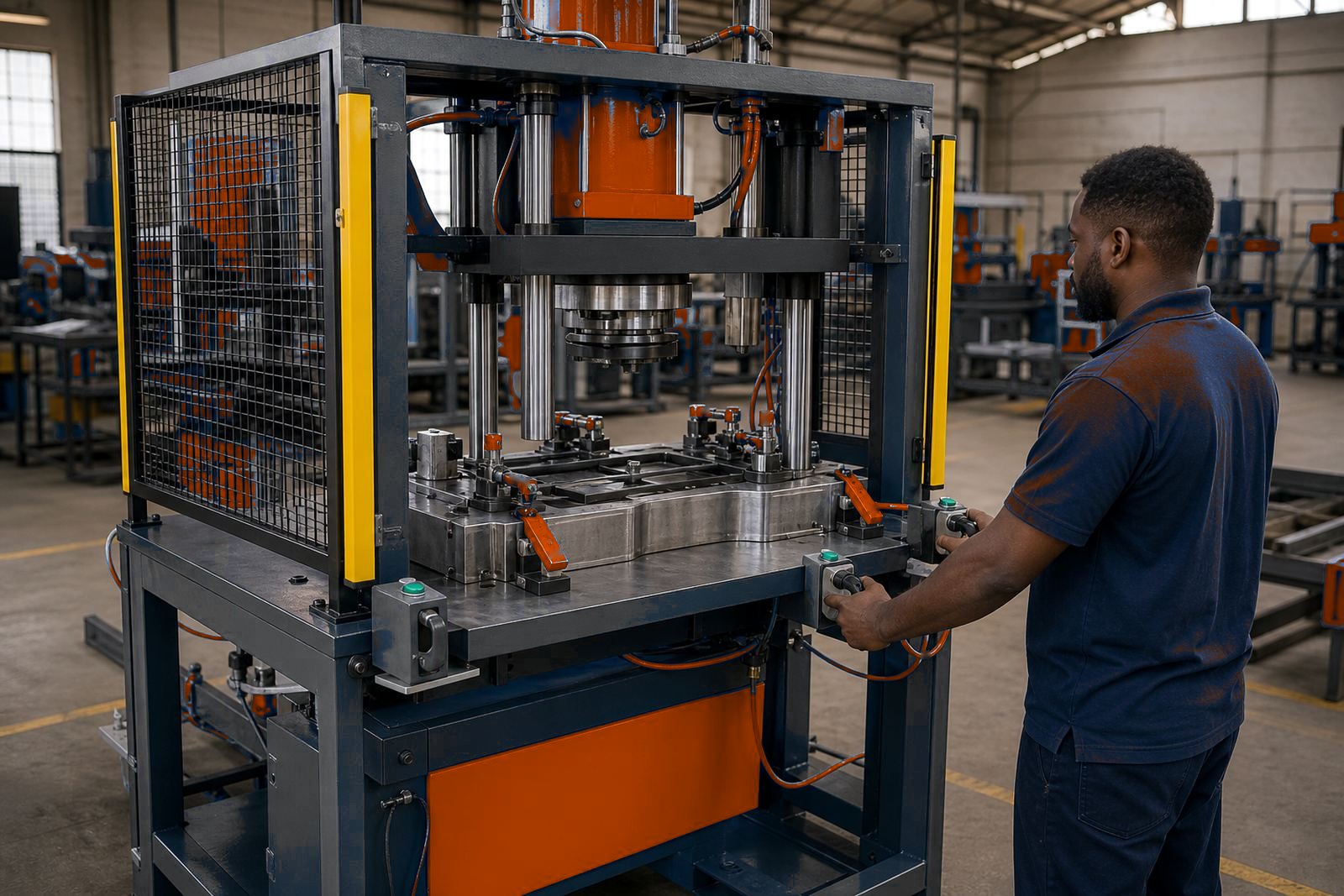
Two-hand controls were used on the press points where the operator needed a safe start condition. Light curtain protection was added where access around the working zone needed extra control. That gave the factory a guarded setup that suited repeated production and reduced the chance of hands entering the press area during operation.
- Multi-station pneumatic press layout
- Controlled stroke setting for each operation
- Two-hand controls at the active stations
- Light curtain integration at access points
- Custom tooling for closure, rivet and seal work
We also kept the tooling change points practical. If a closure size changed, the team could swap inserts and reset the station rather than disturb the whole line. That matters on a floor where packs do not always arrive in neat, steady batches and where production has to keep moving with the least amount of rework.
Guarding, air lines and the workshop build
Most of the build was done in our Isando workshop, where the frame sections, guards and tooling were prepared before site installation. The guarding was designed around the press motions and the loading points, not fitted as an afterthought. That kept visibility decent while still separating the operator from the moving parts.
The air line setup was laid out to feed the stations evenly, with attention to pressure stability across the line. Pneumatic presses depend on consistent supply and clean routing, especially when the same machine must perform more than one closure task in a shift. The stroke setting and cylinder action were checked station by station during setup, then set against the product sample supplied by the factory.
- Workshop fabrication of frame and guard sections
- Air line setup matched to station demand
- Stroke setting checked per closure type
- Tooling mounted for repeat alignment
- Site installation planned around floor access
The site itself needed careful placement because production space was already in use. We worked the line into the available area without blocking the walkways or the pack handling route. Once the equipment was in place, the guard opening points and control positions were tested against the way the operators actually loaded parts.
Commissioning across five working weeks
Commissioning was carried out over five weeks from layout checks through to production handover. The first stage focused on alignment, air feed checks and station sequencing. The second stage was about press behaviour under load, where we adjusted tooling pressure, stroke and timing until each closure action settled into a reliable pattern.
After that, we spent time on operator training and routine changeover. The team needed to understand what each station should feel like in normal running, how to identify a poor press set, and when to stop for a tooling check instead of forcing the cycle. That part matters on a guarded line, because the controls only do their job when the people using them know the sequence properly.
The final stage was production handover. We ran sample closures through the line, checked the press marks, watched the repeatability of the rivet and stake positions, then reviewed the cleaning and changeover routine with the factory team. By the end of commissioning, the line was set for regular use and the working notes were handed over in practical form.
Results on the floor in Durban
The finished line gave the factory a controlled way to process closures in repeatable batches, with guarded operation and a clearer loading pattern. It reduced the number of loose manual steps around the press work and made the station flow easier to manage during normal production.
The client also had a setup that suited coastal conditions better than a bare, open press arrangement. The guarding, tooling layout and air routing were all planned for daily use in a humid environment, where dirt and moisture can make a fast job turn messy if the layout is careless.
- Cleaner repeat production across the closure stations
- More consistent press action after stroke setting
- Safer loading with two-hand controls and light curtains
- Better handover for the factory team
- Less disruption during product changeover
If we were briefed on a comparable Durban line, we would keep the station count compact and make tooling change points easy to reach. That suits a real plant, where floor space is limited and the work must remain steady from one shift to the next.
Key facts
| Project | Durban Closure Line |
|---|---|
| Client type | Coastal factory producing closure assemblies |
| Location | Durban, KwaZulu-Natal |
| Line type | Multi-station pneumatic press line |
| Main operations | Assembly, crimping, riveting, staking, pack sealing |
| Commissioning period | 5 weeks |