What the Gqeberha line needed to do
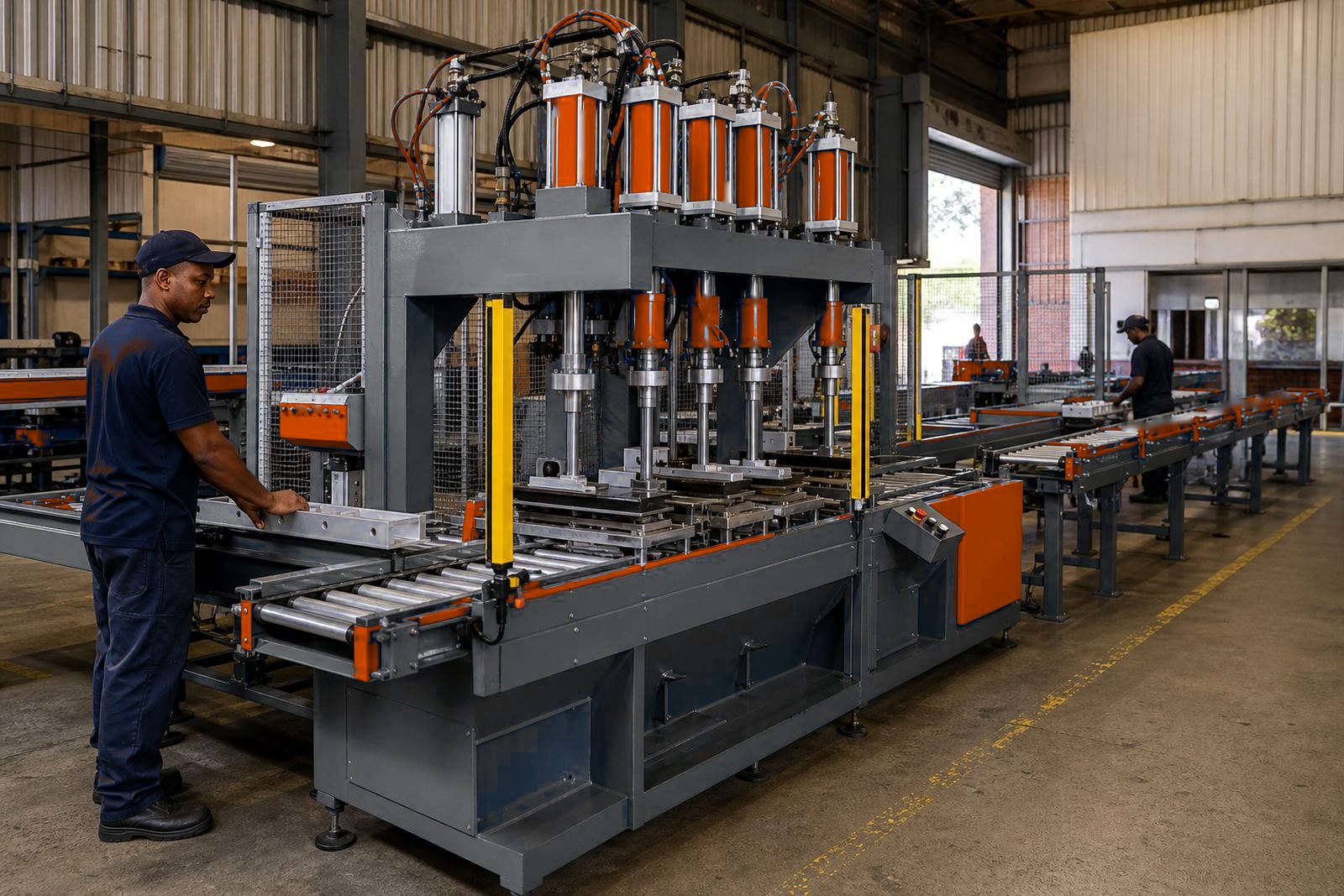
The client was a light industrial manufacturer in Gqeberha working through a repeating fastening process on parts that had to stay square while each rivet was set. Their team wanted one press station for loading, one for riveting and one for discharge, with the movement between stations staying orderly and easy to supervise.
The brief called for a pneumatic press with consistent air driven force, controlled stroke depth and enough room for tool access without crowding the operator. We also had to keep the process tidy for batch work, because the line handled the same part family across long shifts and small handling errors would show up quickly in the finished assembly.
- Repeat riveting on a fixed part family
- Stable clamping and accurate placement
- Clear operator movement between stations
- Safe access around the tooling face
The press package we built around the job
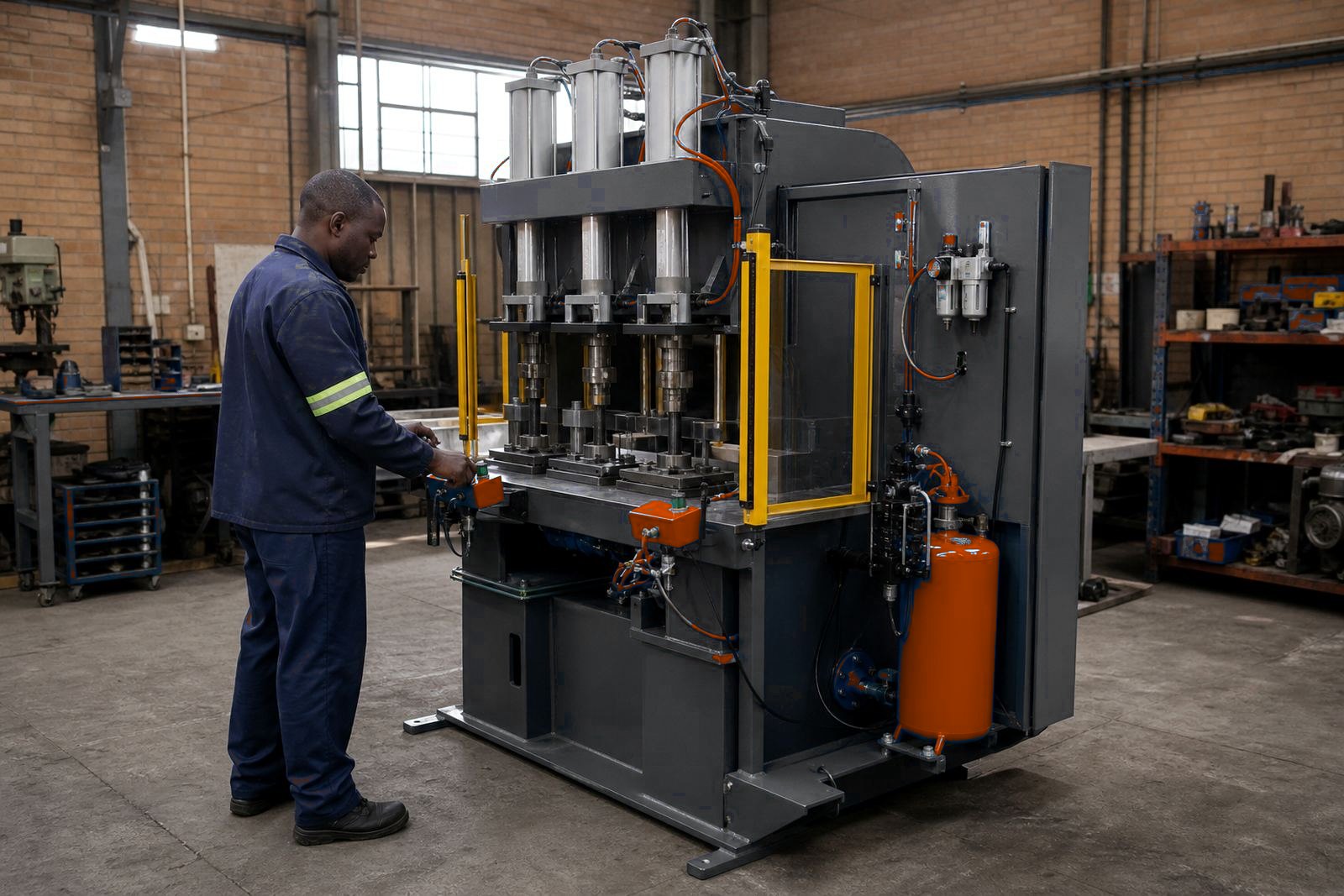
We supplied a three station pneumatic press arrangement with guided cylinders, fixed tooling nests and adjustable stroke setting for the rivet stack height. The press frame was set up for controlled downward travel, and the tooling was shaped to support the workpiece without marking the visible surfaces.
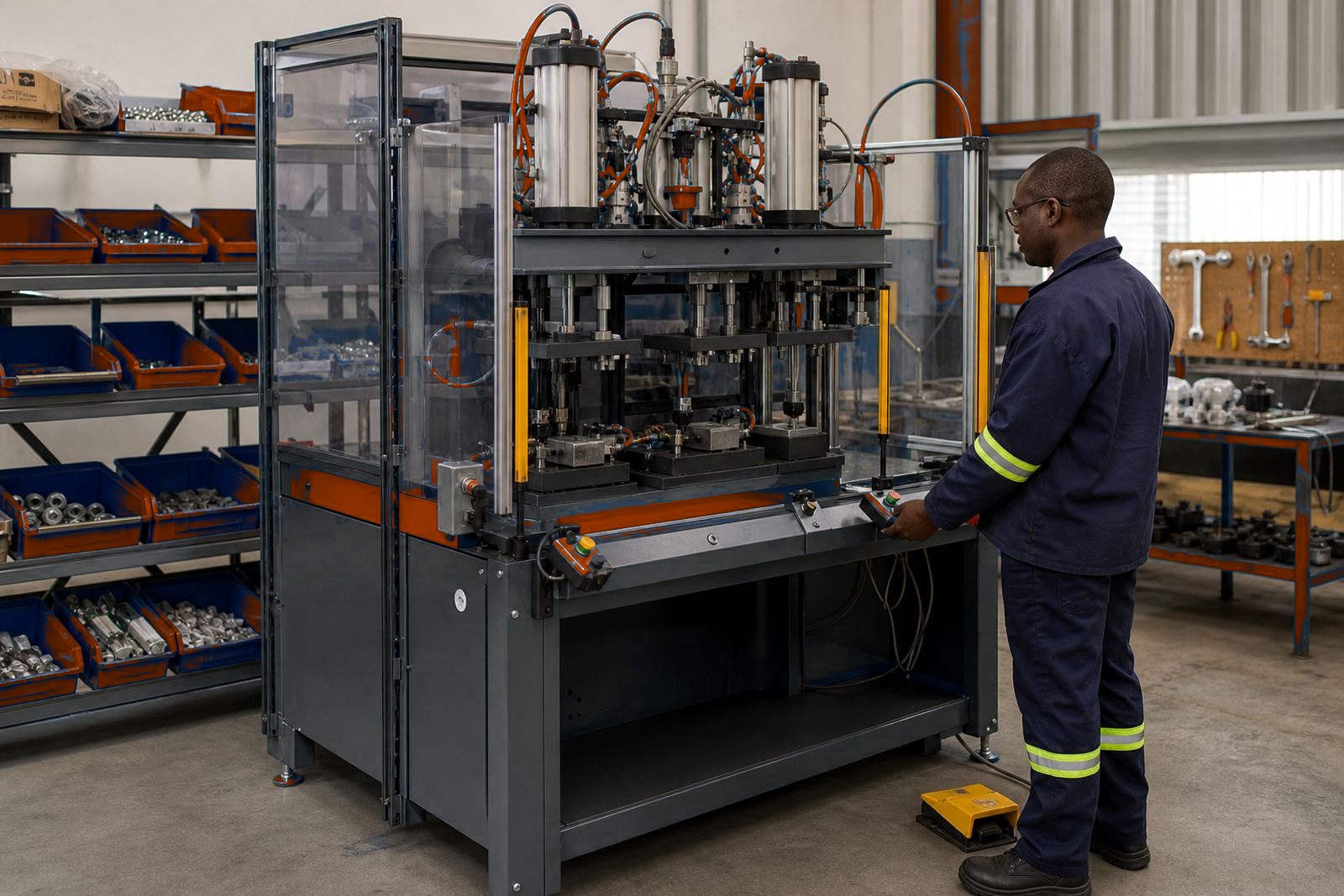
Two hand controls were used at the point of operation, with light curtain protection fitted around the working zone where the access opening needed to stay open for loading. That mix gave the team a clear operating sequence and reduced hand exposure near the tooling face during each cycle.
- Three station layout for load, rivet and offload
- Guided pneumatic cylinders with repeatable travel
- Stroke setting matched to the fastening stack
- Two hand controls for cycle initiation
- Light curtain integration at the working zone
Tooling, guarding and air setup on site
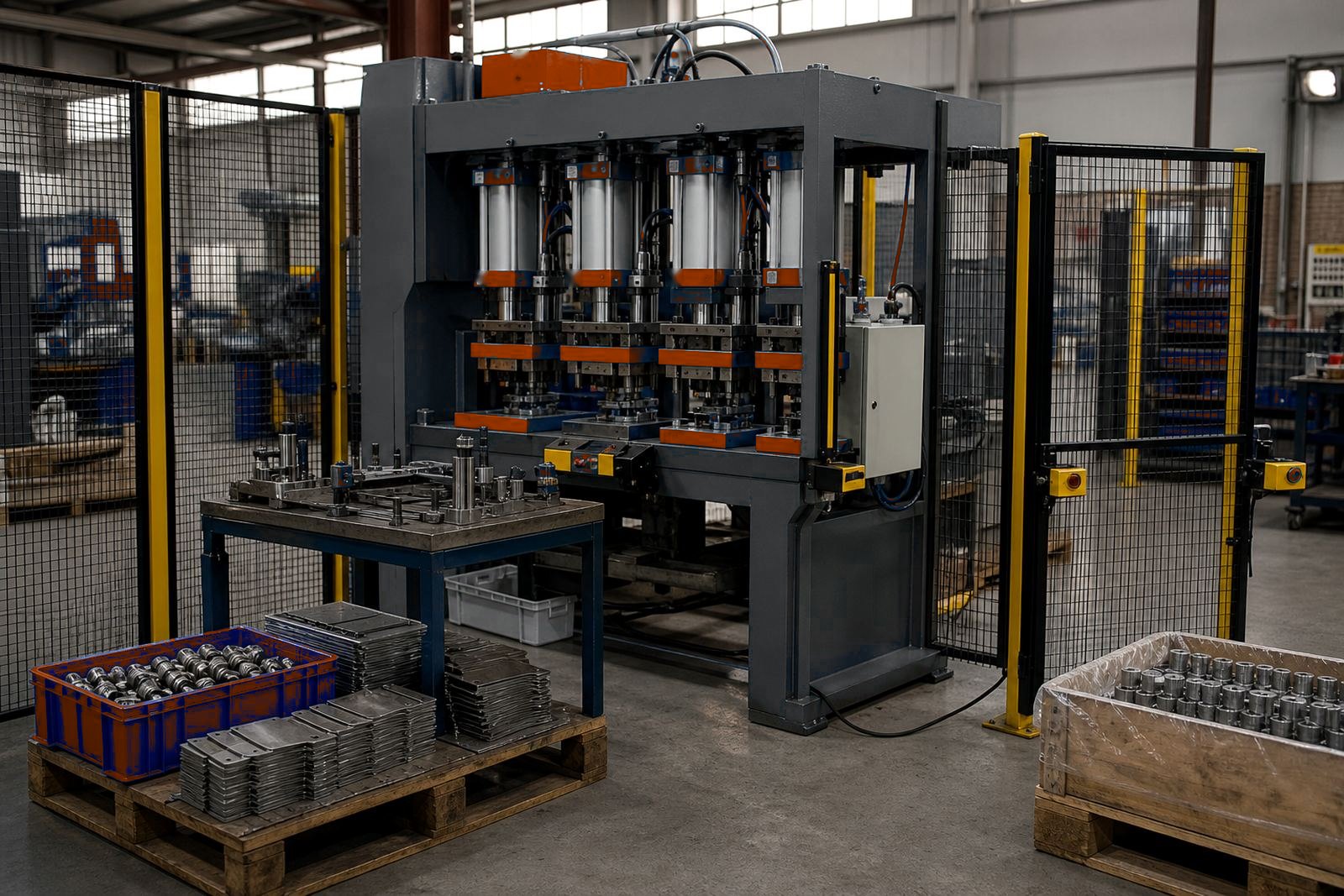
Musa Hartnick designed the tooling around the part geometry and the rivet positions, then Johan Ramokgopa and the workshop team built the fixtures to suit the press table and station spacing. The guarding was arranged so the operator could still place parts neatly, but not reach into the cycle area with the press live.
Air line setup formed a larger part of the job than some teams expect. In a pneumatic press, pressure stability matters because a drop in supply changes the feel of the stroke and can affect rivet setting. We set the line work to suit the machine layout, checked the regulator range and confirmed the cylinder movement under working pressure before the line was signed over.
- Custom tooling for the rivet positions
- Fixture design matched to the part profile
- Guarding build around the operator opening
- Air line setup with pressure checks
- Stroke setting verified under working conditions
Commissioning and operator training in the same visit
Lerato Moagi carried out commissioning on the press and checked that the cycle sequence, station timing and safety devices worked together. The machine was tested through loading, cycle start, ejection and part removal so the team could see the handover points in real use rather than only on paper.
Anele Engelbrecht then led the operator training, focusing on tool change steps, safe hand position, checking the rivet seat and keeping the part location consistent from shift to shift. The training was practical and direct, because the operators needed to work the line without guessing at the sequence or adjusting the process by feel alone.
- Commissioning covered cycle sequence and safety checks
- Operators were shown the full loading pattern
- Tool changes were explained at the press face
- Part seating checks were built into the routine
Timeline on the floor in Gqeberha
The project ran across four weeks from the first technical review to final production handover. Week one was used for measurements, part review and tooling layout. Week two covered design work and workshop fabrication. Week three handled assembly, guarding fitment and functional checks. Week four was spent on site installation, commissioning and training.
That schedule suited the client because their line had to keep moving while the new press was integrated. It also gave enough time to tune the stroke and tool contact before production started to build up around the machine.
- Week 1: review, measurements and layout
- Week 2: tooling design and fabrication
- Week 3: assembly and internal testing
- Week 4: site install, commissioning and training
What changed once the line was running
After handover, the team had a clearer riveting routine and less variation between operators. The fixed station layout reduced part handling uncertainty, while the two hand controls and light curtain arrangement made the cycle easier to manage during busy production periods.
The client also gained a better platform for future tooling changes. Because the press table, guarding and cylinder travel were set up with the next production step in mind, the line could take small adjustment work without needing a full rebuild each time the part family changed.
- More consistent rivet setting across shifts
- Cleaner handling between loading and discharge
- Safer cycle control at the press face
- Better base for later tooling changes
What we kept in place for the next fastening line
On a similar riveting job, we would keep the same sequence of work: measure the part first, set the stroke second, and prove the guarding before production begins. That sequence keeps the mechanical side and the operator side aligned, especially when the line has more than one station and the parts need repeatable placement.
We would also keep the commissioning and training linked to the same handover window. When the people using the press see the tooling, the controls and the safety devices working together, the machine settles into production with fewer interruptions and less confusion around the set points.
- Measure the part before any tooling is cut
- Set stroke after checking the rivet stack
- Prove guarding and control logic together
- Train operators against the installed machine
Key facts
| Project | Gqeberha riveting line for repeat fastening tasks |
|---|---|
| Machine type | Multi-station pneumatic press |
| Stations | Three station layout for load, rivet and discharge |
| Control | Two hand controls with light curtain protection |
| Air and stroke | Compressed air driven cylinders with adjustable stroke setting |
| Work scope | Custom tooling, guarding, commissioning, air line setup and operator training |