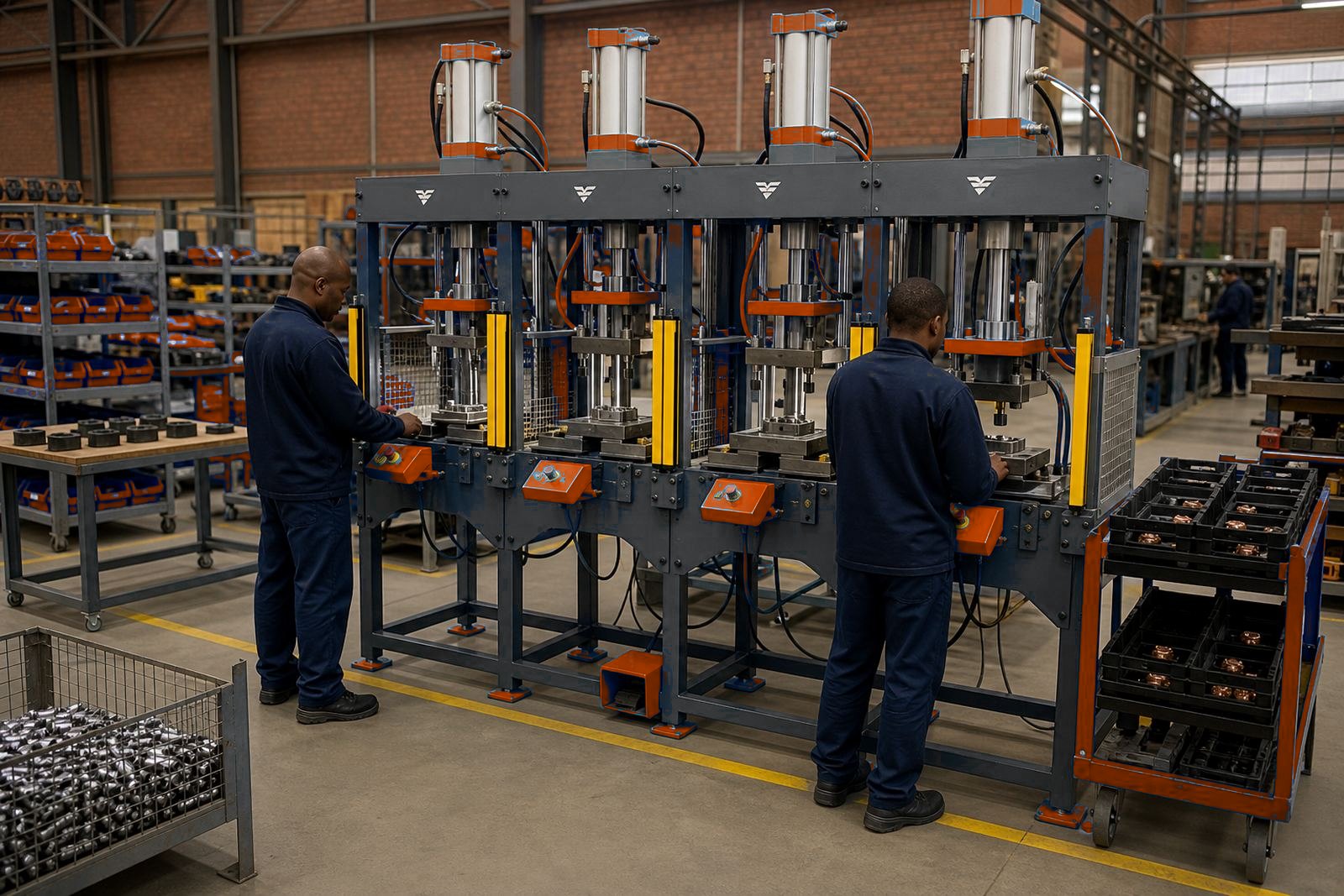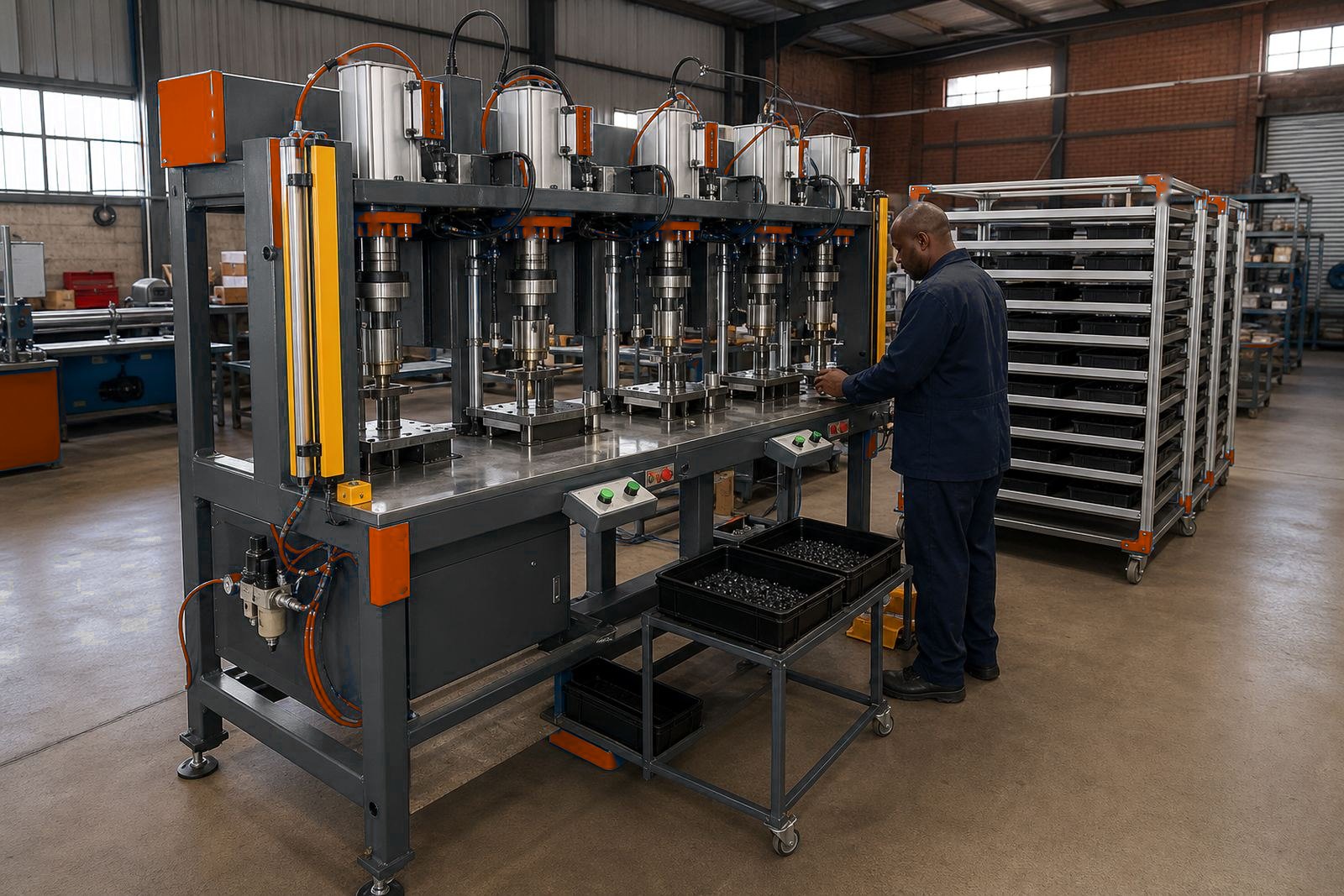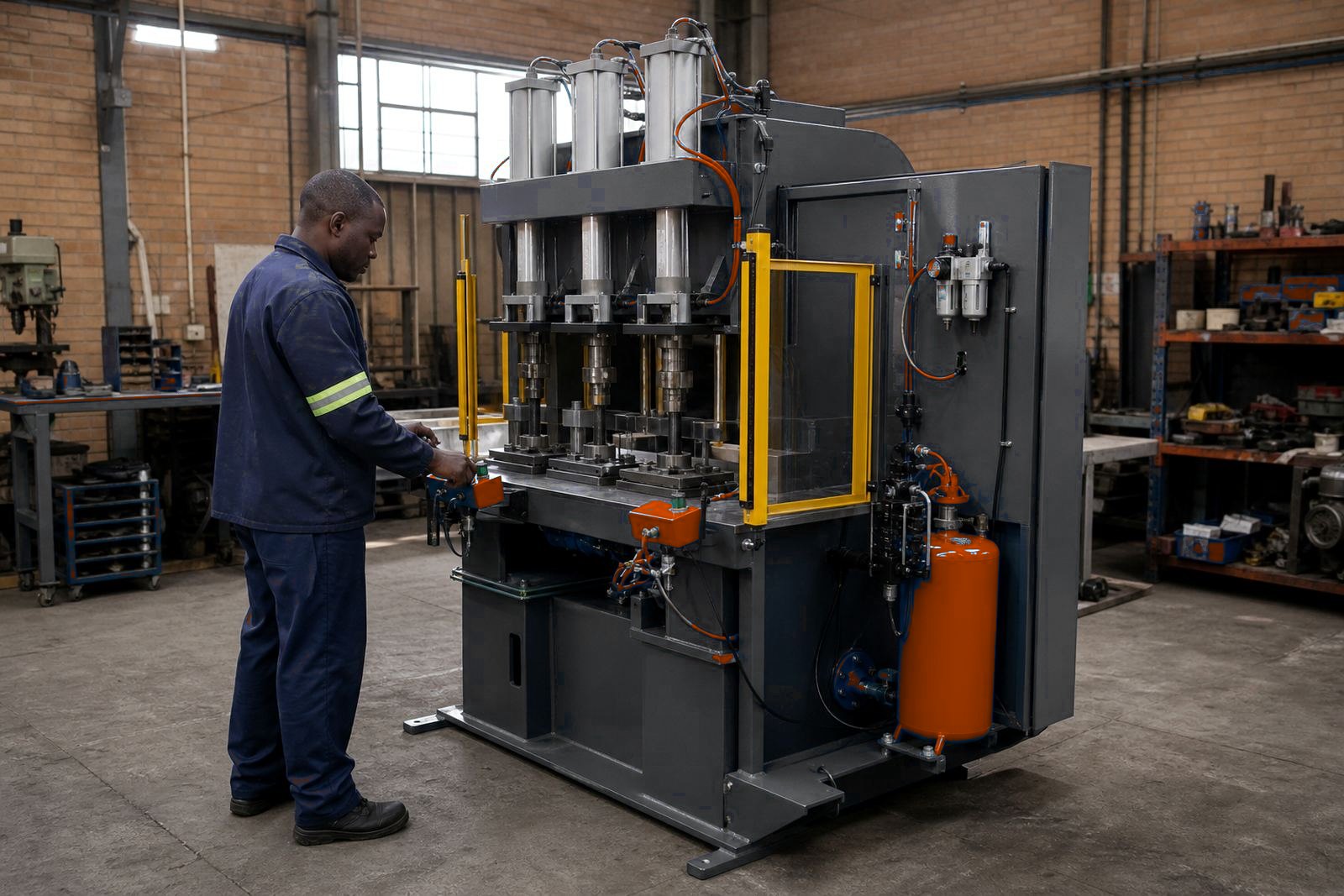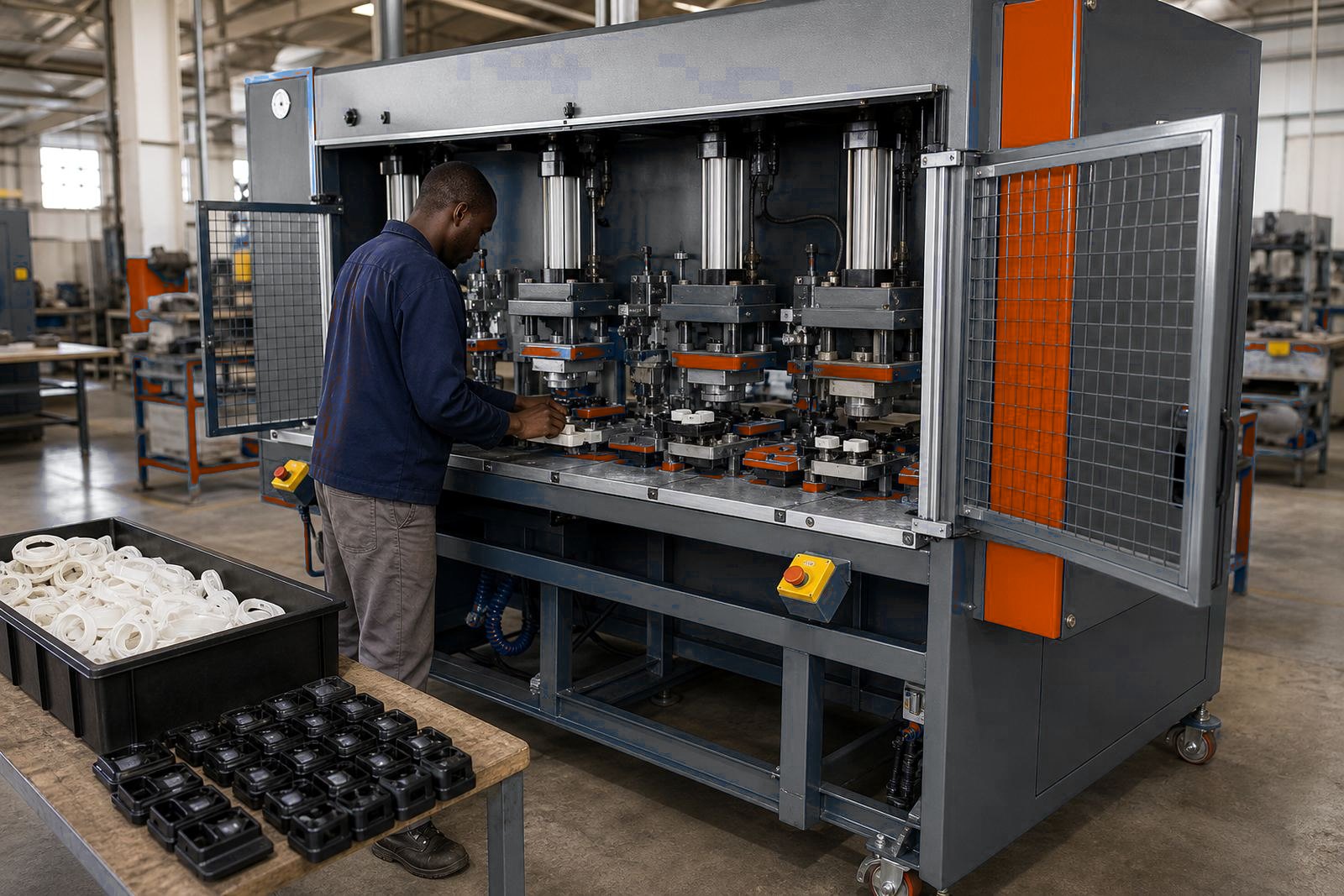
A plastics line in Pretoria needed steadier retention
The client was a plastics manufacturer in Pretoria working with retention features on moulded parts, where a staking operation had to hold shape without crushing the component. Their earlier method left too much movement in the part and the operators had to work around inconsistent placement, which made the process harder to repeat cleanly.
The brief asked for a dedicated staking cell with stable nests, practical guarding and a layout that suited short production runs and regular changeovers. We also had to keep the operator position clear and make sure the press stroke, fixture height and control position all worked together rather than fighting the person using the station.
- Process: plastic component staking for retention features
- Area: Pretoria, with commissioning on site
- Use case: repeat work with controlled press movement
The layout had to work around the part, not the other way round
The biggest constraint was part stability. Plastic pieces can shift if the nest is shallow or the support points are wrong, and then the staking tip lands off centre. That gives uneven deformation, poor retention and unnecessary rework. We spent time on the nest layout so the part would sit square before the press cycle started.
There was also limited floor space around the work area, so the guarding had to protect the operator without making the cell awkward to load. We kept the front access open for loading and unloading, then shaped the side and rear protection around the travel of the press head. The result was a cell that felt tidy in use and did not force the operator to reach into unsafe positions.
- Stable nest points for accurate part location
- Guarding set around the working travel of the press
- Access kept clear for loading and removal
What we built into the staking cell
MultiPress supplied the press structure, the working station, custom tooling and the guarding arrangement. The tooling was made for the component profile and the staking points, with the press stroke set to suit the material and the depth of deformation required. Where the part demanded a softer touch, we adjusted the air pressure and stroke to avoid over-stressing the plastic.
We also added two-hand controls so the operator stayed in a safe control position during the cycle. Light curtain integration was used where the layout called for extra presence detection at the front opening. The guarding, controls and tooling were set up as one working system, not as separate items hanging around the machine.
- Custom staking tooling matched to the component shape
- Two-hand control for cycle initiation
- Light curtain integration at the open side of the cell
- Stroke setting matched to part depth and retention need
Commissioning in Pretoria and the first production checks
Commissioning covered the mechanical set-up, air line setup, stroke setting and the first production runs with the client team. We checked how the part sat in the nest, how the staking head came down on the material and whether the cycle left a clean retention feature without excessive flare or distortion. Small changes in stroke and pressure made a noticeable difference, so the setup was handled carefully.
Once the motion and guarding checks were complete, the station moved into operator training. That covered loading order, safe hand position, cycle start discipline, simple daily checks and what to look for when the staking result drifted from the target. The team had to understand the reason behind the setup, not just the sequence of buttons and levers.
- Commissioning included air, stroke and safety checks
- Training covered loading, cycle control and daily checks
- First runs used real parts from the production line
Four weeks from workshop build to handover
The job ran over four weeks from the first workshop layout to the production handover. In week one, we went through the brief, checked the parts and mapped the tooling design. Week two moved into fabrication and guarding preparation. Week three was used for assembly, fit-up and control integration. Week four covered site installation, adjustment and operator training.
The timeline was practical rather than rushed, because staking work can look simple until the part is in the nest and the cycle starts revealing small faults. A shallow support, a slightly long stroke or a control point placed badly can turn into daily irritation for the operators. Taking the time to tune the cell saved more trouble than trying to force it through fast.
- Week 1: project brief, part review and tooling layout
- Week 2: fabrication and guarding prep
- Week 3: assembly and control integration
- Week 4: site install, tuning and handover
What settled out once the cell was running
After handover, the line had a steadier process for plastic component retention. Parts sat more consistently in the nest, the staking action was more controlled and the guarding layout made the work area easier to manage. Operators no longer had to compensate for a loose set-up, which cut down on awkward handling and uneven results.
The client also gained a cell that could be adjusted in a sensible way when part geometry changed. That matters on plastics jobs, because tool wear, component variation and small changes in material behaviour can all show up at the station. A staking cell with proper stroke control and fixture discipline is easier to live with over the long run.
- More consistent part location in the nest
- Cleaner retention features on the component
- Safer, more orderly loading around the station
What we would carry across on a comparable Pretoria installation
We would follow the same sequence of work: part review first, then nest design, then guarding, then commissioning. That sequence gave the best chance of getting the stroke, controls and safety layout right before the cell went onto the floor. It also made the training easier because the operators could see how each piece of the station fitted the next one.
For a similar staking line, we would again spend time on the nest height, the operator stance and the relation between the two-hand controls and the front opening. Those details decide whether the cell feels natural or awkward. A good staking station should guide the operator through the work without forcing extra movement.
- Start with the component, not the frame
- Set the nest before finalising guarding
- Check operator reach before sign-off
Key facts
| Project | Pretoria Staking Cell |
|---|---|
| Application | Plastic component retention |
| Station type | Multi-station pneumatic press cell |
| Working controls | Two-hand controls and light curtain integration |
| Main adjustments | Stroke setting, air pressure and nest alignment |
| Project duration | 4 weeks |
| Region | Pretoria, Gauteng |