Where the service hands actually need to reach
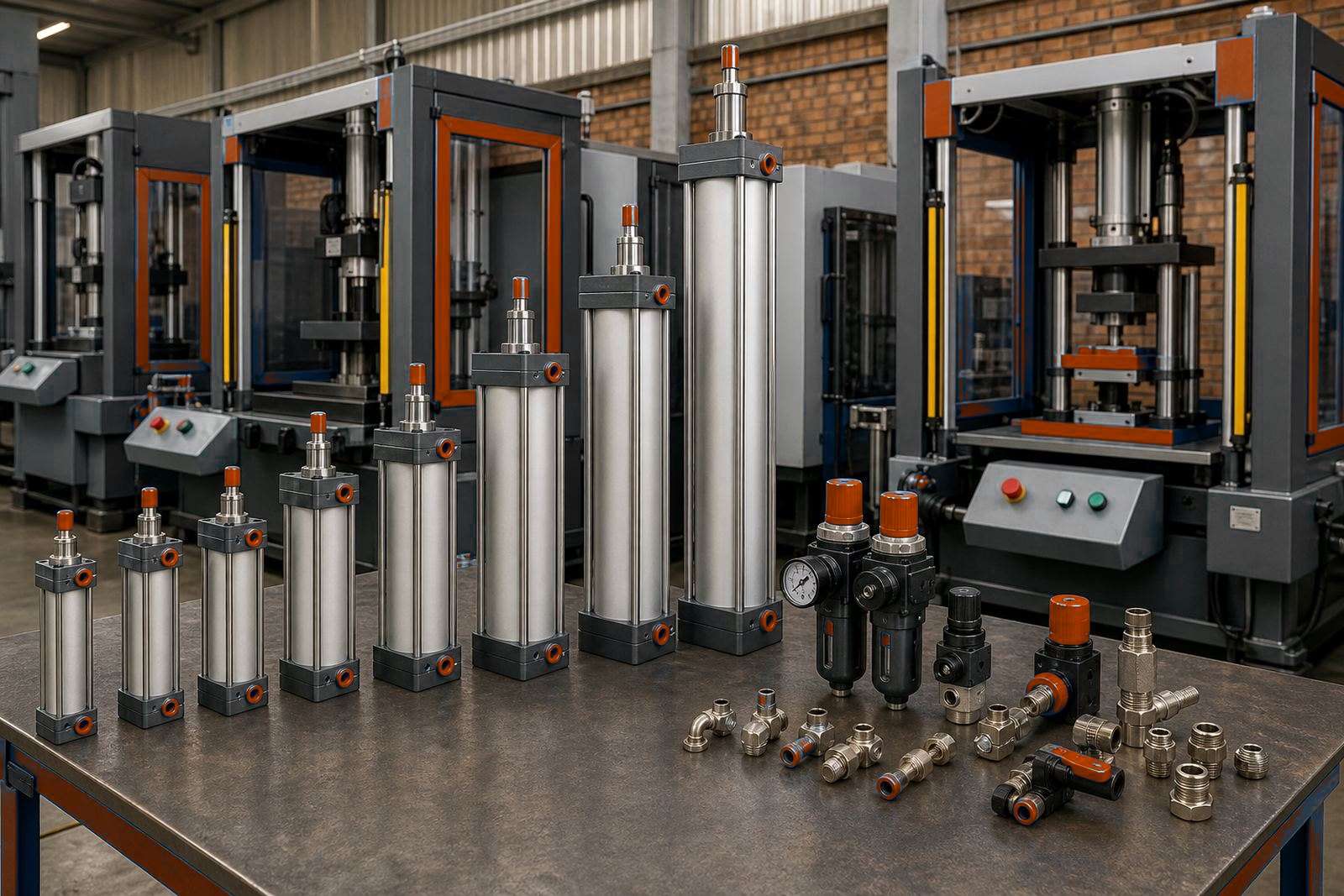
On a press line, the useful access points are rarely the large panels people notice first. The real work happens around the cylinders, air lines, manifolds, two-hand control wiring, light curtain brackets and the tooling area where fasteners loosen under vibration. If those points are cramped, maintenance turns into half a shift of lifting, leaning and working round sharp edges.
Good access starts with a clear path to the parts that move and the parts that wear. A guard should open far enough for safe inspection, and still close without dragging on hinges or catching on floor dirt. On presses used for assembly, crimping, riveting, staking and pack sealing, that extra space matters because the tooling and stroke setting change from job to job.
- Leave room to inspect hoses without removing a full side panel.
- Keep fasteners visible where routine torque checks are needed.
- Allow safe reach to light curtain mounts and sensor brackets.
- Plan for tool change space near the ram and fixture bed.
What gets missed when access is too tight
The first problems are usually small. A fitting starts to seep, a hose rubs against a frame edge, or a lock nut works loose on a guide bracket. If the access point sits behind a fixed guard or a welded brace, the issue stays hidden until the press starts cycling rough or the stroke no longer lands cleanly on the fixture.
Air-driven presses depend on clean, stable movement. When maintenance cannot get to the cylinder mounts, stroke stops and airline connections, the press may still run but not in the way the tooling needs. That shows up in uneven crimps, light rivets, shallow staking, or seals that close with a mark on the pack. The cost is not only repair time, it is lost confidence in the machine on the shop floor.
- Hidden fittings are harder to re-torque after vibration.
- Poor hose routing makes abrasion more likely at bend points.
- Blocked access slows checks on cylinder seals and rod movement.
- Cramped guards can make routine cleaning awkward and incomplete.
Access points that help the workshop, not just the installer
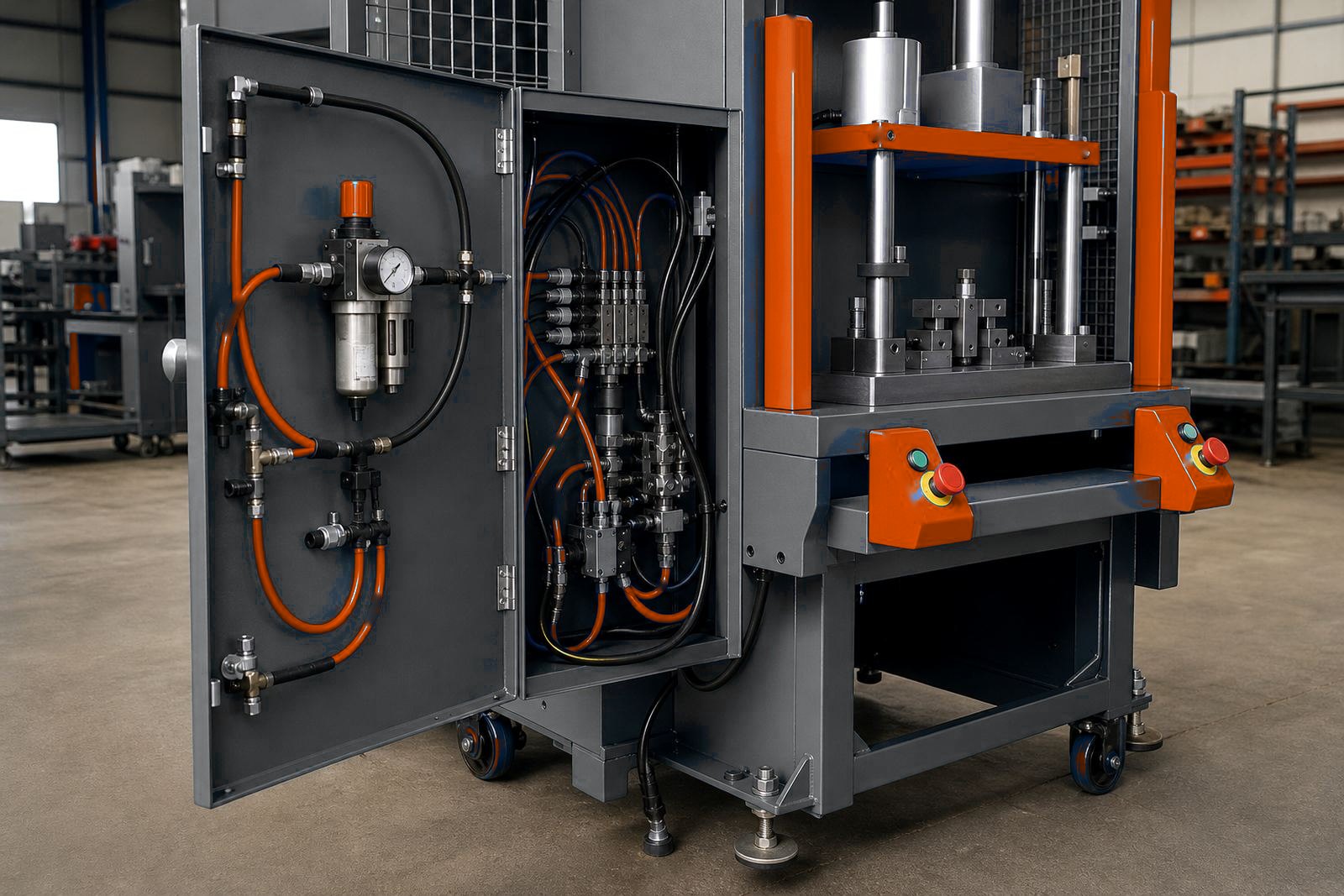
A press that is easy to maintain is usually easier to build as well. Hinged panels, removable guard sections, labelled isolation points and clear service gaps all help the workshop team. When the tooling designer, foreman and commissioning technician work together early, service access for hands, spanners and inspection lamps is built in.
We often look at the line in three parts: the air supply, the press body, and the tooling zone. Each one needs a different kind of access. Air supply checks may need a narrow opening for filters and regulators, while the press body needs wider reach around cylinders and fasteners. The tooling zone needs space for cleaning, setting and changeover without leaving the operator exposed.
- Use removable covers where repeat inspection is expected.
- Mark isolation points so the shut-down sequence stays clear.
- Keep airline bends gentle, not squeezed against corners.
- Make sure service access does not block operator sight lines.
Two-hand controls, light curtains and the space around them
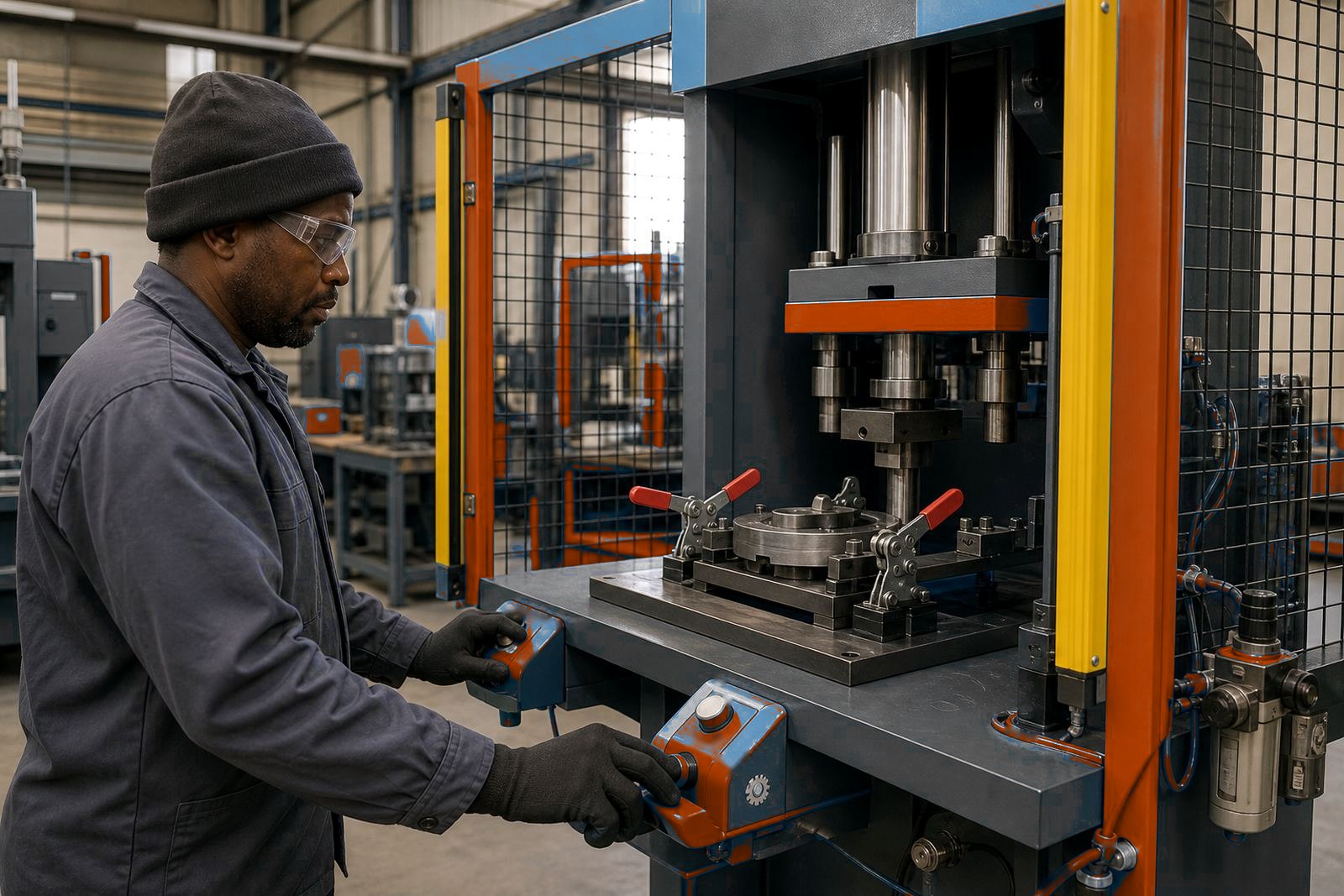
Safety parts need maintenance access too. Two-hand controls should be mounted where they are easy to test and replace, but not where dust and knocks will finish them off early. Light curtains need careful bracket placement, because a bracket that is too close to a maintenance opening can lead to misalignment after a routine service. On a multi-station press, that problem can affect the whole line, not just one station.
Access also affects proving the safety circuit after a tool change. If the technician has to squeeze round a frame to reset a sensor or inspect a cable, the job takes longer and the chance of a missed fault goes up. A better arrangement keeps the maintenance path separate from the operator path, with enough visibility to check that all stations are clear before the press cycles again.
- Place test points where a technician can reach them without climbing over guards.
- Allow enough hand space around light curtain posts for cleaning and alignment.
- Keep control devices clear of splash, impact and frequent tooling movement.
- Use cable routes that can be inspected without opening every panel.
A Durban line with salt air and everyday wear
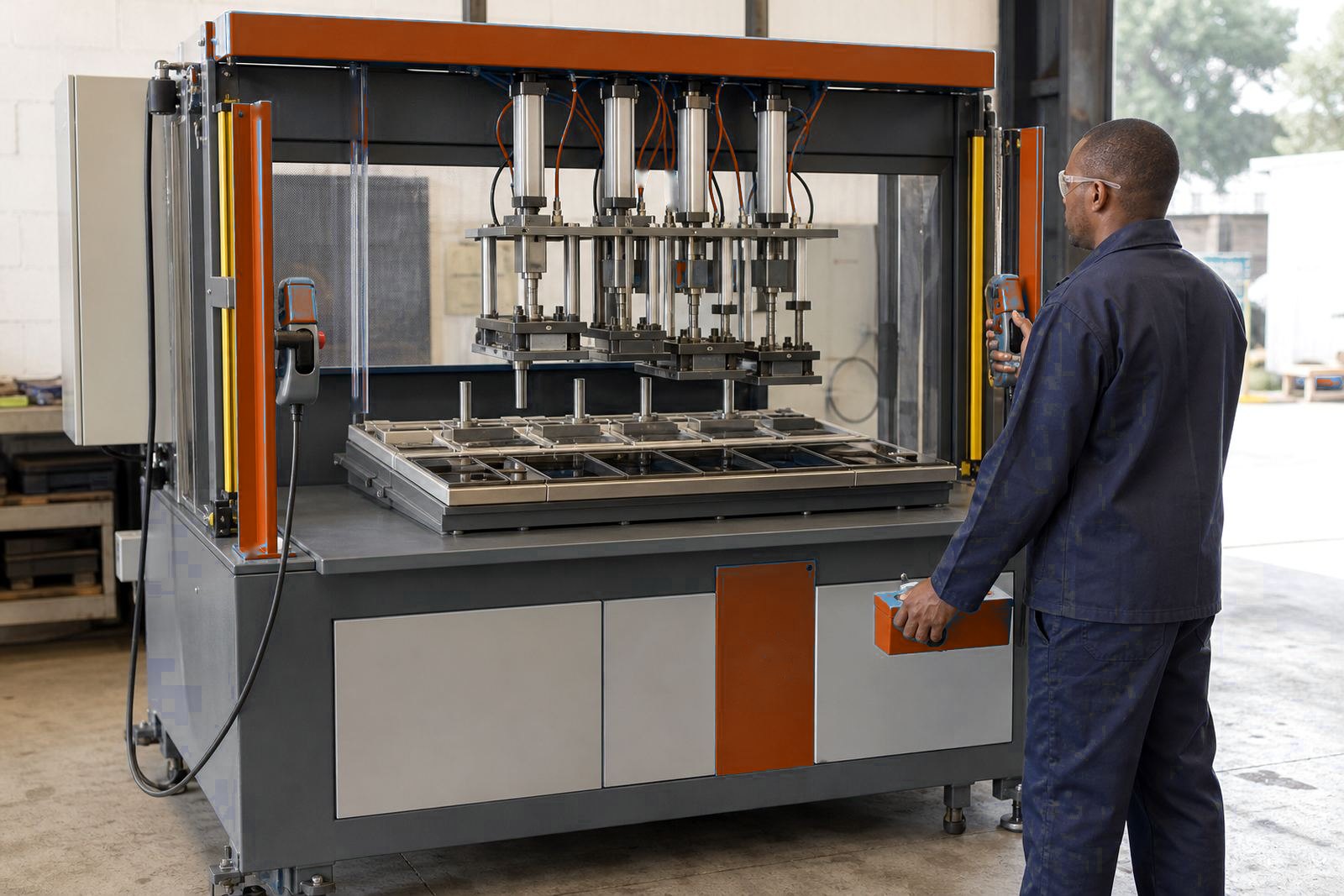
A pack sealing press for a Durban factory showed the difference a few small access choices can make. The site had good production discipline, but the humid air and coastal grime meant hose ends, bracket bolts and guide fixings needed regular eyes on them. Because the service openings were placed near the working points, the team could inspect the fittings without stripping the full guard set each time.
That same press had a narrow pocket near the rear cylinder mount during the first layout. It was changed before handover, giving the maintenance team proper reach to the fasteners and a clear view of the stroke stop. The result was not fancy, just practical. The line stayed easier to check, and the workshop did not need to force tools into corners where they did not belong.
- Coastal humidity makes corrosion checks more frequent.
- Clear access helps spot early wear on hose ferrules and clamps.
- Fastener checks are cleaner when the service face is open and direct.
- Small layout changes can save a lot of awkward labour later.
Designing for upkeep before the first cycle starts
Plan where fitters will reach the cylinders, valves and lubrication points while the frame is still on paper. That means thinking about stroke setting, tooling changes, guarding builds and site installation together. If a press will be used for assembly on Monday and riveting on Tuesday, the access to each station has to work across those changeovers without creating a tangled routine for the operator or the technician.
At MultiPress in Isando, that planning sits with the tooling design, projects and commissioning team as one job. Pieter Sauls oversees the build direction, while the workshop and commissioning team shape the details that matter on the floor. The aim is plain enough: make the press safe to run, easy to inspect, and straightforward to keep in service when the line is busy.
That approach suits factories in Johannesburg, Pretoria, Durban, Gqeberha and East London where the same machine may see different products through the week. Good access points make routine checks faster to perform, and they also make faults easier to find before they spread from one station to the next.