Where subassembly presses earn their place
A subassembly station is usually smaller than a full production line, but the job can be just as exacting. A bracket must sit flat, a clip must seat fully, or a crimp must close to the right depth before the part moves on. Pneumatic presses suit that kind of work because the force, stroke and hold point can be set around the part, not the other way round.
For Johannesburg and Pretoria factories, that often means a bench or frame mounted press with one or more stations, a fixed fixture, and a guarded working area. In coastal plants around Durban, Gqeberha and East London, tooling selection also has to take humidity and routine cleaning into account, especially where pack sealing or light assembly sits near other workshop activity.
- Short strokes for compact parts and close-tolerance actions
- Higher tonnage options where a firmer press is needed
- Station layouts that separate loading, pressing and offload
What the station has to do in one cycle
A good subassembly press keeps the sequence plain. The operator loads the fixture, checks the part location, starts the cycle, and the press completes the action without wandering. That action may be a crimp on a terminal, a rivet set into a small bracket, a staking move on a moulded component, or a seal closure on a pack.
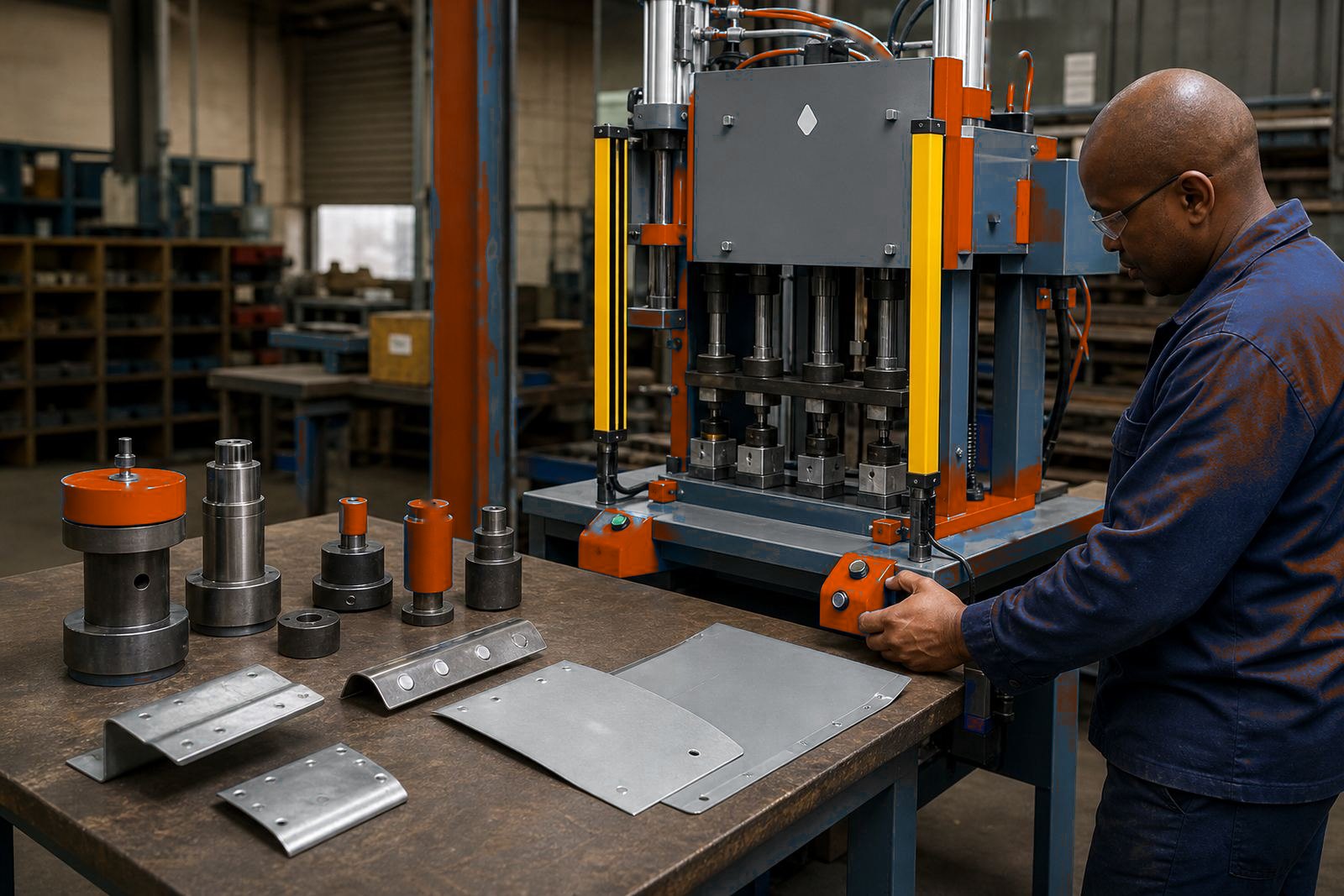
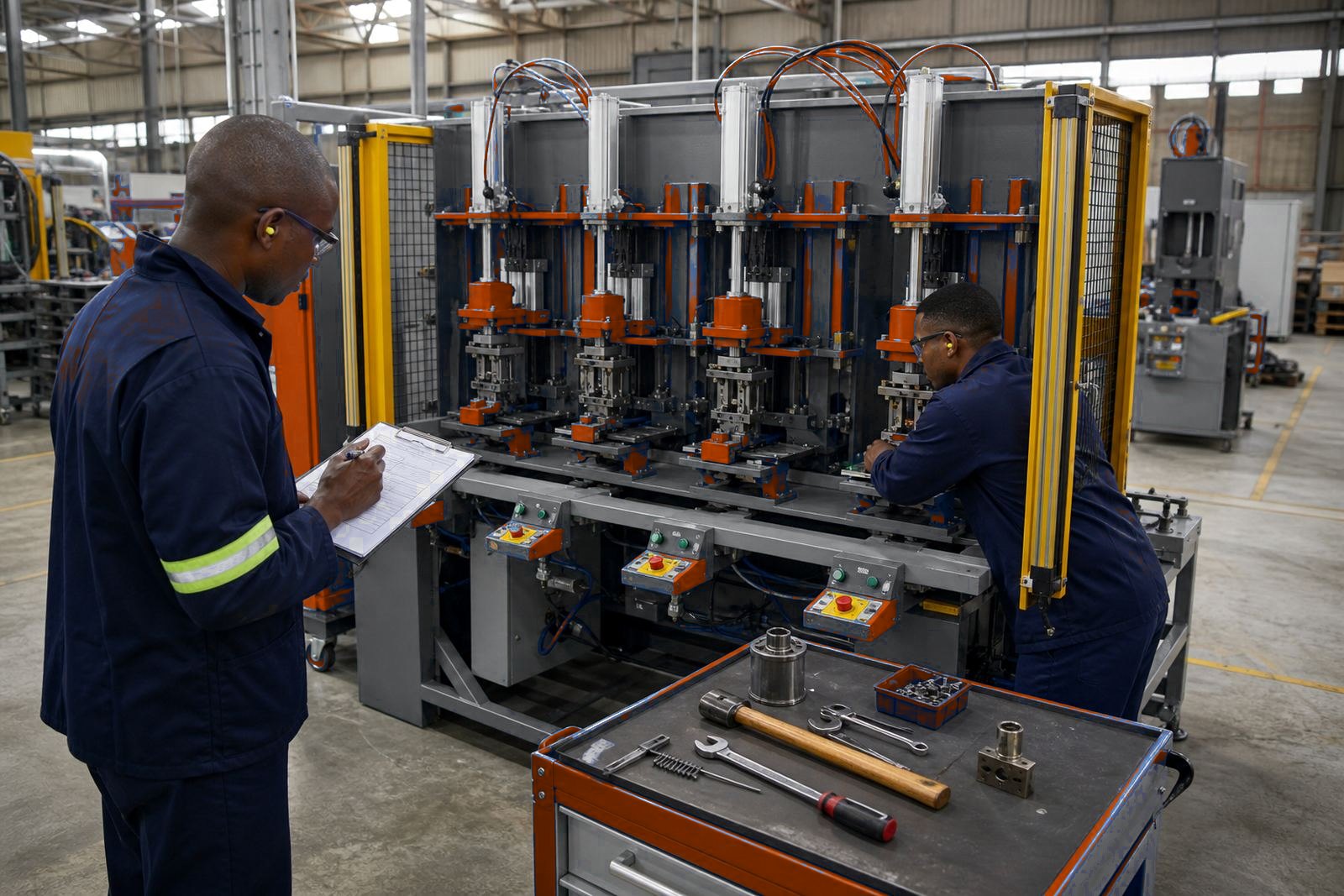
Two-hand controls are common when both hands should stay clear of the tooling. Light curtains add another layer where the station opening is wider or where the product shape makes guarding more difficult. The point is not to make the press complicated, it is to make the working space hard to misuse.
- Two-hand control for direct operator start-up
- Light curtain guarding where access needs extra control
- Positive stops and stroke setting for repeatable depth
Tooling that holds the part in the right place
Most subassembly problems begin before the ram moves. If the component is not seated properly in the fixture, the press will only lock in the error. That is why tooling design matters as much as cylinder size or air pressure. The clamp surfaces, nest pockets and locating pins must suit the part shape and the way an operator loads it during a normal shift.
Musa Hartnick in the tooling workshop spends a lot of time on that part of the job. A fixture may need quick-change inserts for more than one variant, or a deeper pocket to stop a round part rolling under the load. For a local Kempton Park job, a simple tweak to the locating face can mean fewer crooked parts and less rework at the table next to it.
- Locating pins and nests for repeat positioning
- Quick-change tooling for more than one variant
- Fixture faces suited to metal, plastic or mixed parts
Air pressure, stroke and the feel of the press
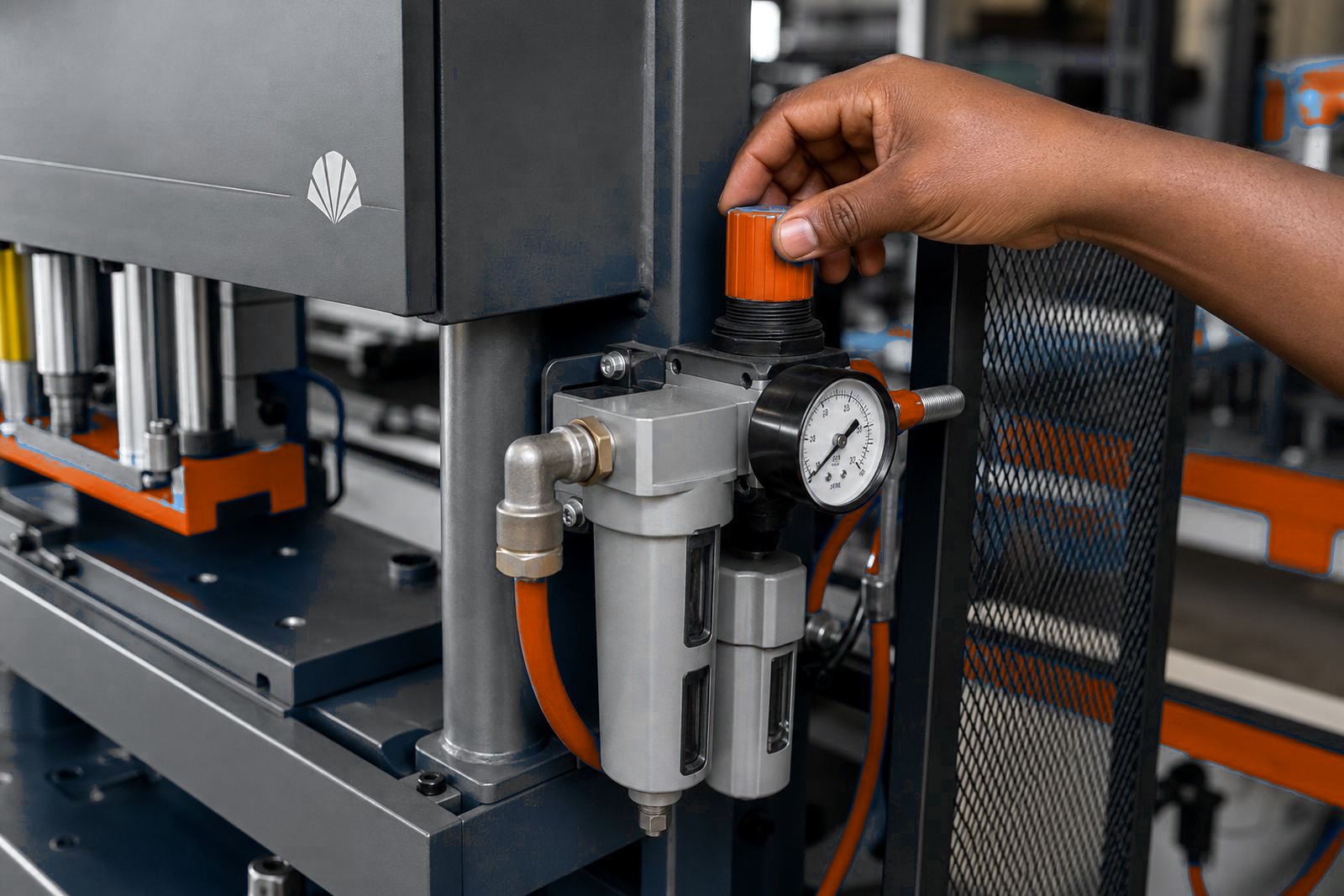
Pneumatic presses depend on clean air at the right pressure, stable supply lines and a stroke that matches the task. Too much stroke can slow the cycle or force the operator to wait for unnecessary travel. Too little stroke leaves the part half processed. The ram also needs enough guidance to keep the action straight, especially on narrow crimping or riveting tools.
Air line setup is not a side detail. Water, oil carryover or poor filtration can affect valve behaviour and cylinder movement, which shows up as an inconsistent press feel. During commissioning, Lerato Moagi checks the press movement, the stroke setting, and the handoff between the control system and the physical tooling so the cycle behaves the same from the first part to the last.
In pack sealing work, the stroke often needs a lighter touch and a cleaner finish. In rivet or stake applications, the same machine may need firmer pressure and a more defined dwell. That is why one press frame can serve several jobs, but only if the set-up is done with care.
How guarding and controls fit local shop-floor rules
In a South African factory, the press has to work with the plant's own safety rules and internal checks. That includes guarding around the tool area, suitable emergency stop placement, and controls that make the cycle deliberate rather than accidental. Where staff rotate between stations, a well placed control panel and clean visual layout help the next operator use the machine.
One common mistake is to treat guarding as a box to tick. A better approach is to start with the part, the operator position and the reach needed for loading. Then the guarding, light curtains and two-hand controls can be matched to the motion of the press, not forced around it. Johan Ramokgopa usually looks at access first, then the frame, then the service route for the air lines and tooling.
- Guard openings sized around the actual part and fixture
- Emergency stops visible from the normal working position
- Control placement that suits trained operators and changeovers
Commissioning a line in Isando or at a plant across the country
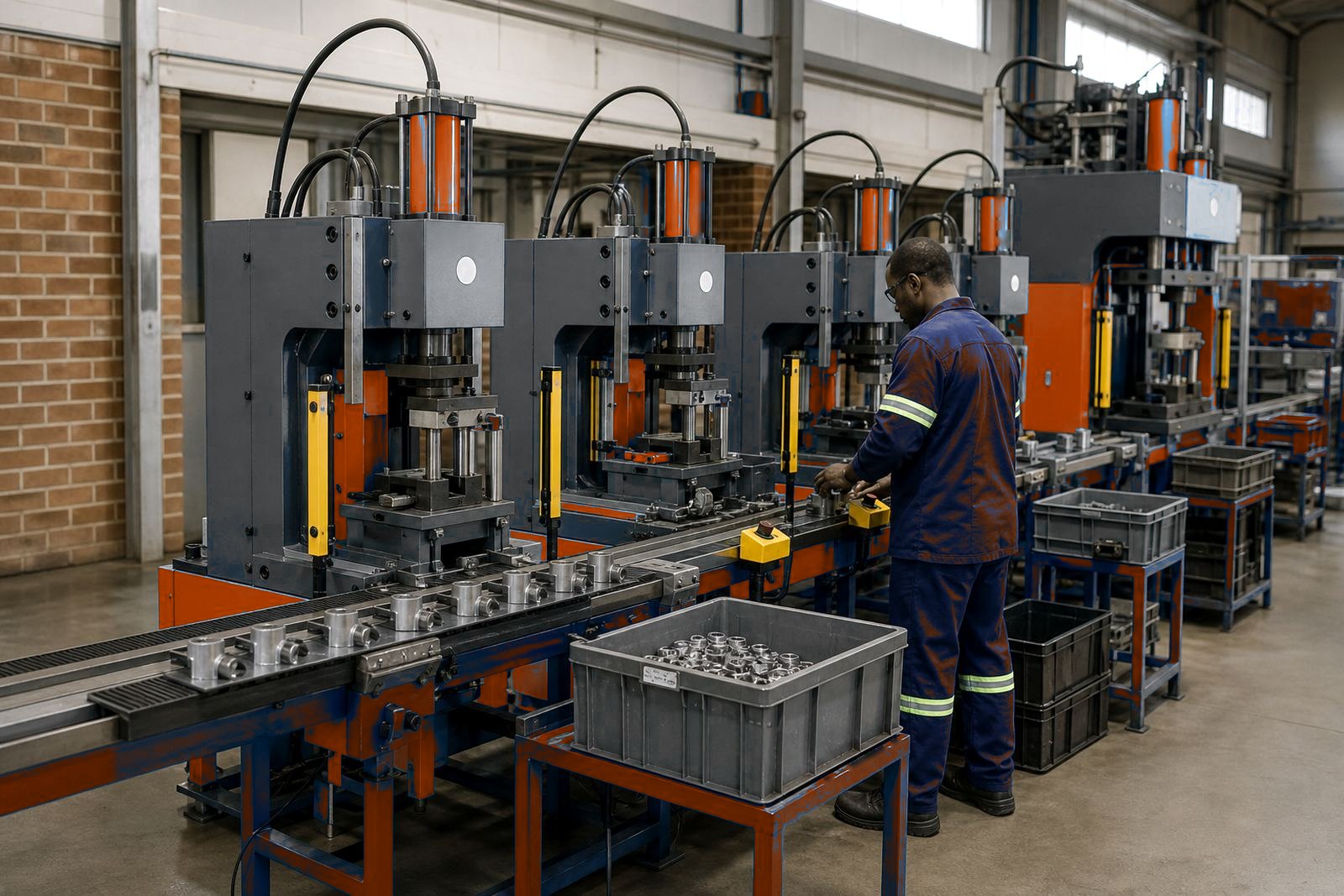
Commissioning is where the press becomes part of daily production instead of a machine on a stand. In Isando, or at a site in Boksburg, Durban, Gqeberha or East London, that usually means checking the frame level, stroke setting, air line connections, tool alignment, and the cycle timing under real loading. A press that looked fine in the workshop may need fine adjustment once it sits beside conveyors, tables or a packaging bench.
Thandiwe Matlala coordinates the site work, while Pieter Sauls and the team handle the fit between the press and the job. If a plant needs a production handover, the final checks should cover the basic running order, the tooling change method, the guarding position and the operator sequence. If those items are unclear, the press may still run but the station will waste time every shift.
- Frame position and air supply checked on site
- Stroke and cycle settings matched to the part
- Tool change method set out for production staff
Training that keeps the station useful after handover
Operator training matters because a subassembly station lives or dies on daily handling. The cycle may be pneumatic, but the process still depends on people loading parts correctly, spotting wear on tooling, and knowing when a setting has drifted. Anele Engelbrecht covers the working sequence, safe loading, basic fault recognition and the signs that the fixture needs attention.
For factories running multiple variants, training should also cover changeover habits and tool storage. A clean changeover is not only about speed, it is about repeatability. If the wrong insert goes back into the fixture or the stroke gets altered without note, the next batch starts with a problem that could have been avoided.
For a plant in Kempton Park making small subassemblies for a larger line, that kind of discipline can save more time than an extra machine ever would. The best press is the one the team can run, maintain and hand over without confusion.
When the job is a pressed subassembly, the details are rarely dramatic. They are just exacting: fixture, stroke, air, guard and training all lined up in the same station.