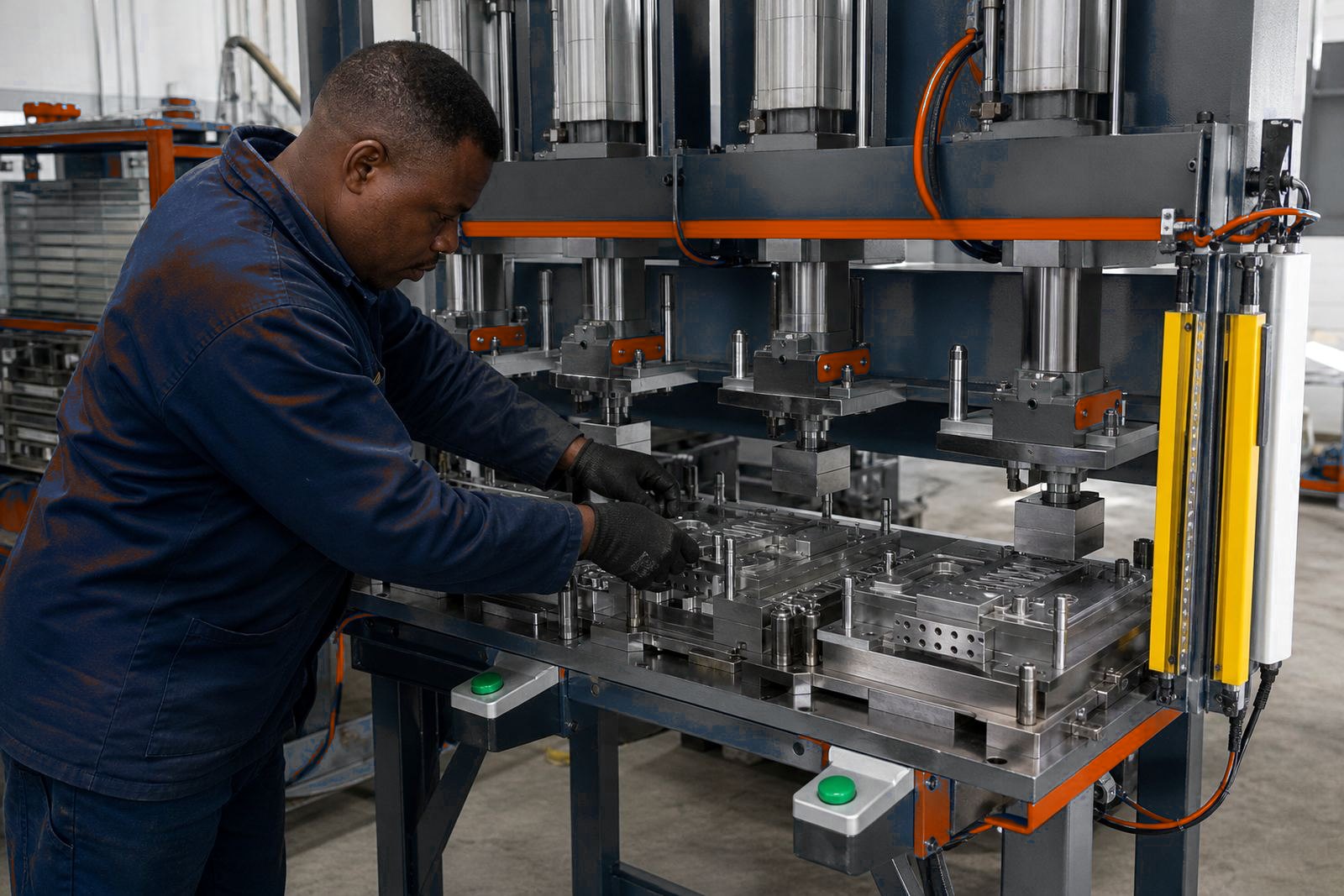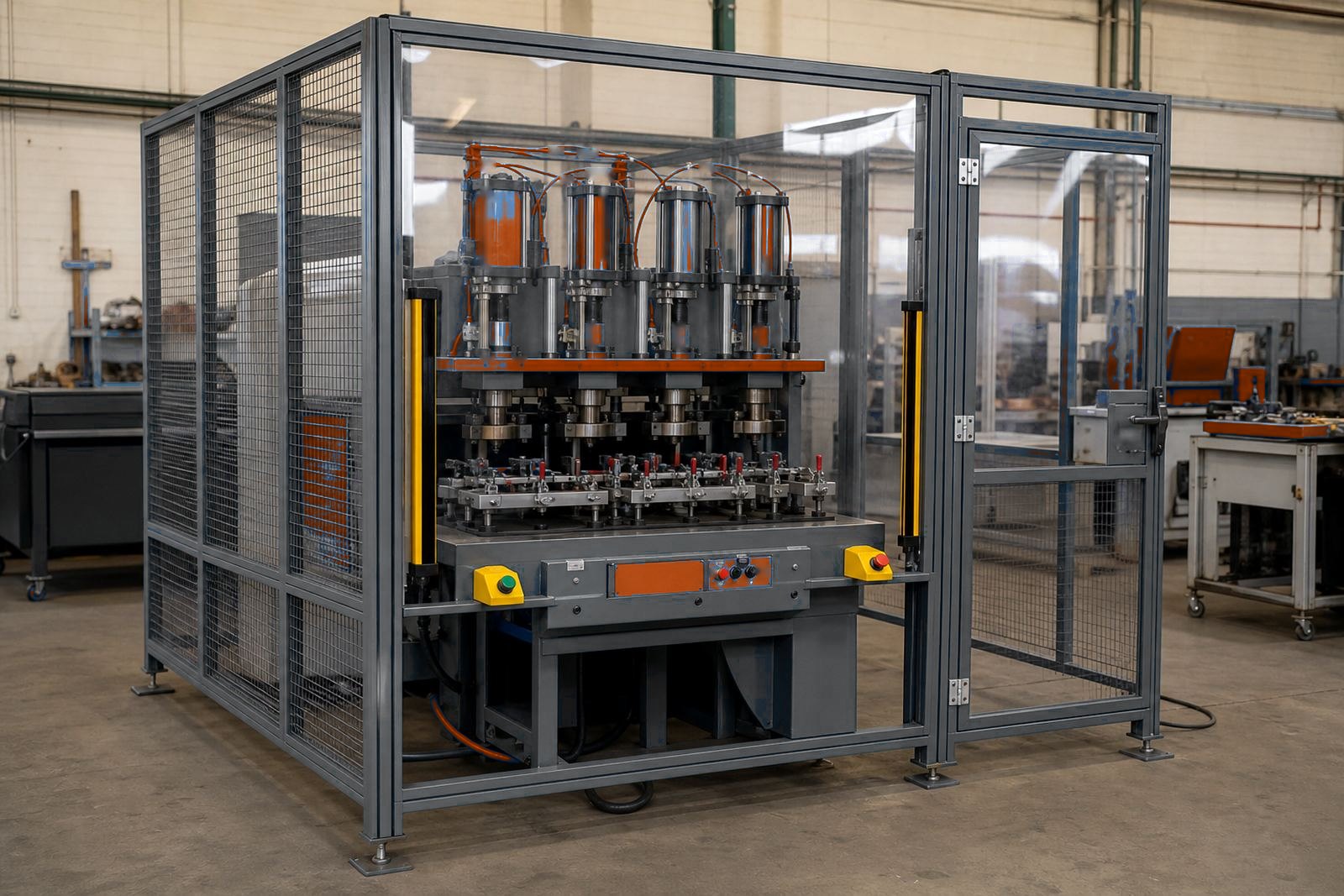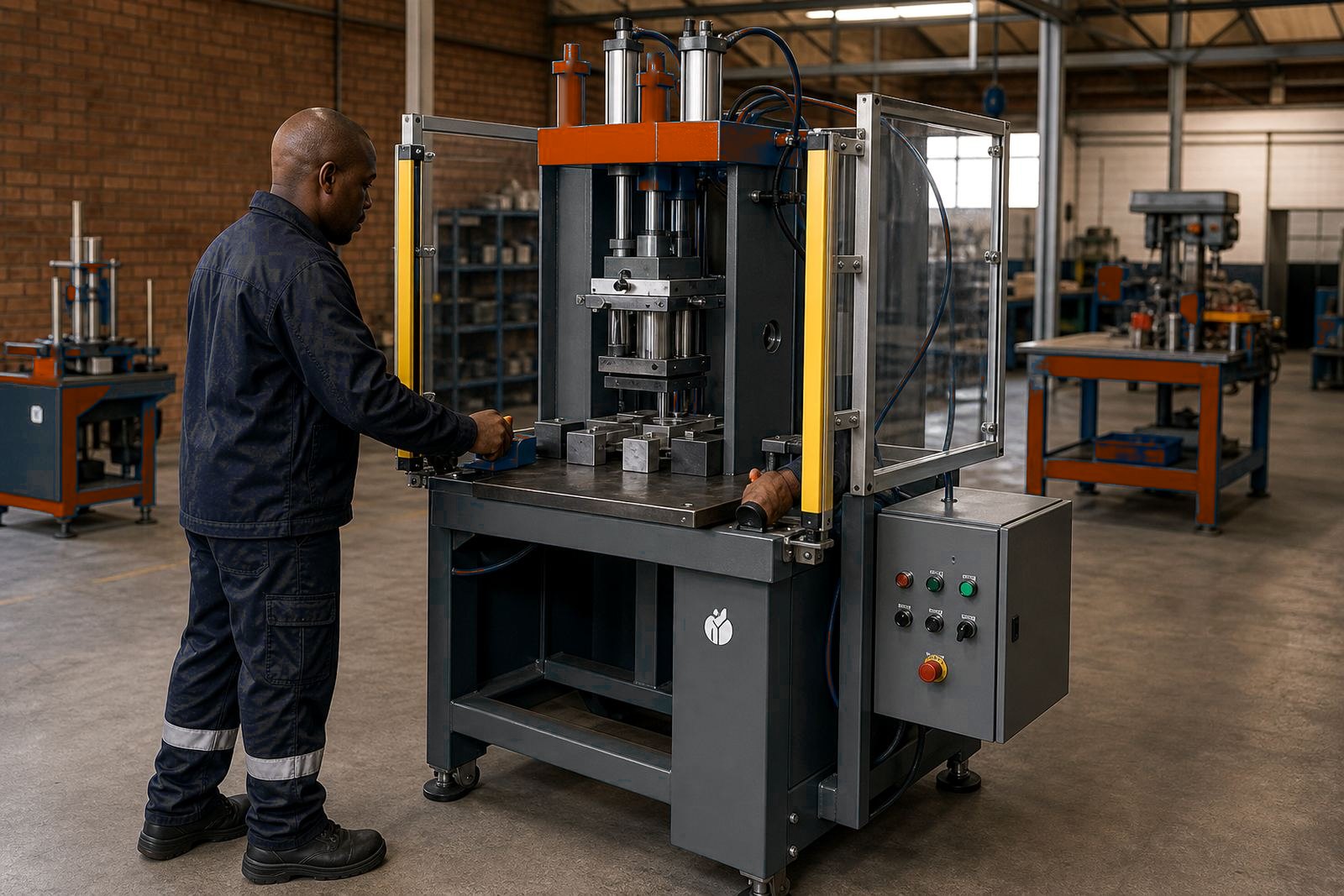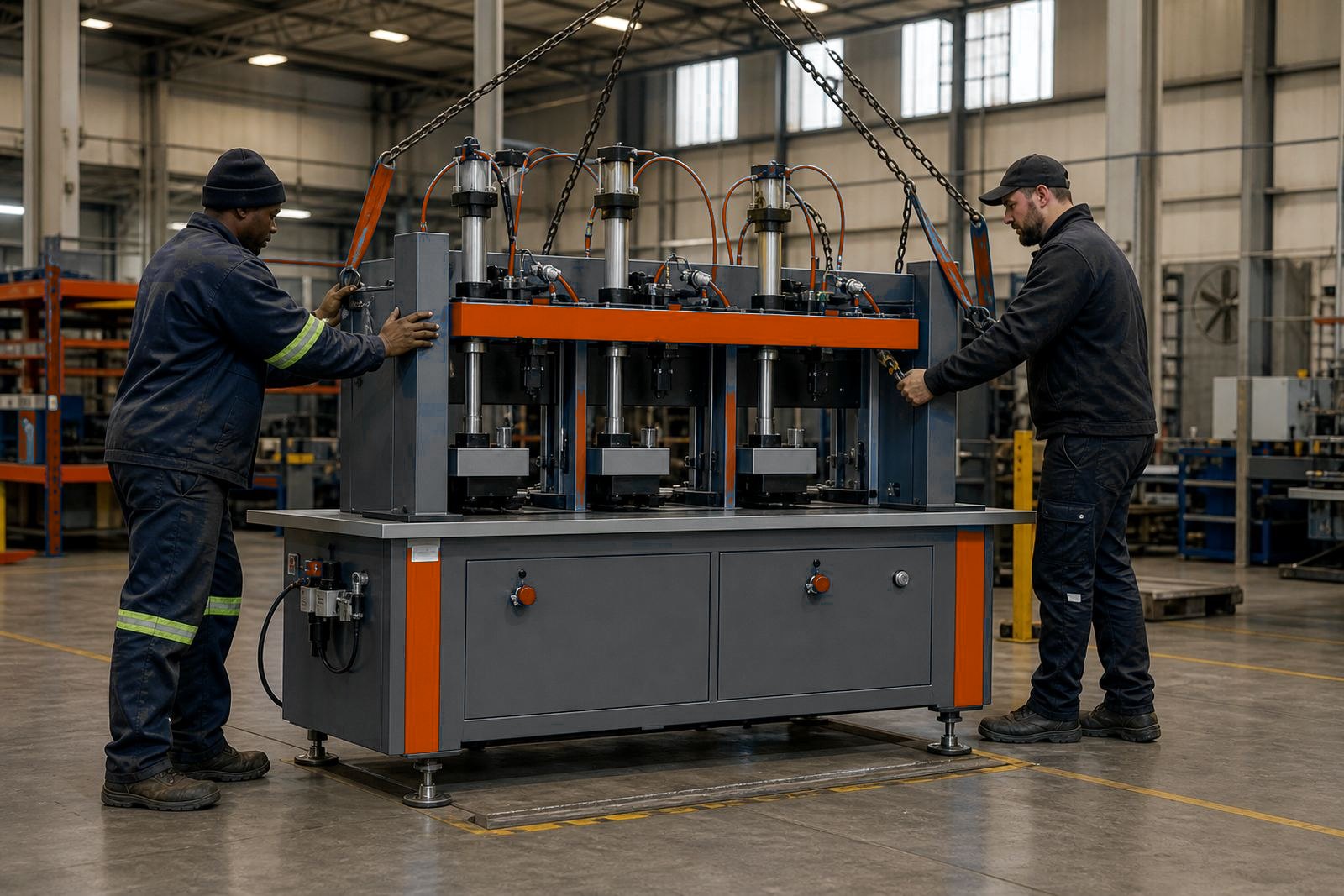
Setting the press in the right footprint
Our site installation work starts with the floor plan, anchor points and the travel needed around the machine. A multi-station pneumatic press needs room for loading, unloading, guard access and tool change space, so the position has to suit the job not just the drawing. In Isando and across Gauteng, many factory floors are tight on space and the route from receiving to final position needs careful handling.
We place press frames, associated tooling and guarding in the correct working line, then check that the operator stance, feed side and discharge side make sense for the process. Where pack sealing or crimping lines sit alongside assembly stations, the layout often needs small changes that save a lot of trouble later.
What is included on site
A site installation can include the following work, depending on the press and the line around it.
- Positioning of the press frame and tool set
- Setting of guards, gates and access panels
- Connection points for the compressed air feed
- Stroke setting to suit the part and tool depth
- Two-hand control placement and operator reach checks
- Light curtain alignment where the application calls for it
- Tooling fit-up, clamp checks and basic trial cycles
- Production handover notes for the team on shift
We also check that the table, bed or fixture surface matches the tooling path. If the press is used for riveting, staking or crimping, the die set needs clean movement and a clear return path. Pack sealing work can be more sensitive to heat-free pressure settings and repeatable dwell, so the setup has to reflect that process rather than a general press layout.
Air, stroke and control checks before first use
Pneumatic presses rely on stable air supply, correct pressure and a stroke that matches the job. On site we check the air line routing, filter position and the pressure range available to the cylinder set. If the line is too low the press will not form properly, and if it is too high the tooling can take unnecessary wear.
Stroke setting is included in the install from the start. For assembly work the stroke may be short and quick, while riveting or staking can need a deeper controlled movement with a clean bottoming point. Two-hand controls are placed to suit the operator and the timing is checked against the cycle. Light curtains, where fitted, must be positioned so they protect the hand zone without interfering with normal loading.
That is also the stage where we review the tooling change method. If a line uses more than one station, each station must be identified clearly and the changeover points need to stay practical for the workshop team.
How the installation visit usually runs
The visit begins with a site walk and a look at the floor condition, access path and connection points. Then the frame is moved into position, levelled and set against the planned workflow. After that we fit the tooling, guard panels and controls, then run a controlled set of checks before the line is handed over for live use.
- Receipt and position check against the agreed layout
- Levelling, anchoring or final placement
- Tool alignment and fixture registration
- Air line connection and leak check
- Safety device checks on guards and light curtains
- Trial pressing with sample parts or test packs
- Operator walk-through on loading, cycling and shut-down
Where the line runs under production pressure, we keep the setup orderly and the notes clear. On larger factory floors in Johannesburg, Pretoria and Ekurhuleni, that often means working around other machines, forklifts and shift changes without disturbing the rest of the plant more than needed.
Lead times, pricing and project scope
Turnaround is affected by the press size, the number of stations and the level of guarding or controls needed. A single station with a basic fixture is not the same job as a multi-station line with custom tooling, two-hand controls and light curtain integration. Site access, offloading conditions and the state of the air system also affect how the install is planned.
Pricing is quoted around scope and actual job detail. We look at the frame size, tooling count, guard build, air line setup, stroke setting and whether commissioning and training are part of the same visit. If the line includes several stations or a tricky pack sealing application, the quote needs enough detail to cover the actual work on the floor.
For factories outside Gauteng, travel and site time are worked into the job plan so the install is costed properly. We work in Durban, Gqeberha, East London and other South African production areas where the equipment needs to be set up on location, not just dropped off and left.
Aftercare once the line is running
After the installation, the line does not disappear into the background. The first operating days often show small things that need a tweak, like a guard latch that needs adjustment, a stroke stop that needs fine setting or a tooling face that needs a cleaner register. We stay close to the practical side of the job so the press keeps working the way it was handed over.
Operator training is part of that support. The team needs to know the loading order, the meaning of the controls, the safe way to clear a jam and the right point to stop if the cycle looks wrong. In plants using crimping, riveting or staking presses, a clear handover makes the difference between a tidy line and a line that gets misused by shift two. We also keep the tooling change method plain so the workshop crew can manage it without confusion.
If changes are needed later, our contact form is the place to begin the process for a site visit or extra setup work.
Key facts
| Typical press type | Multi-station pneumatic press for assembly, crimping, riveting, staking or pack sealing |
|---|---|
| Air supply | Compressed air feed matched to the cylinder and stroke requirements |
| Control method | Two-hand controls and safety devices where specified |
| Stroke range | Set to suit the part depth, tool travel and cycle control |
| Safety options | Guarding builds and light curtain integration where the line needs them |
| Service scope | Site installation, tool fit-up, air line setup, commissioning and operator training |